ARCTIC AURORA WATCH: A high-speed stream of solar wind is gently buffeting Earth's magnetosphere today. As a result, there is a chance of minor G1-class geomagnetic storms. Arctic sky watchers should remain alert for auroras this weekend. Aurora alerts: SMS Text

MARS GOES RETROGRADE: For months, Mars has been creeping eastward among the stars of the constellation Taurus. Today, Oct. 30th, it reversed course. Now the planet is moving westward. Astronomers call this "retrograde motion." It's a sign that Earth and Mars are about to have a close encounter. This movie from graphic artist Larry Koehn explains everything:
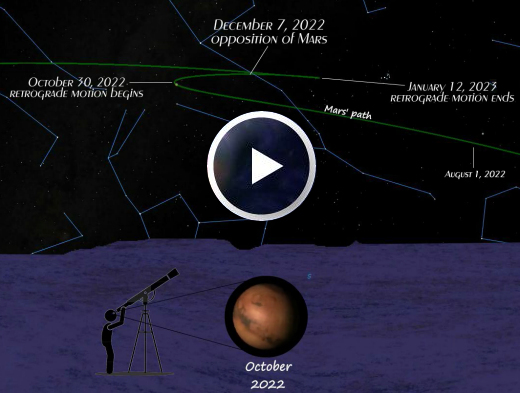
The onset of retrograde motion means that Earth and Mars are converging. At closest approach on Dec. 1st the two worlds will be just 0.545 AU apart, providing spectacular views through backyard telescopes. Less than a week later on Dec. 7th the Moon will pass in front of Mars, creating a lunar occultation visible from parts of the Americas, Europe and Northern Africa.
Retrograde motion will continue through Jan 12, 2023, and lots will happen between now and then. Enjoy the show!
Realtime Mars Photo Gallery
Free: Spaceweather.com Newsletter
A BLUE CLOUD ON MARS: Mars is supposed to be red. But when amateur astronomer Thomas Williamson looked on Oct. 26th, he saw a different color. "The north pole was electric blue," he says.
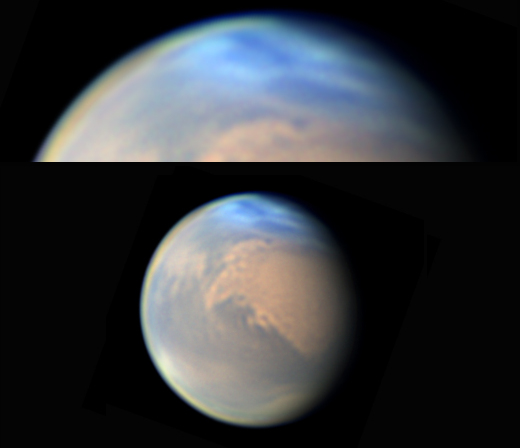
Williamson photographed the North Polar Hood, a giant cloud of water ice that forms over the Martian north pole during winter. Why blue? That's the color of sunlight scattered from very tiny crystals of ice (smaller than the wavelength of light itself) floating in the cloud.
"Mars was amazing through my binoviewers on my 12.5-inch f/5.1 Newtonian at about 400x!" says Williamson. "I'm looking forward to the next few weeks as Mars increases in apparent size."
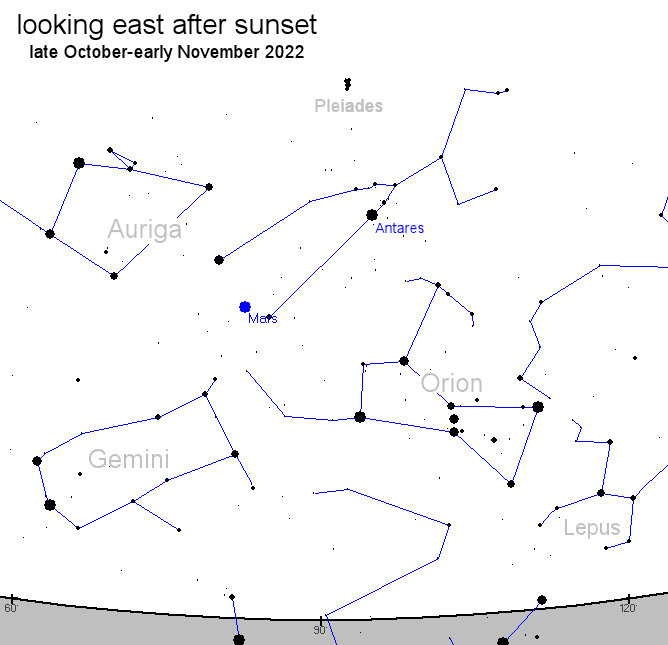
Indeed the view is about to improve as Earth and Mars converge for a close encounter on Dec. 1st. Between now and then, Mars will double in brightness to magnitude -1.9 (brighter than Sirius) and increase in size to 17.2 arcseconds. Look for the Red Planet and its blue hood rising in the east after sunset in the constellation Taurus: sky map.
Realtime Space Weather Photo Gallery
Free: Spaceweather.com Newsletter
AMBER BUMBLEBEE SPACE PENDANT: Bumblebees don't usually fly so high. On Oct 15, 2022, the students of Earth to Sky Calculus launched this one to the stratosphere onboard a cosmic ray research balloon. Here it is floating 115,158 feet above California's Sierra Nevada:
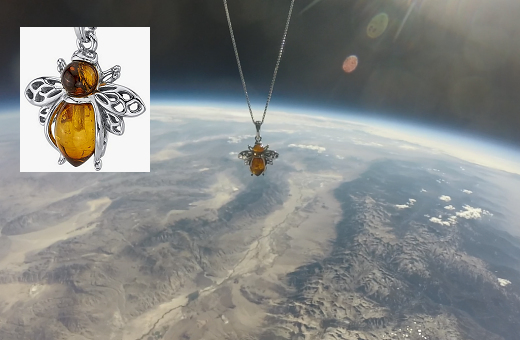
You can have it for $159.95. This bee is made of genuine Baltic Amber with a sterling silver exoskeleton. The rich Cognac-colored pendant measures 3/4 inch and comes with a matching 18-inch sterling silver chain.
The students are selling these unique pendants to support their cosmic ray ballooning program. Each one comes with a greeting card showing the bumblebee in flight and telling the story of its trip to the stratosphere and back again.
Far Out Gifts: Earth to Sky Store
All sales support hands-on STEM education
Realtime Aurora Photo Gallery
Free: Spaceweather.com Newsletter