INCREASING CHANCE OF FLARES: NOAA forecasters have boosted the chance of M-class solar flares today to 25%. This is in response to the continued growth of AR3141. The big sunspot now has a 'beta-gamma' magnetic field that harbors energy for moderately-strong explosions. Any flares will be geoeffective as the sunspot is turning toward Earth. Solar flare alerts: SMS Text
TOTAL ECLIPSE OF THE MOON: The full Moon passed through Earth's shadow this morning, producing a total lunar eclipse. Kevin R. Witman watched the full Moon turn red from Cochranville, Pennsylvania:
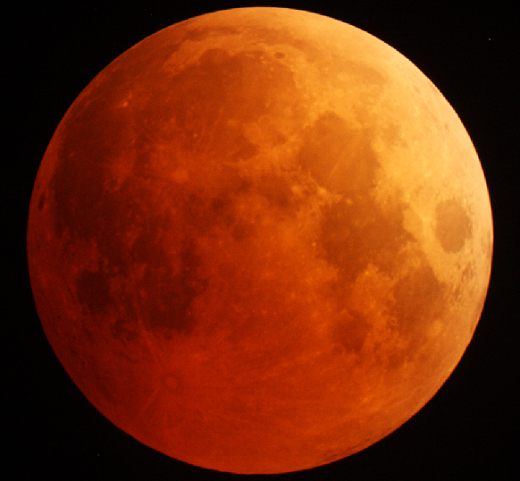
"Skies were clear in Southeastern Pennsylvania for this epic event," says Witman. "The eclipse was fairly dark compared to other eclipses I have observed in the past--perhaps because it was less than 20 degrees above the western horizon." Exhaust from the Tonga volcano lingering in the stratosphere since its eruption almost 11 months ago may have also darkened the eclipse, although this remains to be proven by systematic observations.
In Alberta, Canada, the sky grew so dark during totality that Alan Dyer was able to photograph faint bands of red and green airglow:
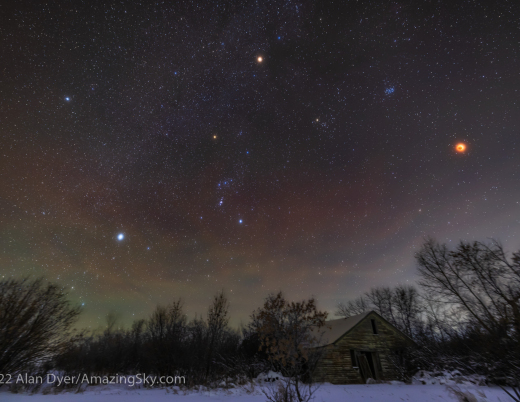
"I shot this from home in southern Alberta on a night that we were lucky to have clear at all, as it had been snowing heavily all day," says Dyer. "It cleared at night as predicted, but the temperature dropped to -25° C, so just operating the camera was a chore."
Got a picture of the eclipse? Submit it here!
Realtime Eclipse Photo Gallery
Free: Spaceweather.com Newsletter
A ROCKET OVER MANHATTAN: Alex Krivenyshev woke up before sunrise Monday morning. Good decision. He saw a rocket over Manhattan:
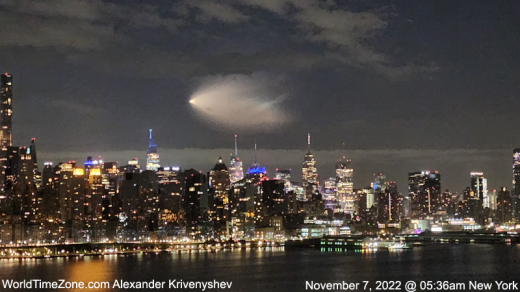
It was a Northrop Grumman Antares rocket carrying a Cygnus resupply spacecraft to the International Space Station. The launch from Wallops Island, Virginia, was visible from much of the US eastern seaboard.
"There was uncertainty as to what could be seen in the early morning skies over Manhattan," says Krivenyshev. "However, those who woke up at 5:35 a.m. were treated to a spectacular show lasting 30-40 seconds with an amazing spiral vapor trail from a separated booster rocket viewed above New York City."
The Cygnus spacecraft carried some unusual science experiments to the ISS headlined by a human tissue bioprinter. During its first trip to space in 2019, the BioFabrication Facility successfully printed a partial human knee meniscus and a large number of human heart cells. The 2019 flight confirmed that microgravity printing produces higher-quality tissue samples compared to those printed on the ground. Researchers are eager to conduct additional tests in 2022.
more images: from Cheryl Somariva of Chesterfield, Virginia; from Michael Guerrera of Havelock, North Carolina
Realtime Space Weather Photo Gallery
Free: Spaceweather.com Newsletter
STERLING SILVER HUMMINGBIRD PENDANT: This hummingbird has touched space. On Sept. 22, 2022, the students of Earth to Sky Calculus launched the sterling silver pendant to the stratosphere onboard a cosmic ray research balloon, more than 117,710 feet high:
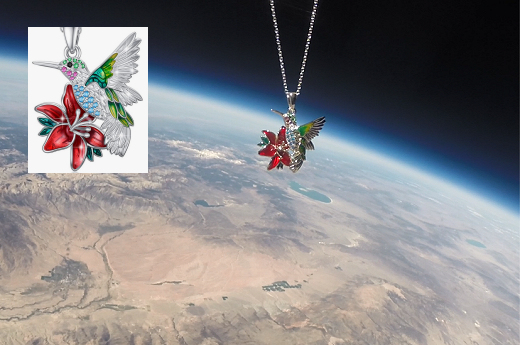
You can have it for $149.95. The students are selling hummingbird pendants to pay the helium bill for their cosmic ray ballooning program. Each one comes with a greeting card showing the bird and red lily in flight, and telling the story of their trip to the stratosphere and back again.
Far Out Gifts: Earth to Sky Store
All sales support hands-on STEM education
Realtime Aurora Photo Gallery
Free: Spaceweather.com Newsletter