BLUEWALKER 3 SIGHTINGS (UPDATED): Evidence is mounting that AST SpaceMobile's Bluewalker 3 (BW3) satellite has unfurled its its huge antenna. Multiple sightings now confirm that the satellite is suddenly as bright as a 1st or 2nd magnitude star. Astronomers had previously worried that BW3 could become one of the brightest objects in the night sky; it's too soon to rule that out. Morning flybys are currently happening over the USA. Check Heavens Above for local flyby times and let us know what you see.
NEW CHINESE SATELLITE SURPRISES SKY WATCHERS: Last night a strange gaseous plume glided over the middle of the USA, surprising sky watchers. "It looked like some sort of fuel dump or re-entry by a polar-orbiting satellite," says Dan Bush, who recorded the event from Albany, Missouri:
"My meteor camera recorded this video on Nov. 11th at approximately 6:14 p.m. CDT (0:15UT on Nov. 12)," says Bush.
What was it? Dutch radio astronomer and satellite expert Cees Bassa solved the mystery. Hours earlier China launched an environmental satellite from the Taiyuan Satellite Launch Center in north China's Shanxi Province. "The launch put the Yunhai-3 satellite and likely the Long March-6A rocket's upper stage in a ~850 km sun synchronous orbit," he explained on SeeSat. "The latest orbital elements match the exact track at the time of Bush's recordings."
When the pair flew over Missouri, the upper stage was probably dumping excess fuel, creating the comet-like display. In the Bighorn Mountains of Wyoming, amateur astronomer Kevin Palmer saw it, too. He wondered if it might be the newly-brightened Bluewalker 3 satellite. No, it was China.
Realtime Space Weather Photo Gallery
Free: Spaceweather.com Newsletter
DOUBLE-V OVER THE MOON: This is rare during the day. It's super rare at night. When the Moon came up over the Netherlands on Nov. 12th, Peter Paul Hattinga Verschure saw a luminous double-V form in the sky:
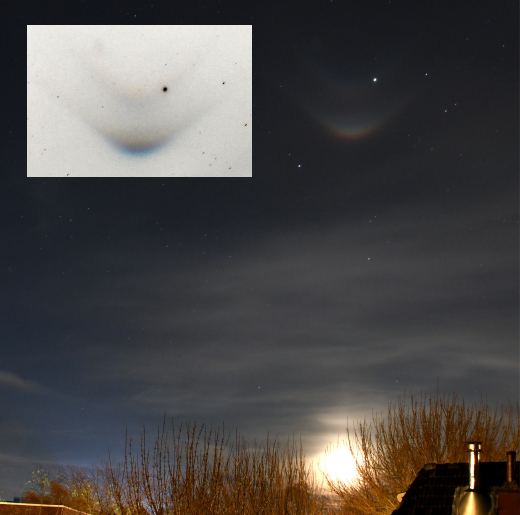
"Shortly after moonrise this striking spot of light developed 22 degrees above the low Moon in the northeast," says Verschure. "It appeared to be the combination of two V-shaped arcs."
These are ice halos. The lower 'V' is a upper tangent arc created by moonlight shining through pencil-shaped ice crystals. The upper 'V' is a rare Parry arc created by similar kinds of ice crystals, but... To make the Parry arc, the crystals had to be horizontal, not rotate, and have two faces horizontal, too. It sounds improbable, and it is.
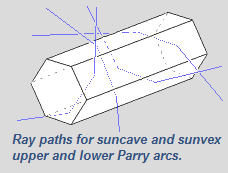
Parry arcs are rare even during the day when sunlight improves their visibility. They're almost unheard of at night. "I believe this kind of Parry arc by moonlite has never been seen before in the Netherlands," says Verschure.
Realtime Space Weather Photo Gallery
Free: Spaceweather.com Newsletter
WHERE NO CHRISTMAS ORNAMENT HAS GONE BEFORE: You cannot buy a rare Capt. Kirk space ornament on Amazon. But you can get one from the Earth to Sky Store. On Oct 9, 2022, the students of Earth to Sky Calculus launched Capt. Kirk to the stratosphere onboard a cosmic ray research balloon. Here he is floating 109,620 feet high:
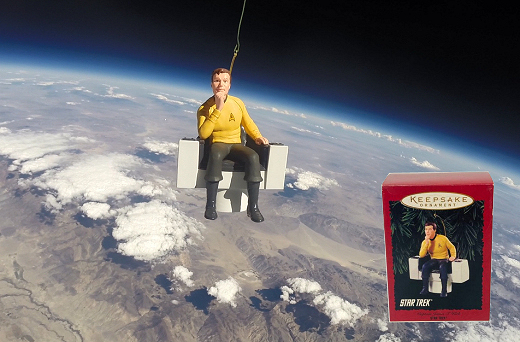
You can have it for $99.95. The students are selling Kirk ornaments to pay the helium bill for their cosmic ray ballooning program. Made by Hallmark in the 1990s, the ornament comes with a greeting card showing the captain of the Enterprise in flight and telling the story of its trip to the stratosphere and back again.
Far Out Gifts: Earth to Sky Store
All sales support hands-on STEM education
Realtime Aurora Photo Gallery
Free: Spaceweather.com Newsletter