LEONID METEOR SHOWER ALERT: Earth is approaching the debris zone of Comet 55P/Tempel-Tuttle, source of the annual Leonid meteor shower. This is not a good year for Leonids. The shower's nominal peak on Nov. 17th is expected to produce no more than 15 meteors per hour. But! There is a chance of a surprise. Some forecasters believe that Earth might graze a 300-year old stream of debris on Nov. 19th, producing an outburst of 50 to 200 meteors per hour. Its timing favors observers in the eastern half of North America, who should be alert for meteor activity this Saturday morning between 1:00 and 1:30 am EST. [full story]
LIFTOFF! ARTEMIS HAS LEFT EARTH: NASA's giant Artemis I rocket succesfully launched from the Kennedy Space Center on Nov. 16th at 1:47 am EST. The thrilling, thunderous launch lit up the night sky and shook the ground with almost 9 million pounds of thrust. NASA says that the Orion crew capsule (unoccupied for this first test flight) is now on its way to the Moon.
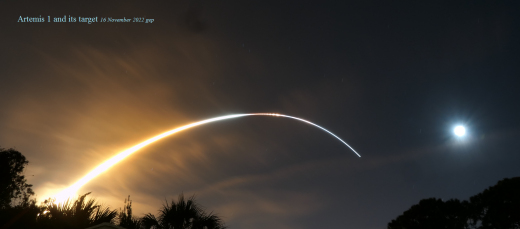
Dr. Gilbert Plumer watched the launched from Rockledge, Florida, where he photographed Artemis and its target (above). "Even though I was 20 miles from the launch pad, there was still enough light for me to read by," says Plumer.
This marks the beginning of a mission that could last as long as 42 days. After more than a week in transit, Orion will orbit the Moon for up to 19 days (approaching the lunar surface within 62 miles) and travel 40,000 miles beyond the far side of the Moon before turning back to Earth. The pictures it takes of the Moon during this time will be unique and spectacular.
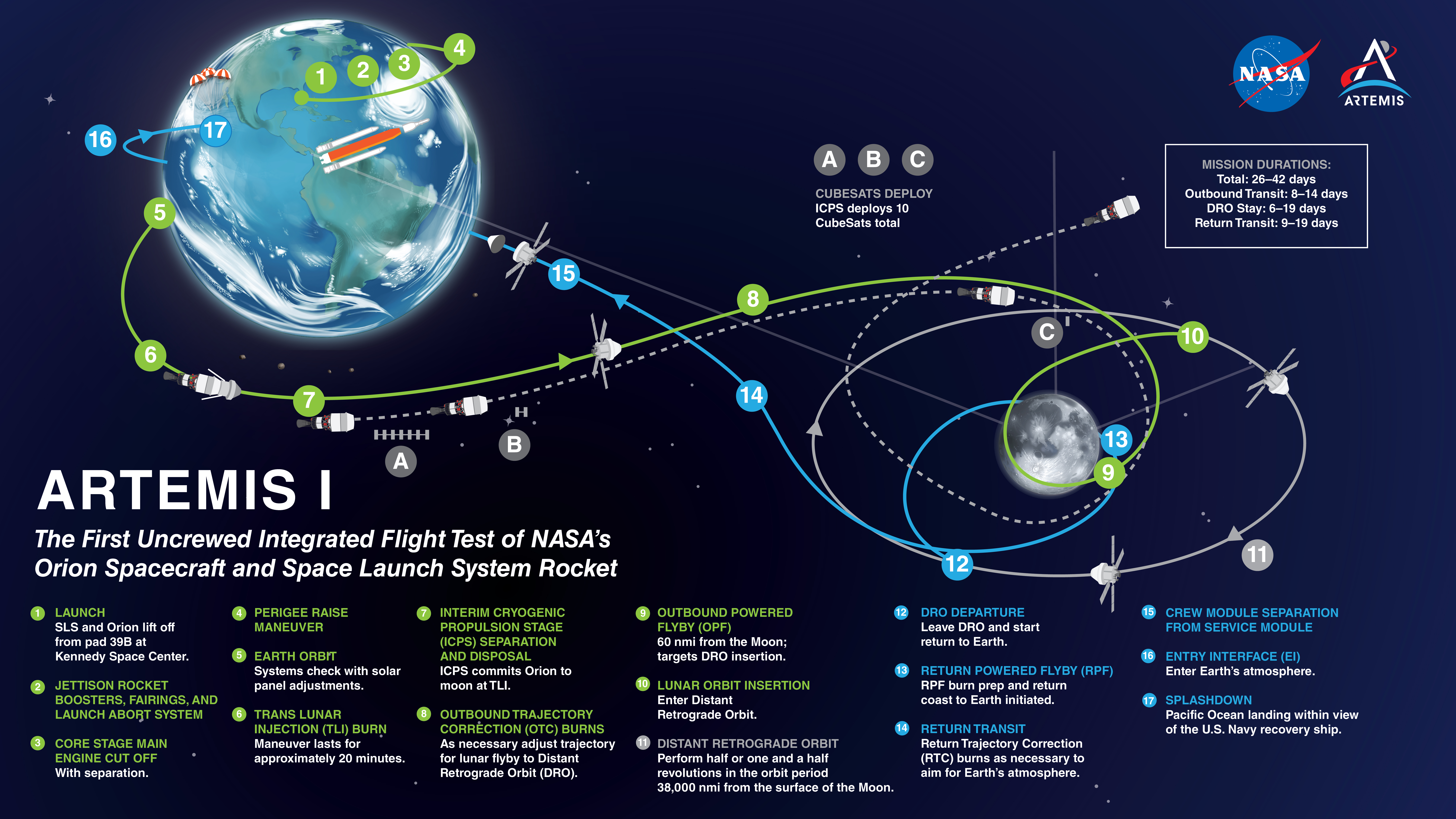
The capsule will stay in space longer than any human spacecraft has (without docking to a space station) and return home faster and hotter than ever before. A key goal of the mission is to test Orion's heat shield when it slams into Earth's atmosphere at 25,000 mph and heats up to 5,000 degrees Fahrenheit.
If all goes well, future launches will carry crew. Astronauts will orbit the Moon in 2024 (Artemis II), then touch down near the Moon's south pole in 2025 (Artemis III). The moonwalkers will include the first woman to step onto the lunar surface.
Realtime Space Weather Photo Gallery
Free: Spaceweather.com Newsletter
WHY DO RUSSIAN ROCKETS MAKE "BLUE AURORAS"? On Nov. 3rd, 2022, sky watchers in Sweden and Norway watched a strange blue aurora snake across the night sky. Its color and motion seemed to defy the normal laws of aurora physics. Indeed, it was not an aurora. Experts quickly realized that the display coincided with the launch of an ICBM from a Russian submarine beneath the White Sea.
It wasn't the first time blue clouds have appeared. On Dec. 9, 2009, a Russian rocket caused a worldwide sensation when it created a blue spiral over Norway. "Blue auroras" appeared again on Oct. 26, 2017, following another Russian battle drill:
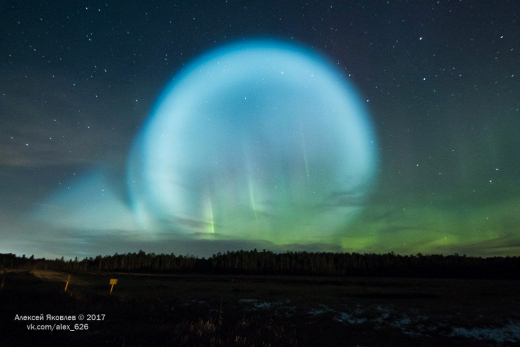
The blue exhaust of a Russian rocket on Oct. 26, 2017. Credit: Alexey Yakovlev of Strezhevoy, Russia
Over the years, Arctic sky watchers have seen many of these blue clouds, with explanations ranging from auroras to aliens to wormholes in space. In fact, rockets are the most likely explanation. Common threads seem to be the involvement of Bulava and Topol missiles, and the use of solid propellant ascent motors.
A paper published in 2016, "Exceptional optical phenomena observed during the operation of Russian launchers," explains how such rockets might produce blue lights:
"A major combustion product of the solid fuel is aluminum oxide Al2O3 (~40% by mass)," the authors write. "At high temperatures, the formation of aluminum monoxide, AlO, also occurs. AlO exists in a gaseous state. Resonant scattering of sunlight by these molecules causes the luminescence in the wavelength region 4374–5424 Ǻ, which corresponds to the turquoise color of the gas-dust trail of the rocket."
Mystery solved? Probably. But that doesn't mean we don't want to investigate further. Arctic sky watchers, if you see any future "blue auroras," submit your photos here.
Realtime Aurora Photo Gallery
Free: Spaceweather.com Newsletter
"I LOVE YOU MORE" OPAL: Nothing says "I love you" like jewelry from space. This sterling silver opal pendant just hitched a ride to the stratosphere on an Earth to Sky Calculus cosmic ray research balloon. At the apex of the flight it floated 101,326 feet above the Sierra Nevada mountains of central California:
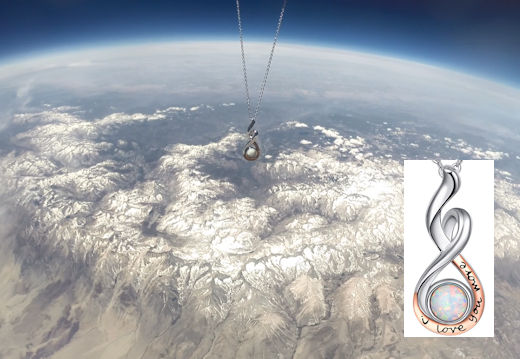
You can have it for $142.95. The opal's infinity wrap is engraved with "I Love You More." It's the perfect birthday, anniversary or (never too early!) Christmas gift for that special someone who loves space. Each pendant comes with a greeting card showing the pendant in flight and telling the story of its trip to the stratosphere and back.
Far Out Gifts: Earth to Sky Store
All sales support hands-on STEM education