LEONID METEOR SHOWER ALERT: Earth is approaching the orbit of Comet 55P/Tempel-Tuttle, source of the annual Leonid meteor shower. This is not a good year for Leonids. The shower's nominal peak on Nov. 17th is expected to produce no more than 15 meteors per hour. But! There is a chance of a surprise. Some forecasters believe that Earth might graze a 300-year-old stream of debris on Nov. 19th, producing an outburst of 50 to 200 meteors per hour. Its timing favors observers in the eastern half of North America, who should be alert for meteor activity this Saturday morning between 1:00 and 1:30 am EST. [full story]
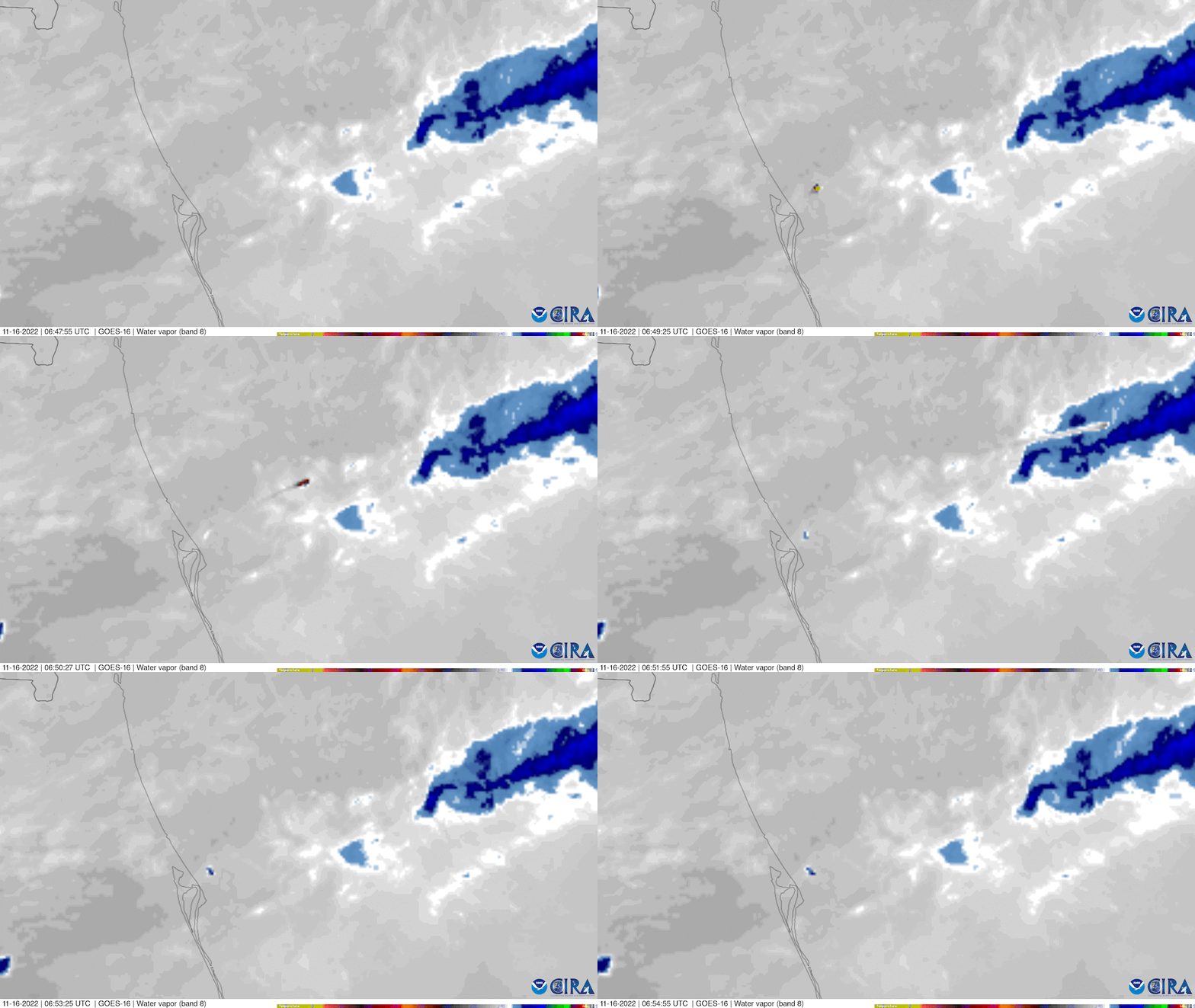
GOES-16 SATELLITE SEES ARTEMIS LAUNCH: NOAA's GOES-16 weather satellite is stationed almost directly above Florida, so naturally it saw the launch of NASA's Artemis moon rocket on Nov. 16th. Infra-red sensors recorded the rocket's hot plume cutting through the atmosphere as it left Earth:
Thanks to Spaceweather.com reader Jim Ruebush for alerting us to these GOES-16 data!
This is a "Band 8" movie. Band 8 is an infrared channel at 6.19 microns tuned to the thermal glow of water vapor in clouds. It works well for rockets, too.
The Artemis rocket successfully propelled NASA's Orion spacecraft toward the Moon. It'll be back in about 25 days after orbiting the Moon and safety-testing onboard systems for future astronauts. Check the Artemis Blog for updates.
Realtime Space Weather Photo Gallery
Free: Spaceweather.com Newsletter
LUNAR OCCULTATION OF MARS: Mark your calendar. On Dec. 7-8, the full Moon will pass in front of Mars with naked-eye visibility across most of North America and Europe. This video from graphic artist Larry Koehn shows how the occultation will look:
At the time of the occultation, Mars will be within a week of its closest approach to Earth. This means the Red Planet's disk will be unusually wide (more than 17 arcseconds across). Even backyard telescopes will reveal details on the Martian surface partially eclipsed by lunar mountains and crater rims. This is a great photo-op for amateur astronomers.
Local times for the occultation: North America, Europe.
Realtime Space Weather Photo Gallery
Free: Spaceweather.com Newsletter
THE EDGE OF SPACE BUTTTERFLY: Are you looking for a far-out gift? Consider the Edge of Space Butterfly. This crystal pendant just hitched a ride onboard an Earth to Sky Calculus cosmic ray research balloon:
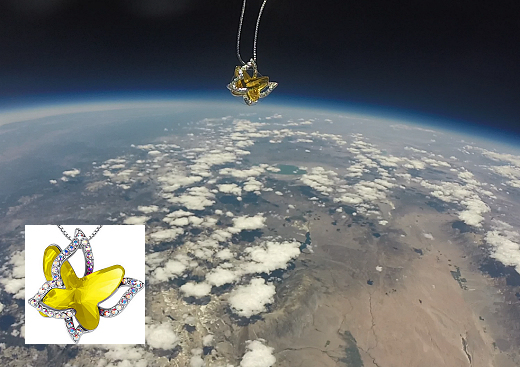
You can have it for $162.95. The inner yellow citrine crystal is surrounded by a "spread your wings" lattice of sparkling zirconia. A rich layer of rhodium plating ensures the longevity of the pendant and its 18-inch chain.
The Edge of Space Butterfly makes a great anniversary, Christmas, or birthday gift. It comes with a greeting card showing the pendant in flight and telling the story of its trip to the stratosphere and back again.
Far Out Gifts: Earth to Sky Store
All sales support hands-on STEM education
Realtime Aurora Photo Gallery
Free: Spaceweather.com Newsletter