ORION COMPLETES LUNAR FLYBY: NASA's Orion spacecraft swooped over the farside of the Moon this morning, taking close-up photos and burning its engines in preparation for orbit insertion on Nov. 25th. NASA will host a news conference on NASA TV at 5:45 p.m. EST to discuss the maneuver and share pictures.
DIMORPHOS STILL HAS A TAIL: More than 2 months after NASA's DART spacecraft slammed into asteroid Dimorphos, debris from the collision is still visible. "Dimorphos still has a tail," reports Arizona amateur astronomer Eliot Herman, who photographed the battered asteroid on Nov. 20th and added it to his post-impact timeline:
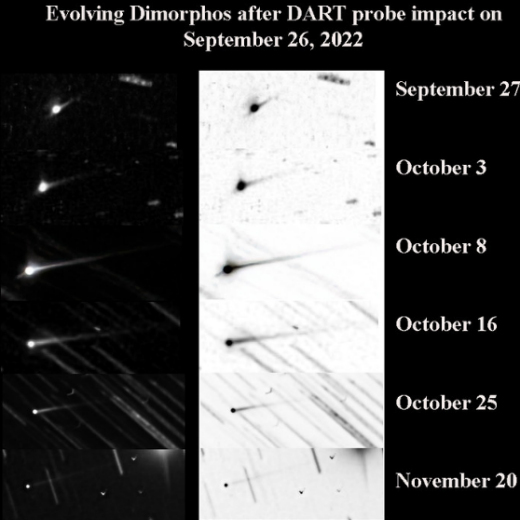
When NASA sent DART to hit Dimorphos, the space agency hoped to change the asteroid's trajectory. It did that and more. A comet was born in the aftermath. DART's impact debris has formed a surprisingly durable tail more than 10,000 km long.
"It will be very interesting to the see the damage when the follow-up probe reaches Dimorphos," says Herman.
Four years from now Europe's Hera spacecraft will visit the asteroid to inspect the impact site. Hera was originally supposed to arrive before DART struck, but delays derailed the mission. All's well that ends well. The delay gives Hera a chance to survey the damage after the dust has finally settled.
more images: from Graziano Ventre of Italy
Realtime Dimorphos Photo Gallery
Free: Spaceweather.com Newsletter
A SMALL ASTEROID JUST HIT EARTH: Astronomers saw it coming. Just a few hours before asteroid 2022 WJ1 hit Earth on Nov. 19th, David Rankin spotted the 0.7-meter space rock in survey images from Mt Lemmon, Arizona. An imminent impact alert quickly spread to sky watchers and researchers. This video from the University of Western Ontario (UWO) shows what happened next:
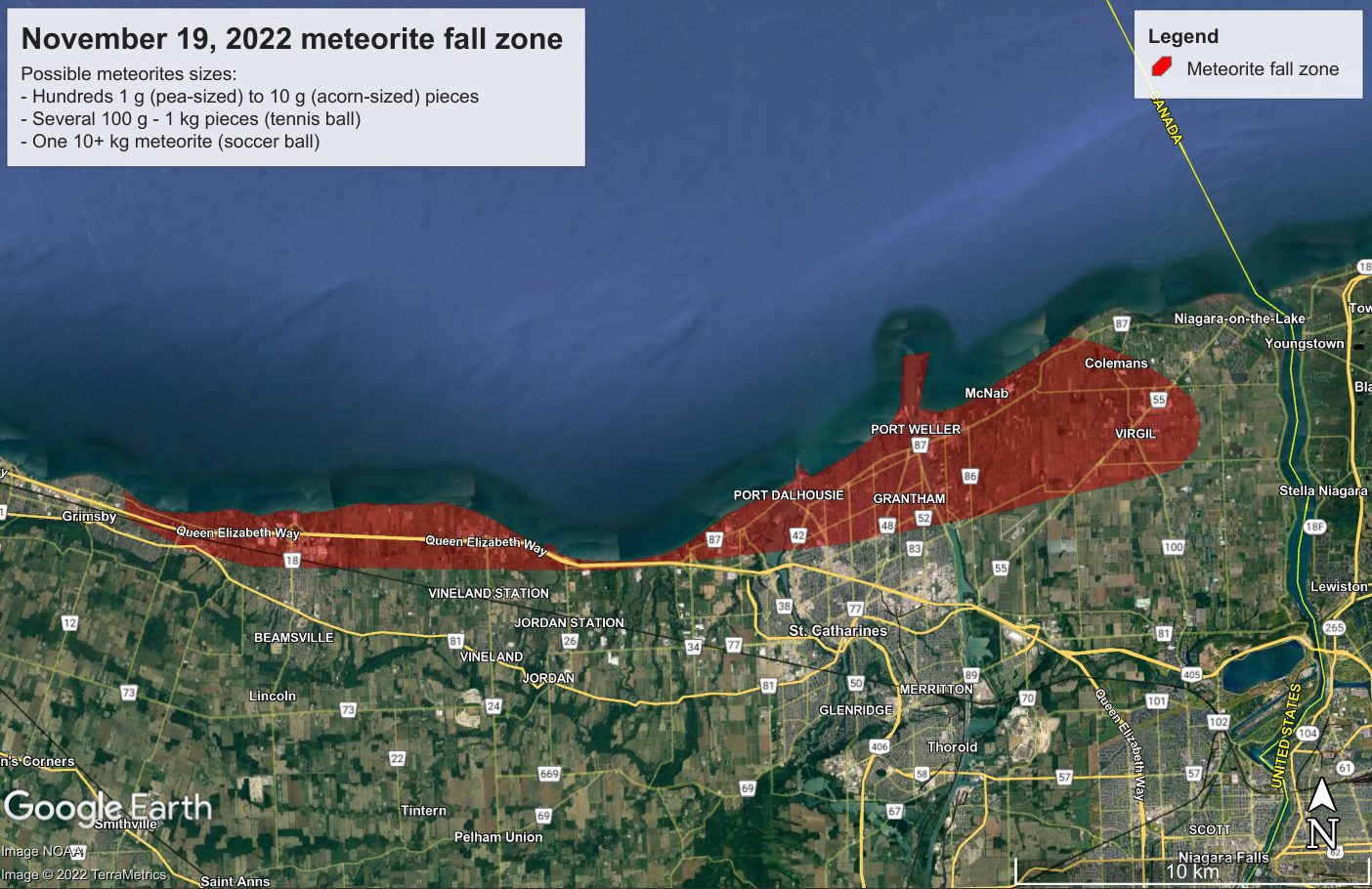
Thousands of people in a broad region around Niagra Falls witnessed the impact. UWO doctoral student David Clark was one of them. He drove to the predicted fall area in the early morning hours and managed to see the fireball with his own eyes parked near Niagara-on-the-Lake. "It passed right overhead and was distinctly green in color," says Clark. "Several minutes later a sonic boom could be heard."
Astronomy professor Paul Wiegert was also alerted early enough to see the fireball. "I expected to see only a distant flash," he says. "Then the fireball suddenly appeared, passing almost overhead. Wow! It was easily visible between broken clouds and noticeably orange-red."
"This fireball is significant because the parent meteoroid was observed telescopically before it hit the atmosphere," adds Peter Brown, Canada Research Chair in Planetary Small Bodies at UWO. "We have a rare opportunity to link telescopic data of an asteroid with its breakup behaviour in the atmosphere to glean insight into its internal structure."
Researchers are now scouring the shore of Lake Ontario for meteorites.
Realtime Space Weather Photo Gallery
Free: Spaceweather.com Newsletter
AMBER BUMBLEBEE SPACE PENDANT: Bumblebees don't usually fly so high. On Oct 15, 2022, the students of Earth to Sky Calculus launched this one to the stratosphere onboard a cosmic ray research balloon. Here it is floating 115,158 feet above California's Sierra Nevada:
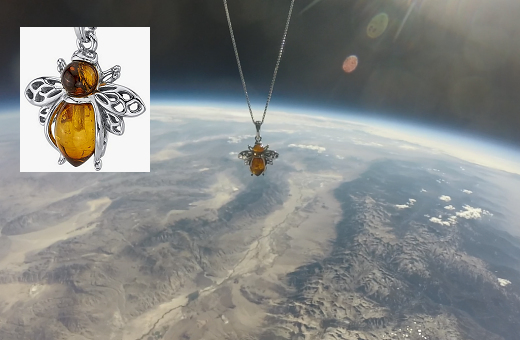
You can have it for $179.95. This bee is made of genuine Baltic Amber with a sterling silver exoskeleton. The rich Cognac-colored pendant measures 3/4 inch and comes with a matching 18-inch sterling silver chain.
The students are selling these unique pendants to support their cosmic ray ballooning program. Each one comes with a greeting card showing the bumblebee in flight and telling the story of its trip to the stratosphere and back again.
Far Out Gifts: Earth to Sky Store
All sales support hands-on STEM education
Realtime Aurora Photo Gallery
Free: Spaceweather.com Newsletter