CHANCE OF MINOR STORMS TODAY: NOAA forecasters say there is a chance of minor G1-class geomagnetic storms on Nov. 22nd when a CME might sideswipe Earth's magnetic field. The faint CME was hurled into space on Nov. 19th by an erupting filament of magnetism in the sun's northern hemisphere. A glancing blow could spark bright auroras around the Arctic Circle. Aurora alerts: SMS Text.

THESE AURORAS ARE NOT AURORAS: Two nights ago astrophotographer Ruslan Merzlyakov went to the coastal wilderness of Denmark's Thy National Park and set up his camera for a long exposure of the Milky Way. He found the galaxy surrounded by aurora-like bands of red and green:
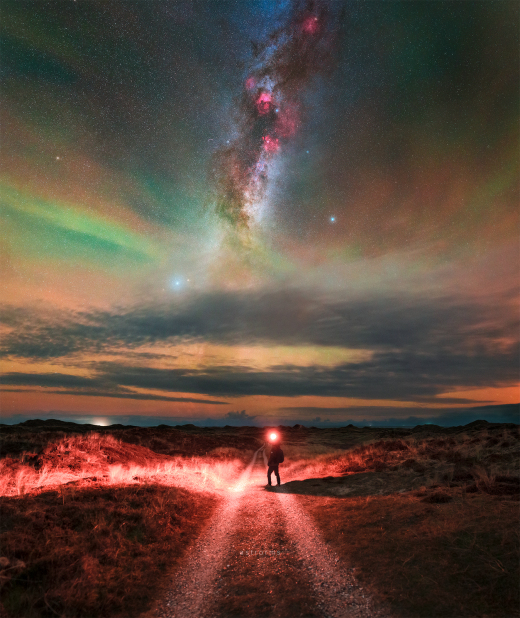
"It wasn't the aurora borealis," says Merzlyakov. "This was a magnificent display of airglow."
Airglow is aurora-like phenomenon caused by chemical reactions in the upper atmosphere. It gets started during the day when the air is illuminated by ultraviolet radiation from the sun. At night the delicate afterglow can be seen from dark-sky locations like Thy National Park.
Green airglow is caused by oxygen. Red airglow is more rare; it is caused by OH. These neutral molecules (not to be confused with the OH- ion found in aqueous solutions) exist in a thin layer 85 km high where gravity waves impress the red glow with a dramatic rippling structure.
Who needs auroras? "The airglow," says Merzlyakov, "was out of this world."
Realtime Space Weather Photo Gallery
Free: Spaceweather.com Newsletter
DIMORPHOS STILL HAS A TAIL: More than 2 months after NASA's DART spacecraft slammed into asteroid Dimorphos, debris from the collision is still visible. "Dimorphos still has a tail," reports Arizona amateur astronomer Eliot Herman, who photographed the battered asteroid on Nov. 20th and added it to his post-impact timeline:
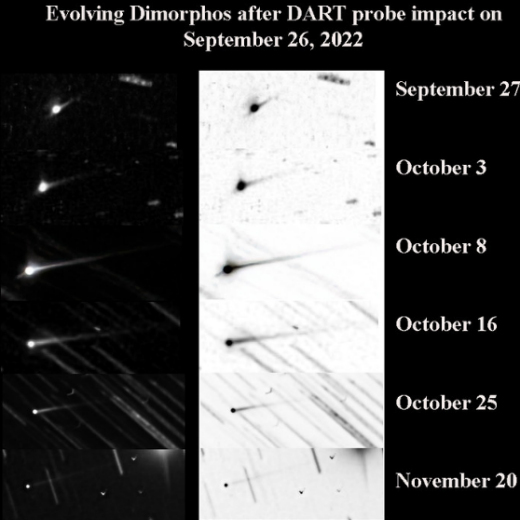
When NASA sent DART to hit Dimorphos, the space agency hoped to change the asteroid's trajectory. It did that and more. A comet was born in the aftermath. DART's impact debris has formed a surprisingly durable tail more than 10,000 km long.
"It will be very interesting to the see the damage when the follow-up probe reaches Dimorphos," says Herman.
Four years from now Europe's Hera spacecraft will visit the asteroid to inspect the impact site. Hera was originally supposed to arrive before DART struck, but delays derailed the mission. All's well that ends well. The delay gives Hera a chance to survey the damage after the dust has finally settled.
more images: from Graziano Ventre of Italy
Realtime Dimorphos Photo Gallery
Free: Spaceweather.com Newsletter
AMBER BUMBLEBEE SPACE PENDANT: Bumblebees don't usually fly so high. On Oct 15, 2022, the students of Earth to Sky Calculus launched this one to the stratosphere onboard a cosmic ray research balloon. Here it is floating 115,158 feet above California's Sierra Nevada:
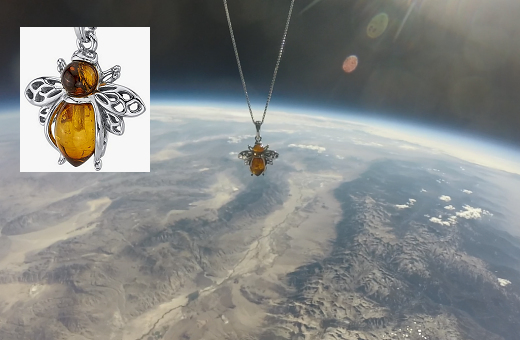
You can have it for $179.95. This bee is made of genuine Baltic Amber with a sterling silver exoskeleton. The rich Cognac-colored pendant measures 3/4 inch and comes with a matching 18-inch sterling silver chain.
The students are selling these unique pendants to support their cosmic ray ballooning program. Each one comes with a greeting card showing the bumblebee in flight and telling the story of its trip to the stratosphere and back again.
Far Out Gifts: Earth to Sky Store
All sales support hands-on STEM education
Realtime Aurora Photo Gallery
Free: Spaceweather.com Newsletter