ALL QUIET: There are four sunspot groups on the sun today. All of them have simple magnetic fields disinclined to explode. NOAA forecasters say there is a slight 10% chance of M-class solar flares and no more than a 1% chance of X-flares on Nov. 24th. Solar flare alerts: SMS Text.
CRYOVOLCANIC ERUPTION ON A COMET: The British Astronomical Association (BAA) is reporting a new outburst of cryovolcanic comet 29P/Schwassmann-Wachmann. On Nov. 22nd, amateur astronomer Patrick Wiggins watched 29P increase in brightness by more than 4 magnitudes--a sign that a major eruption was in progress. On Nov. 23rd, André Debackère used the Faulkes Telescope North in Hawaii to photograph the expanding shell of debris:
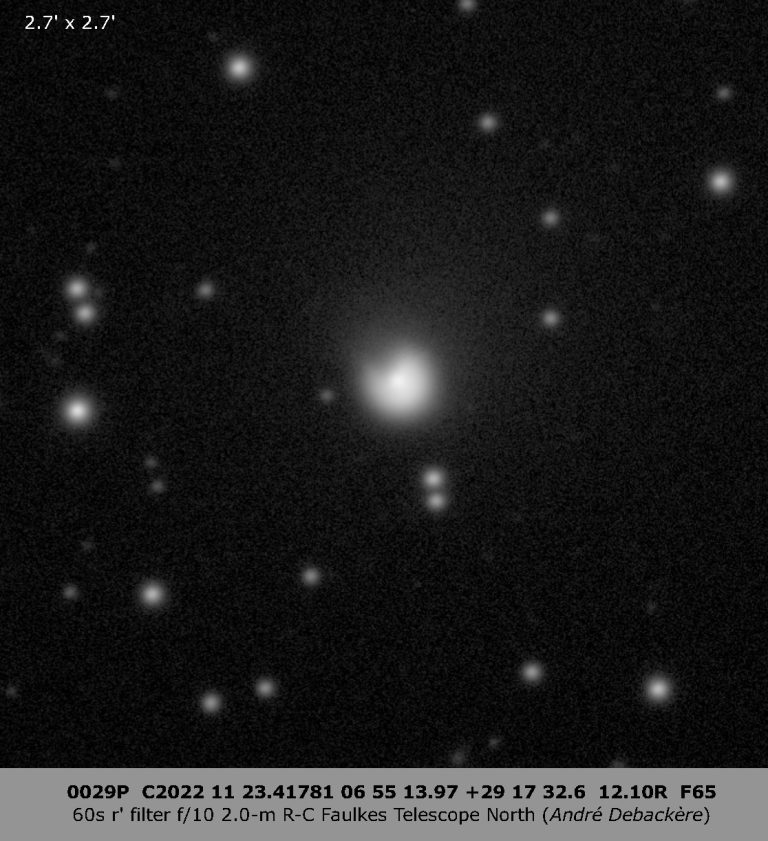
The Pac-Man shape of the ejecta suggests that the outburst is coming from a discrete source on the comet's surface. This would fit a leading model of the comet developed by Dr. Richard Miles of the British Astronomical Association.
Miles believes that 29P is festooned with ice volcanoes. There is no lava. The "magma" is a cold mixture of liquid hydrocarbons (e.g., CH4, C2H4, C2H6 and C3H8) akin to those found in lakes and streams on Saturn's moon Titan. The cryomagma is suffused with dissolved gases N2 and CO--much like carbonation in a soda bottle. These bottled-up volatiles love to explode when a fissure is opened by the warming action of sunlight.
Currently the expanding cloud has an integrated magnitude near +11, which puts it within range of backyard telescopes. If this is anything like past eruptions, Pac-Man should grow much bigger in the nights ahead. Monitoring is encouraged! Observers can find 29P in the constellation Gemini. More information: MISSION 29P.
Realtime Space Weather Photo Gallery
Free: Spaceweather.com Newsletter
VOYAGER GOLDEN RECORD ORNAMENT: This is a must-have Christmas ornament for space fans: The Voyager Golden Record. On Oct. 15th, the students of Earth to Sky Calculus launched it to the stratosphere onboard a cosmic ray research balloon:
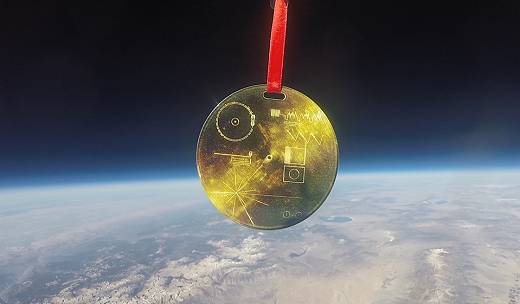
You can have it for $129.95. The 4-inch aluminum disk is imprinted with instructions intended for extraterrestrials, telling them how to play the phonographs now sailing through interstellar space onboard NASA's Voyager probes. Having touched the edge of space, it's the closest thing on Earth to an actual Golden Record.
The students are selling these unique ornaments to support their cosmic ray ballooning program. Each one comes with a greeting card showing the ornament in flight and extra materials decoding the markings on the disk.
Far Out Gifts: Earth to Sky Store
All sales support hands-on STEM education
Realtime Aurora Photo Gallery
Free: Spaceweather.com Newsletter