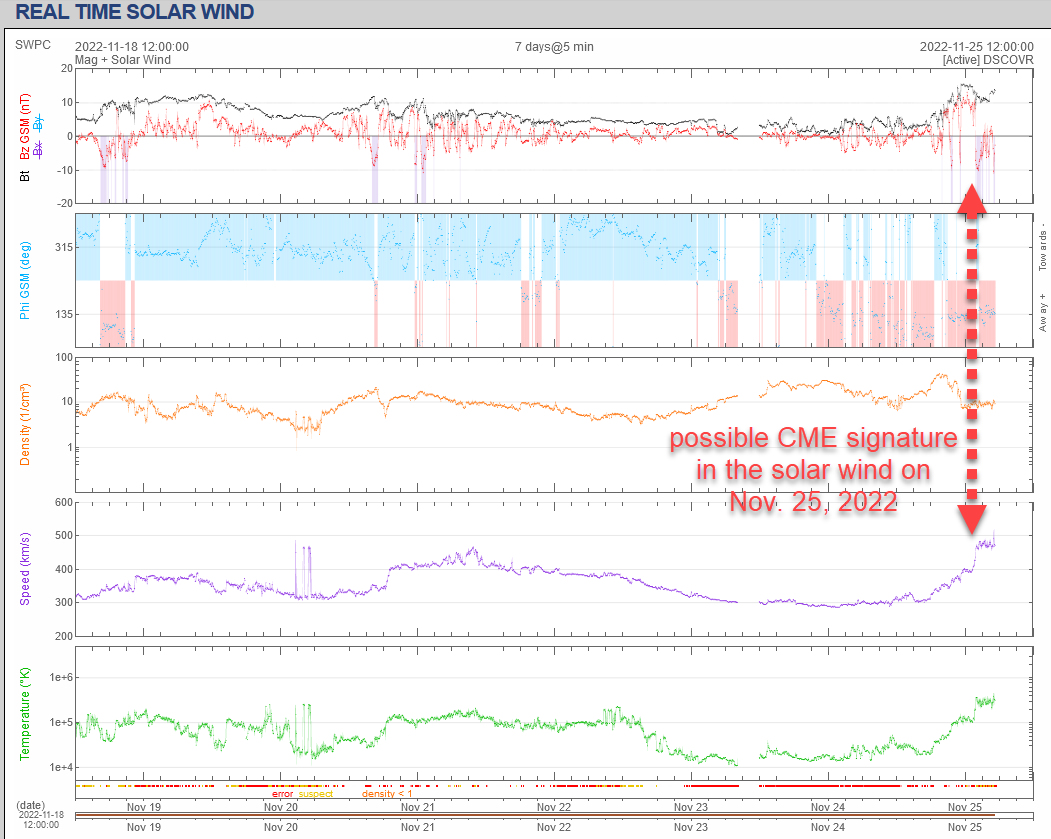
POSSIBLE CME IMPACT: A shock wave in the solar wind hit Earth's magnetic field on Nov. 25th (0230 UT). "It wasnt much of a strike, but it was enough to make auroras here in northern North Dakota," reports Elon Gane, who photographed the display from a roadside near Mohall, ND:
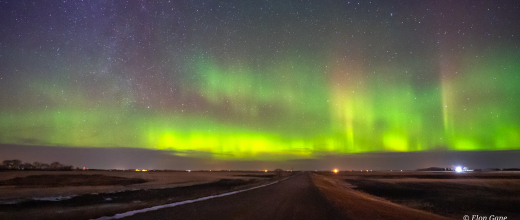
"The lights were faint but clearly visible to the naked eye," says Gane.
The shock wave might have been a faint CME that left the sun on Nov. 19th, hurled in our direction by an erupting filament of magnetism. Forecast models predicted a near-miss, but a grazing impact may have happened instead. Aurora alerts: SMS Text.
Realtime Aurora Photo Gallery
Free: Spaceweather.com Newsletter
CRYOVOLCANIC ERUPTION ON A COMET: The British Astronomical Association (BAA) is reporting a new outburst of cryovolcanic comet 29P/Schwassmann-Wachmann. On Nov. 22nd, amateur astronomer Patrick Wiggins watched 29P increase in brightness by more than 4 magnitudes--a sign that a major eruption was in progress. On Nov. 23rd, André Debackère used the Faulkes Telescope North in Hawaii to photograph the expanding shell of debris:
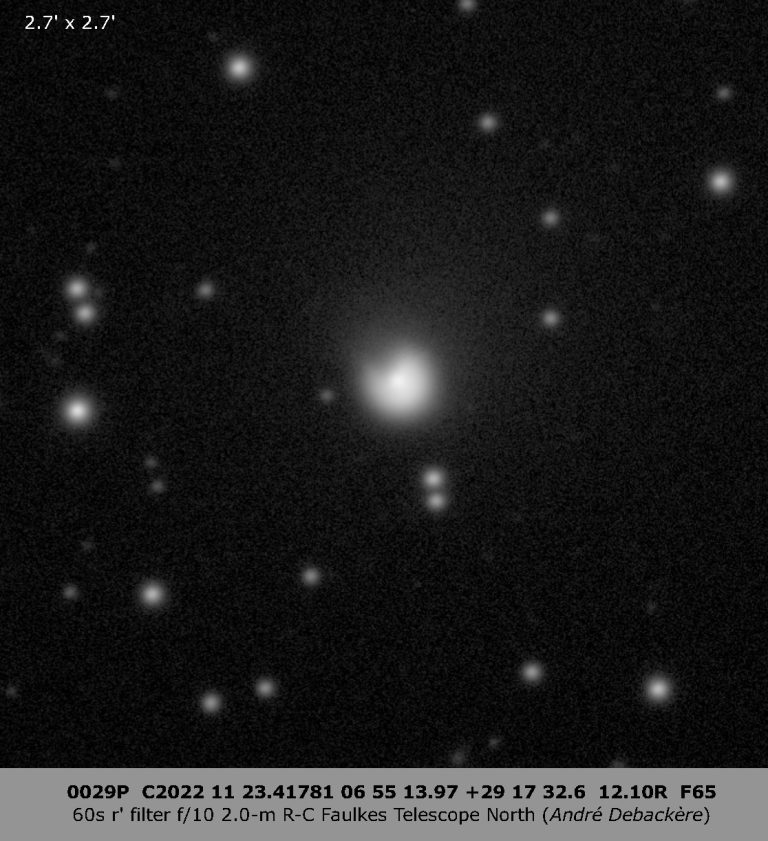
The Pac-Man shape of the ejecta shows that this is not a uniform global eruption. Instead, it is coming from one or more discrete sources on the comet's surface.
This fits a leading model of the comet developed by Dr. Richard Miles of the British Astronomical Association. Miles believes that 29P is festooned with ice volcanoes. There is no lava. The "magma" is a cold mixture of liquid hydrocarbons (e.g., CH4, C2H4, C2H6 and C3H8) akin to those found in lakes and streams on Saturn's moon Titan. The cryomagma is suffused with dissolved gases N2 and CO, much like carbonation in a soda bottle. These bottled-up volatiles love to explode when a fissure is opened by the warming action of sunlight.
A new image just taken by Cai Stoddard-Jones using the Faulkes Telescope North adds weight to the idea that a single volcano or active zone is involved. Processing the data with a rotational gradient filter, Stoddard-Jones found an intense condensation of debris at position angle 330 degrees:
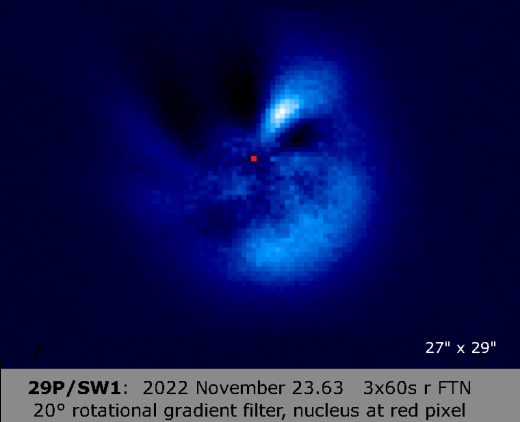
This narrow plume probably leads back to the primary source the eruption. The plume is currently streaming away from the nucleus at 75 m/s (270 km/hr) and stretches more than 11,000 km from end to end. If an eruption like this were happening on Earth, it would jut far outside our planet's atmosphere; it's huge.
These dimensions, plus the integrated brightness of the comet (magnitude +11), put 29P within easy range of many backyard telescopes. If past eruptions are any guide, Pac-Man should grow much larger in the nights ahead. Observers can find 29P after sunset in the constellation Gemini.
For more information visit the British Astronomical Association's MISSION 29P website.
Realtime Space Weather Photo Gallery
Free: Spaceweather.com Newsletter
BLACK FRIDAY AT THE EDGE OF SPACE: Christmas is coming. Are you looking for a far-out gift? Check out the Earth to Sky Store. It's filled with unique items that have flown to the edge of space onboard cosmic ray research balloons.

Carried aloft by giant helium balloons, these unique gifts have flown above 99.7% of Earth's atmosphere, experiencing space-like blasts of cosmic rays, extreme cold, and a wild ride parachuting back to Earth after the balloon explodes. Even Amazon doesn't carry items this far out.
Don't forget to enter coupon code "BLACKPEARL" at checkout for a 15% Black Friday discount.
Far Out Gifts: Earth to Sky Store
All sales support hands-on STEM education
FULL VENUS ON THANKSGIVING: Like the Moon, Venus has phases. On Thanksgiving, the second planet was full. "Venus was 99% illuminated when I photographed it on Nov. 24th," reports Kevin R. Witman, who sends this picture from Cochranville, Pennsylvania:
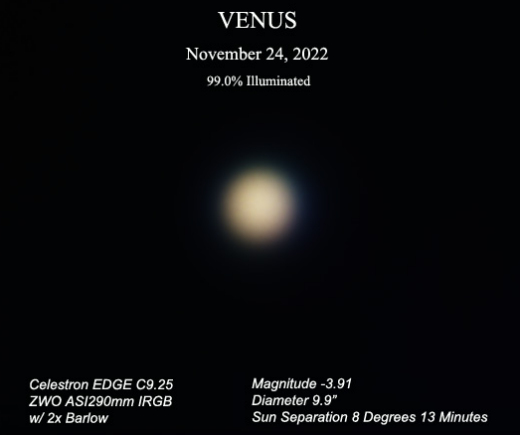
It's not easy to observe Venus when it is full. From Earth, Venus looks full when it is on the opposite side of the sun--as far from Earth as it can get and surrounded by bright sunlight.
"With Venus only 8 degrees away from the sun, it was a great challenge just to find its small disk against the very bright background sky," says Witman. "But I managed to do it using a Celestron EDGE HD C9.25 with a 2x Barlow."
Realtime Space Weather Photo Gallery
Free: Spaceweather.com Newsletter
Realtime Aurora Photo Gallery
Free: Spaceweather.com Newsletter