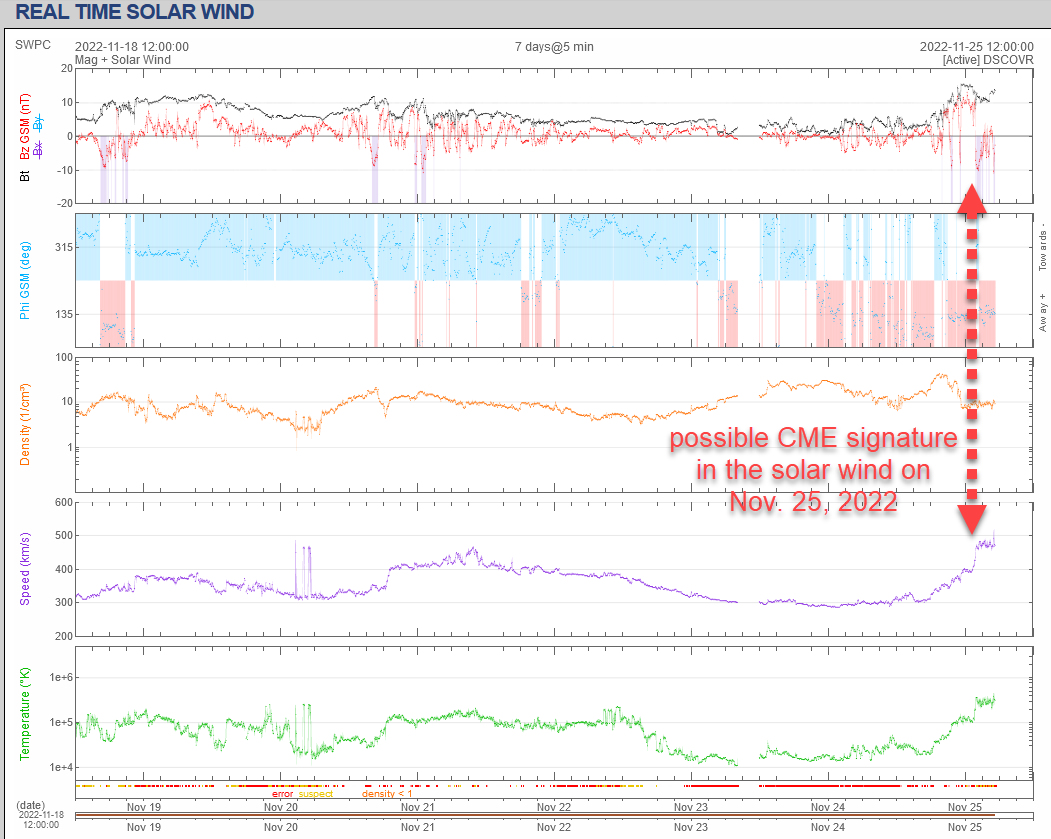
HIGH LATITUDE AURORA WATCH: Earth is inside a high-speed stream of solar wind following a possible CME impact on Nov. 25th. With the wind blowing nearly 600 km/s, high latitude auroras are possible this weekend, especially around the Arctic Circle. Aurora alerts: SMS Text.
CRYOVOLCANIC ERUPTION ON A COMET (UPDATED): The British Astronomical Association (BAA) is reporting a new outburst of cryovolcanic comet 29P/Schwassmann-Wachmann. On Nov. 22nd, the comet's nucleus suddenly brightened by more than 4 magnitudes--a sign that a major eruption was underway. Cryomagmatic debris is now expanding in a shell shaped like Pac-Man:
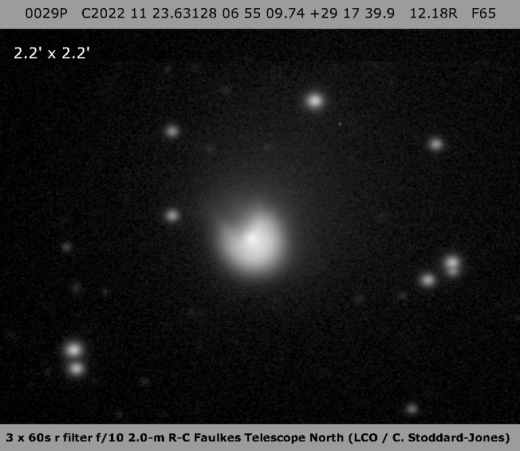
Cai Stoddard-Jones took the picture on Nov. 23rd using the Faulkes Telescope North in Hawaii. At the time, the shell was already more than 100,000 km in diameter.
The Pac-Man shape of the ejecta shows that this is not a uniform global eruption. Instead, it is coming from one or more discrete sources on the comet's surface.
This fits a leading model of the comet developed by Dr. Richard Miles of the British Astronomical Association. Miles believes that 29P is festooned with ice volcanoes. There is no lava. The "magma" is a cold mixture of liquid hydrocarbons (e.g., CH4, C2H4, C2H6 and C3H8) akin to those found in lakes and streams on Saturn's moon Titan. The comet's cryomagma is suffused with dissolved gases N2 and CO, a bit like carbonation in a soda bottle. These bottled-up volatiles love to explode when a fissure is opened by the warming action of sunlight.
A new image taken on Nov. 25th by astronomers André Debackère and M. Malaric adds weight to the idea that a single volcano is driving the outburst. Processing the data with a rotational gradient filter, Debackère found a bright plume of debris at position angle 330 degrees (the 1 o'clock position):
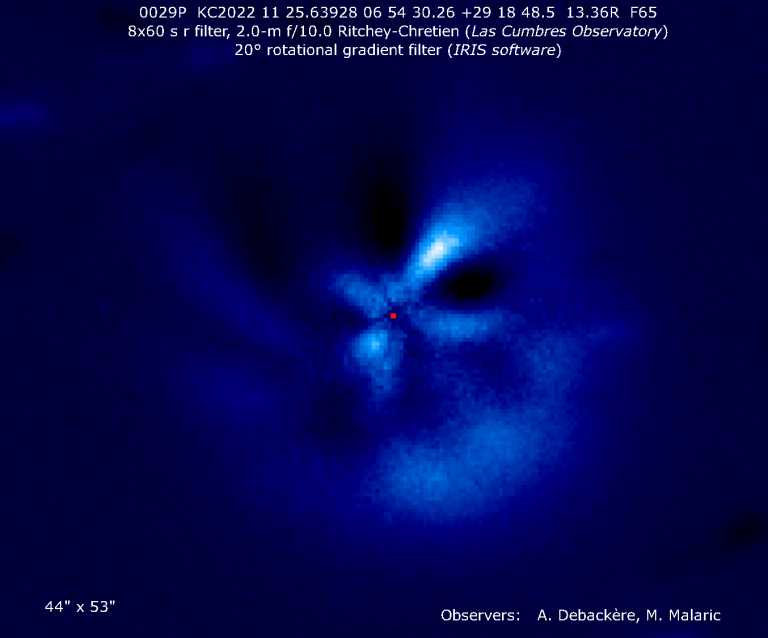
This narrow plume probably leads back to the primary source the eruption. Currently streaming away from the nucleus at 75 m/s (270 km/hr), the plume stretches more than 11,000 km into space. If an eruption like this were happening on Earth, it would be plastering thousands of satellites with frosty hydrocarbons.
The integrated brightness of the comet (magnitude +11), puts it within easy reach of many backyard telescopes. Pac-Man already subtends an angle wider than Mars and, if past eruptions are any guide, it should grow much larger in the nights ahead. Observers can find 29P after sunset in the constellation Gemini.
For more information visit the British Astronomical Association's MISSION 29P website.
more images: from Tom Gwilym of Sturgeon Bay, Wisconsin;
Realtime Space Weather Photo Gallery
Free: Spaceweather.com Newsletter
BLACK FRIDAY AT THE EDGE OF SPACE: Christmas is coming. Are you looking for a far-out gift? Check out the Earth to Sky Store. It's filled with unique items that have flown to the edge of space onboard cosmic ray research balloons.

Carried aloft by giant helium balloons, these unique gifts have flown above 99.7% of Earth's atmosphere, experiencing space-like blasts of cosmic rays, extreme cold, and a wild ride parachuting back to Earth after the balloon explodes. Even Amazon doesn't carry items this far out.
Don't forget to enter coupon code "BLACKPEARL" at checkout for a 15% Black Friday discount.
Far Out Gifts: Earth to Sky Store
All sales support hands-on STEM education
Realtime Aurora Photo Gallery
Free: Spaceweather.com Newsletter