ORION IS HEADING HOME: NASA's Orion spacecraft just broke out of lunar orbit and it is beginning its return journey to Earth. On the way home, Orion will buzz the Moon on Monday, Dec. 5th, passing less than 80 miles above the lunar surface. This maneuver will slingshot Orion toward Earth for a record-hot reentry and slashdown in the Pacific Ocean on Dec. 11th. Check the Artemis blog for updates.
BIG SUNSPOT ALERT: A new sunspot (AR3153) is rotating over the sun's southeastern limb, and it is a big one. NASA's Solar Dynamics Observatory (SDO) is seeing at least two dark cores significantly wider than Earth. The entire group is inset in this magnetic map of the sun's surface taken by SDO during the early hours of Dec. 2nd:
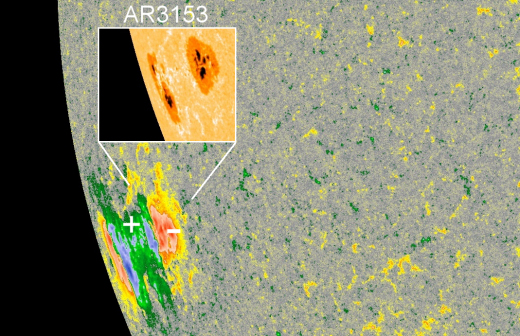
So far the sunspot's magnetic field appears to be cleanly separated into + and - polarities--no mixing. This means it poses little threat for explosive solar flares. However, this could change. The sunspot is rapidly growing, doubling in size since yesterday, so its magnetic architecture may soon be quite different. Stay tuned! Solar flare alerts: SMS Text.
more images: from Pepe Manteca of Barcelona, Spain
Realtime Space Weather Photo Gallery
Free: Spaceweather.com Newsletter
MARS VS JUPITER: Mars is a small planet, and usually it looks puny next to a giant like Jupiter. Not so last night. On Dec. 1st, Thomas Williamson photographed both Mars and Jupiter from his back yard in Albuquerque, New Mexico; then he placed the images side by side. "Mars looked pretty big," he says.
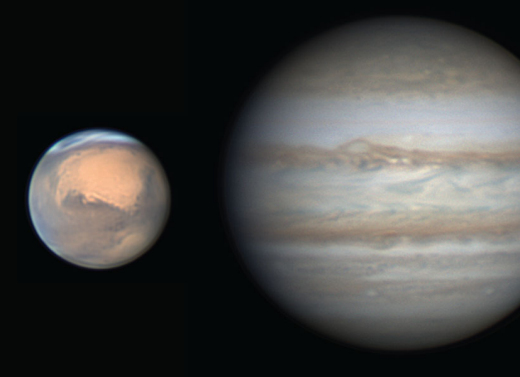
Why? Mars is unusually close to Earth, less than 51 million miles away. Because of this proximity, the Martian disk has swollen to 17 arcseconds in diameter, a fair fraction of Jupiter.
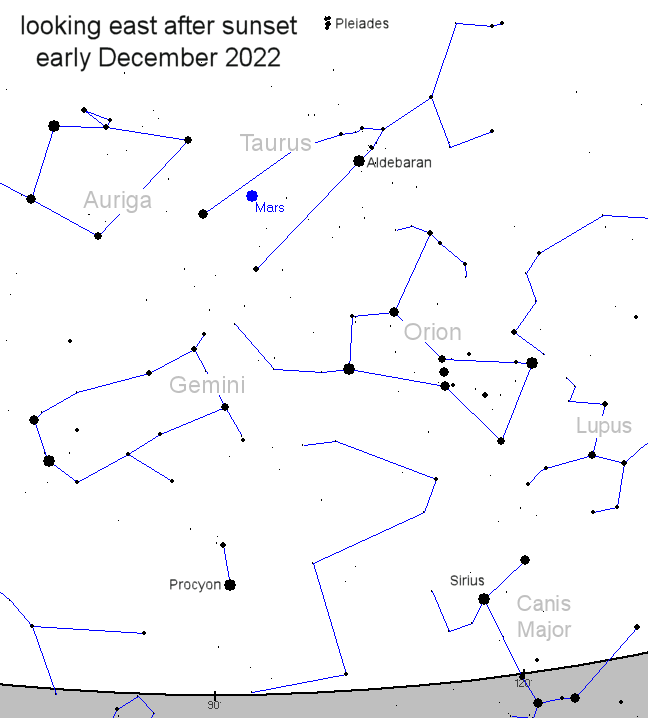
Technically, Dec. 1st was the night of closest approach, but Mars will be almost equally nearby all week long. "Beautiful and bright orange, Mars is high in the sky near midnight. It is wonderful to see in the eyepiece!" says Williamson. Take a look: sky map.
Realtime Space Weather Photo Gallery
Free: Spaceweather.com Newsletter
GIFTS FROM THE EDGE OF SPACE: Christmas is coming. Are you looking for a far-out gift? Check out the Earth to Sky Store. It's filled with unique items that have flown to the edge of space onboard cosmic ray research balloons.

These unique gifts have floated above 99.7% of Earth's atmosphere, experiencing space-like blasts of cosmic rays, extreme cold, and a wild ride parachuting back to Earth after the balloon explodes. Even Amazon doesn't carry items this far out. Don't forget to enter coupon code "SPACESANTA" at checkout for a 10% holiday discount.
Far Out Gifts: Earth to Sky Store
All sales support hands-on STEM education
Realtime Aurora Photo Gallery
Free: Spaceweather.com Newsletter