NINE SUNSPOT GROUPS: Today, there are nine distinct sunspot groups crossing the face of the sun--the greatest number so far during young Solar Cycle 25. This would seem to boost the odds of a solar flare. However, all nine sunspots have stable magnetic fields disinclined to explode. Solar activity may remain low despite the high sunspot count. Solar flare alerts: SMS Text.
THE EXTENDED SOLAR CYCLE: So you thought you knew the solar cycle? Think again. A new paper published in Frontiers in Astronomy and Space Sciences confirms that there is more to solar activity than the well-known 11-year sunspot cycle. Data from Stanford University's Wilcox Solar Observatory (WSO) reveal two solar cycles happening at the same time, and neither is 11 years long.
"We call it 'the Extended Solar Cycle,'" says lead author Scott McIntosh of NCAR. "There are two overlapping patterns of activity on the sun, each lasting about 17 years."
Solar physicists have long suspected this might be true. References to "overlapping solar cycles" can be found in research literature as far back as 1903. A figure from the new Frontiers paper seems to clinch the case:
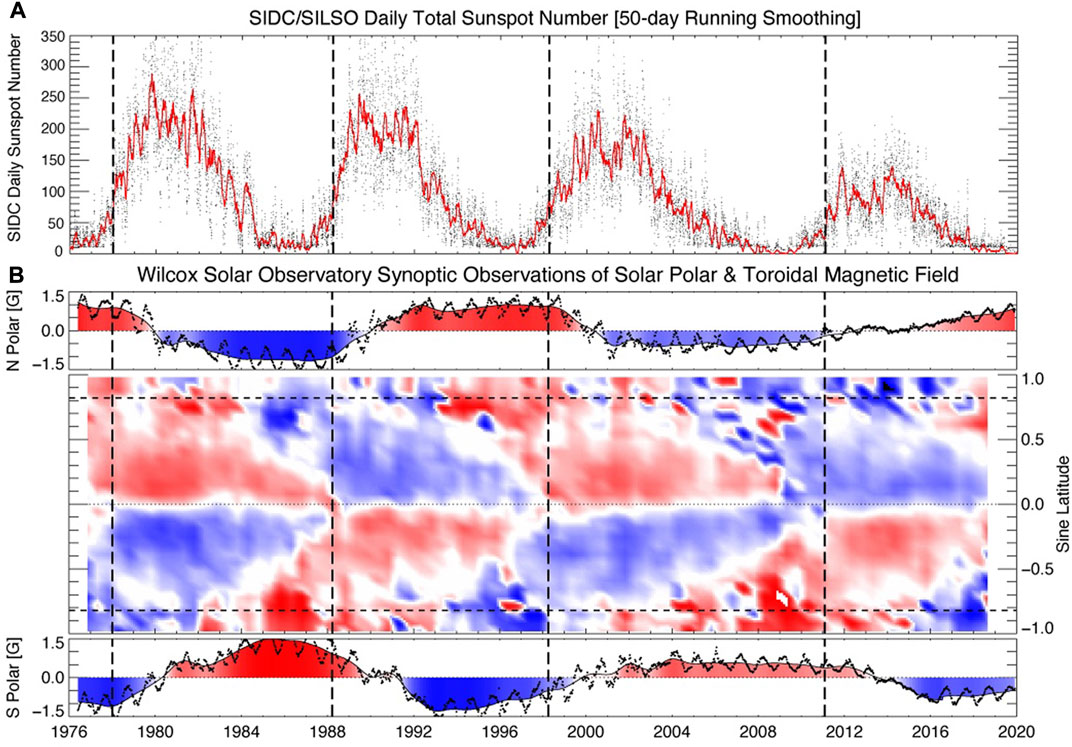
The top panel shows sunspot counts since 1976. The curve goes up and down every 11 years, which explains why everyone thinks the solar cycle is 11 years long. The bottom panel shows what's really going on.
"The red and blue colors represent magnetic fields on the surface of the sun," explains Phil Scherrer of Stanford University, a co-author of the paper who works closely with data from the Wilcox Solar Observatory. "We have been monitoring these fields since 1976, gathering a unique long-term record of the sun's magnetism."
Wilcox data show not one but two co-existing patterns of activity. They overlap in a way any music major will recognize: The sun is "singing rounds." A round is a musical piece in which multiple voices sing the same melody, but start the song at different times. Imagine a group of children singing "Row, row, row your boat." Half of the kids start first; the other half start 5 syllables later. The sun is doing the same thing with its magnetic fields, except instead of 5 syllables ("row, row, row your boat") the gap is a little more than 5 years.

In the zoomed-in image, above, two representative cycles are labeled "1" and "2". Most of the time both cycles are active, but not always. When one stops (....life is but a dream...), the other takes complete control of the sun and sunspot counts surge. This is when Solar Maximum happens. McIntosh calls the transition "the Terminator."
11 years vs. 17 years. 1 cycle vs. 2 cycles. What difference does it make?
"The Extended Solar Cycle may be telling us something crucial about what's happening deep inside the sun where sunspot magnetic fields are generated," says McIntosh. "It poses significant challenges to prevalent dynamo theories of the solar cycle."
Want to learn more? Milestone references in the development of the Extended Solar Cycle paradigm include Martin & Harvey (1979), Wilson et al (1988), Srivastava et al (2018).
Realtime Space Weather Photo Gallery
Free: Spaceweather.com Newsletter
GIFTS FROM THE EDGE OF SPACE: Christmas is coming. Are you looking for a far-out gift? Check out the Earth to Sky Store. It's filled with unique items that have flown to the edge of space onboard cosmic ray research balloons.

These unique gifts have floated above 99.7% of Earth's atmosphere, experiencing space-like blasts of cosmic rays, extreme cold, and a wild ride parachuting back to Earth after the balloon explodes. Even Amazon doesn't carry items this far out. Don't forget to enter coupon code "SPACESANTA" at checkout for a 10% holiday discount.
Far Out Gifts: Earth to Sky Store
All sales support hands-on STEM education
Realtime Aurora Photo Gallery
Free: Spaceweather.com Newsletter