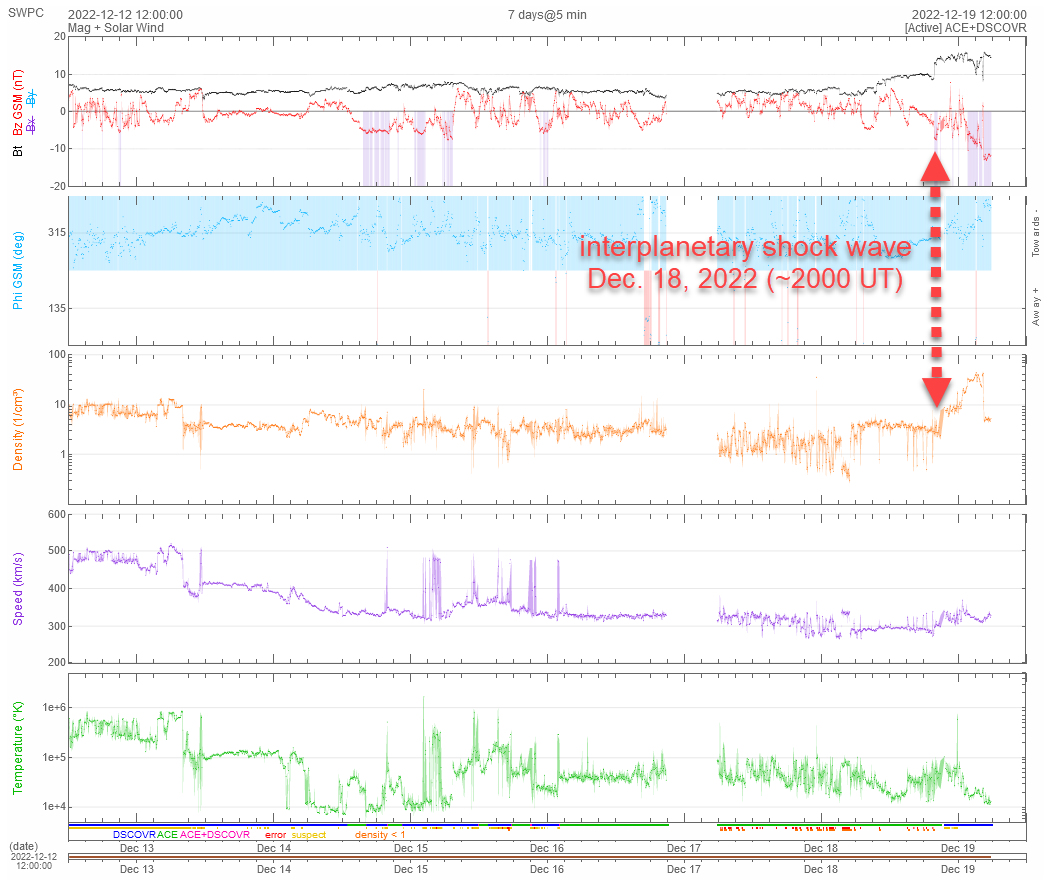
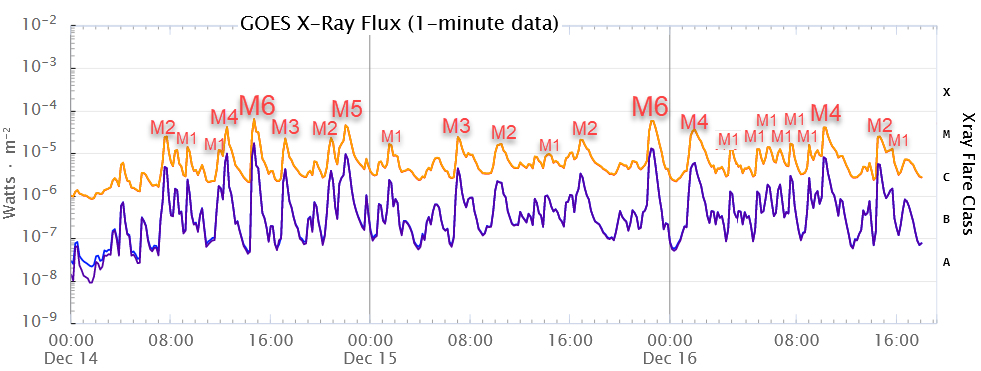
INTERPLANETARY SHOCK WAVE: A shock wave in the solar wind hit Earth's magnetic field during the late hours of Dec. 18th. The impact opened a crack in our planet's magnetosphere, setting the stage for possible G1-class geomagnetic storms on Dec. 19th. The shock wave may have been a CME emitted last week by sunspot AR3165 during its hyperactive flurry of solar flares. Solar flare alerts: SMS Text.

PROBING THE ATMOSPHERE OF A CRYOVOLCANIC COMET: This morning a very rare stellar occultation was visible from Taiwan and parts of North America. Cryovolcanic comet 29P/Schwassmann-Wachmann passed directly in front of a 12th magnitude star. Using a robotic telescope in Mayhill, New Mexico, Eliot Herman took this picture of the star shining through 29P's atmosphere:
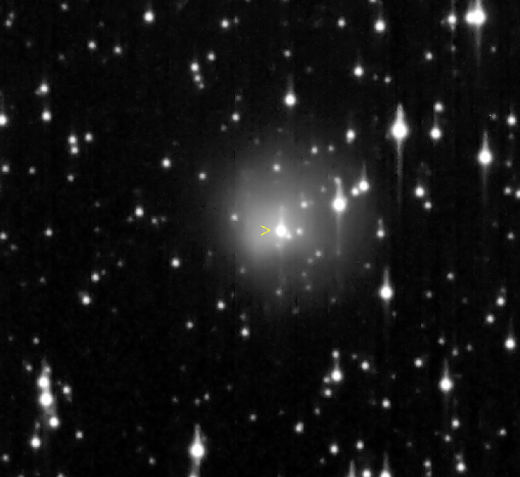
"The resolution of the 17 inch telescope was not sufficient to split the star from the solid body of 29P/Schwassmann-Wachmann," says Herman. "In this image they are a single point of light."
Hopefully, this is only the first of many images of the occultation taken from the Pacific-spanning shadow track. Plotting the star's light curve as it passed behind 29P will help trace the shape of the comet's solid body, which may be unusually spherical.
Moreover, 29P has erupted multiple times since late November--including one outburst on the eve of the occultation. The star will have passed behind residual clouds of outburst debris, allowing astronomers to probe the 'near space' around the comet's nucleus. Stay tuned for updates!
A 'BLUE FLASH' FROM SIRIUS: Sirius is so bright, you can see it even when it is very close to the horizon. Amateur astronomer Bob Beal of St. George, Utah, decided to take a closer look, and he found a 'blue flash':
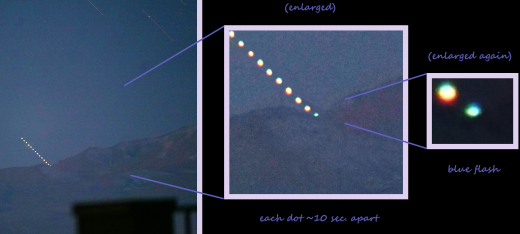
"The timelapse photo shows Sirius setting behind the mountains southwest of town during morning twilight on Dec. 14th," says Beal.
The first exposures show a series of little rainbows. Sirius was spread into its constituent colors by the prismatic action of the low atmosphere. The last exposure is only blue.
"When Sirius hit the ridgeline, parts of its disk were behind the ridge, leaving blue as the last color to disappear," says Beal.
The sun can have blue flashes as well. But the sun requires a mirage to magnify its blue enough to be visible against surrounding blue sky. Sirius has the advantage of darkness; nighttime blue is easier to see. The fact that Sirius itself is blue may help, too.
Realtime Space Weather Photo Gallery
Free: Spaceweather.com Newsletter
GIFTS FROM THE EDGE OF SPACE: Christmas is coming. Are you looking for a far-out gift? Check out the Earth to Sky Store. It's filled with unique items that have flown to the edge of space onboard cosmic ray research balloons.

These unique gifts have floated above 99.7% of Earth's atmosphere, experiencing space-like blasts of cosmic rays, extreme cold, and a wild ride parachuting back to Earth after the balloon explodes. Even Amazon doesn't carry items this far out. Don't forget to enter coupon code "SPACESANTA" at checkout for a 10% holiday discount.
Far Out Gifts: Earth to Sky Store
All sales support hands-on STEM education
Realtime Aurora Photo Gallery
Free: Spaceweather.com Newsletter