ALL QUIET: Solar activity is low and it is likely to remain so through Christmas. All of the sunspots on the Earthside of the sun have relatively stable magnetic fields that pose a threat for, at most, minor C-class flares. The situation could change next week when one or more farside sunspots come over the horizon. Solar flare alerts: SMS Text.
CRYOVOLCANIC COMET OCCULTATION: What are the odds? For the second time in little more than a week, cryovolcanic Comet 29P/Schwassmann-Wachmann is about to occult a star, giving astronomers an opportunity to trace the comet's strangely spherical shape. The shadow track on Dec. 27th cuts across many populated areas in western USA:
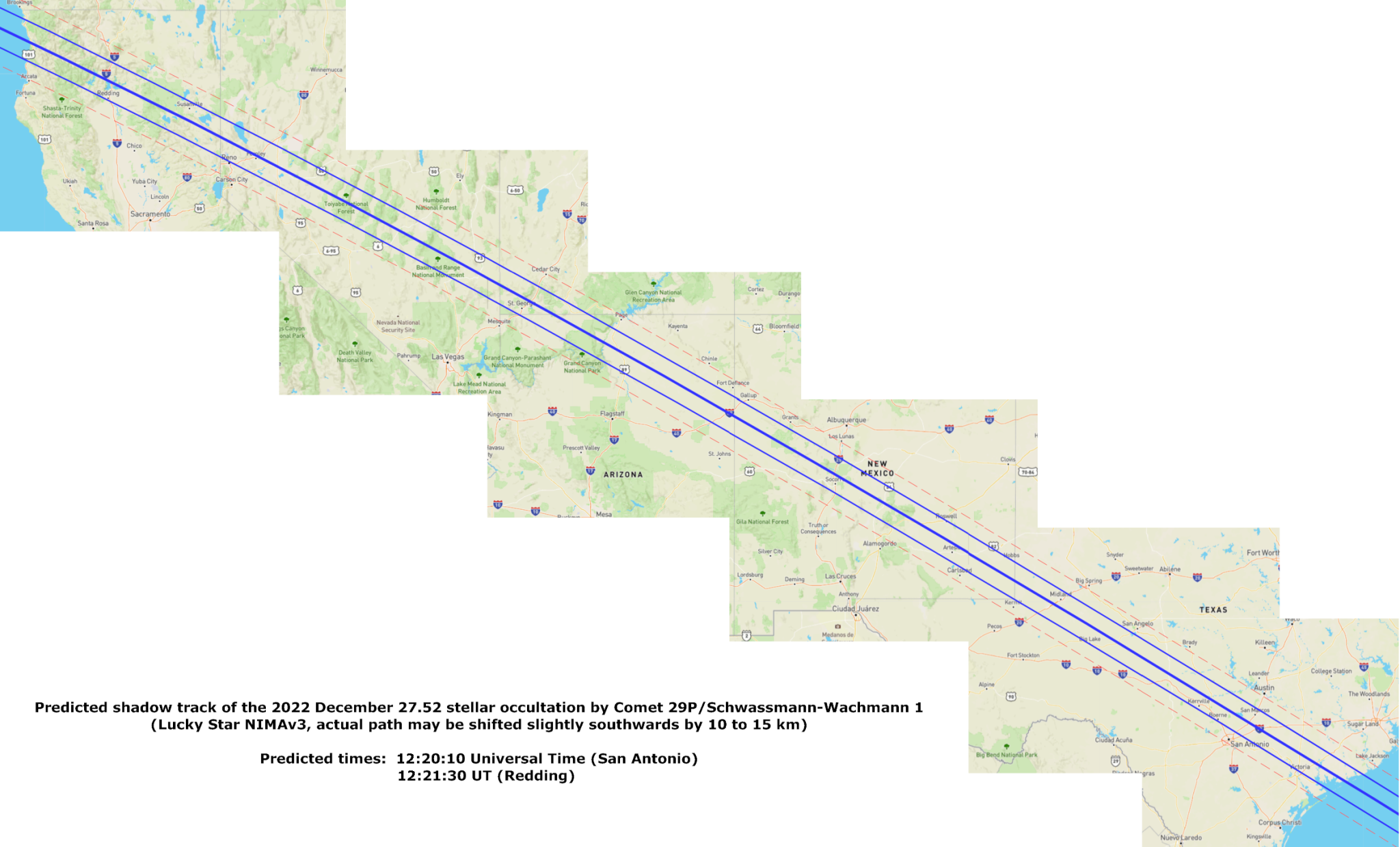
"This event may prove to be the best this decade, so observers please do try and cover it," says Dr. Richard Miles of the British Astronomical Association, a leading researcher of 29P. "It involves a 13th magnitude star," with occultation times range from 12:20:10 UT in San Antonio, Texas, to 12:21:30 UT in Redding, California.
"A video record, preferably with absolute timing, is required," he adds. "Frame exposure times of 0.25 sec or shorter are recommended. The current weather forecast suggests that the north-western half of the track will be plagued by cloud. Most of New Mexico and Texas look to have largely clear skies early on the Tuesday morning."
For updates, check the MISSION 29P website.
CHRISTMAS COMET ALERT (UPDATED): If it's not too late, ask for a telescope for Christmas. Comet ZTF (C/2022 E3) is approaching Earth for a close encounter next month, and it already looks great. Michael Jaeger of Martinsberg, Austria, photographed the two-tailed interplanetary snowball on Dec. 22nd:
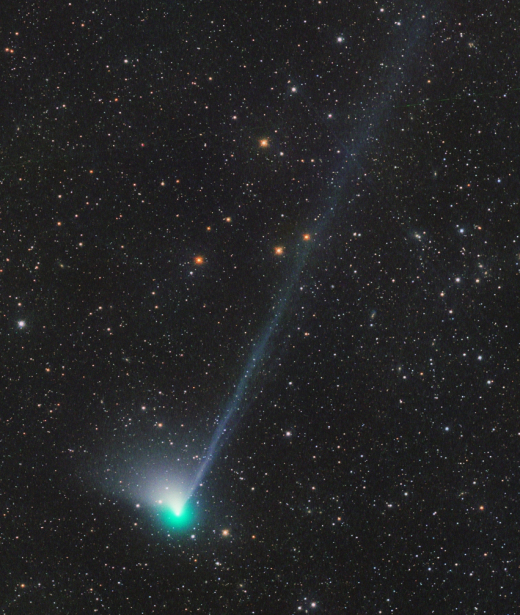
"This comet has become an exciting object," says Jaeger, "Although it will not reach maximum brightness until late January or February, it already shows two tails and a bright green atmosphere."
Discovered in March 2022 by the Zwicky Transient Facility, Comet ZTF is falling in from the outer solar system. Perihelion (closest approach to the sun) will occur on Jan. 12, 2023, at a distance of 1.11 AU. Closest approach to Earth follows on Feb. 1, 2023, at a distance of 0.28 AU. Between those two dates, the comet could hit magnitude 5 or 6, technically visible to the unaided eye.
The two tails Jaeger saw are the dust tail and the ion tail. The ion tail is made of gas and is blown directly away from the sun by the solar wind. The heavier dust tail is curved and more closely traces the comet's orbit.
According to Jaeger, the comet is currently 8th magnitude, which makes it an easy target for mid-sized backyard telescopes. A New Moon over Christmas weekend will provide dark skies for comet-finding. Point your optics here.
more images: from Alan C. Tough using a telescope in Mayhill, New Mexico; from Johnny Barton of Robinson, Texas; from Graziano Ventre of Bellagio Via Lattea, Italy
Realtime Space Weather Photo Gallery
Free: Spaceweather.com Newsletter
GIFTS FROM THE EDGE OF SPACE: Christmas is coming. Are you looking for a far-out gift? Check out the Earth to Sky Store. It's filled with unique items that have flown to the edge of space onboard cosmic ray research balloons.
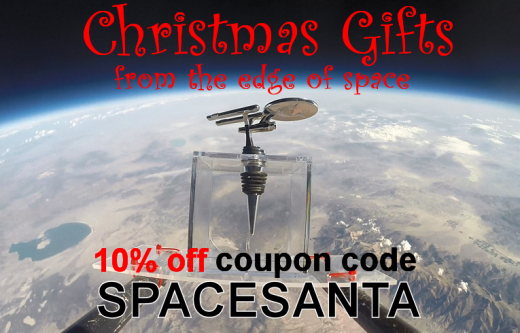
These unique gifts have floated above 99.7% of Earth's atmosphere, experiencing space-like blasts of cosmic rays, extreme cold, and a wild ride parachuting back to Earth after the balloon explodes. Even Amazon doesn't carry items this far out. Don't forget to enter coupon code "SPACESANTA" at checkout for a 10% holiday discount.
Far Out Gifts: Earth to Sky Store
All sales support hands-on STEM education
Realtime Aurora Photo Gallery
Free: Spaceweather.com Newsletter