CHANCE OF FLARES TODAY: NOAA forecasters say there is a 55% chance of M-class solar flares and a 15% chance of X-flares today. Sunspots AR3169 and AR3176 both pose a threat for such explosions. Neither is directly facing Earth, but they're close enough for radio blackouts and glancing-blow CMEs. Solar flare alerts: SMS Text.
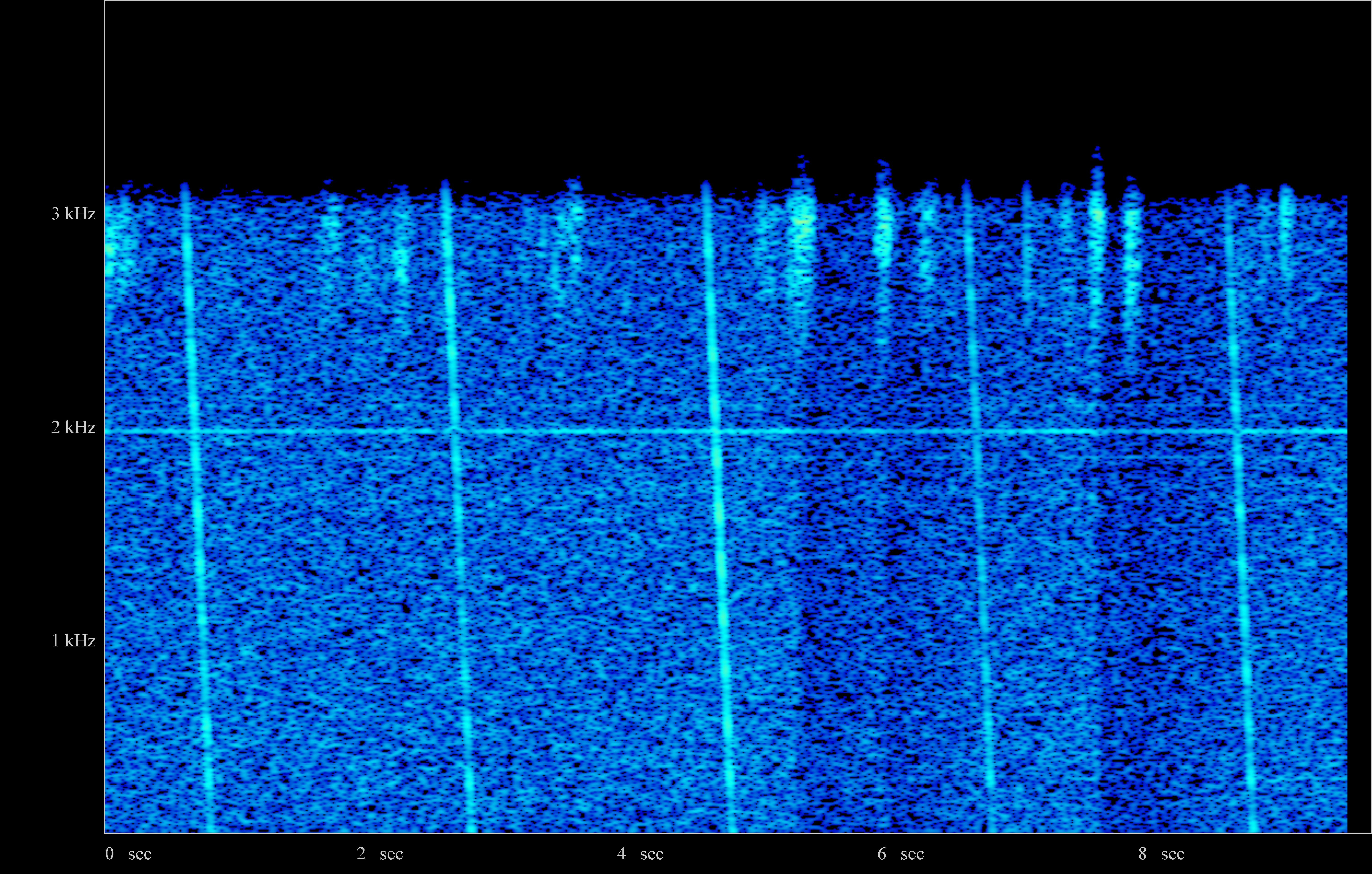
WHAT THE PULSE ACTUALLY LOOKED LIKE: "Ping" Wait 2 seconds. "Ping" Wait 2 seconds "Ping". That's what most ham radio operators heard yesterday when they received HAARP's radar transmission to asteroid 2010 XC15. Scott Tilley of Roberts Creek, British Columbia, took a closer look, and this is what he saw:

"The pulse was lopsided with a fast rise and a slow decay," notes Tilley. "I believe this is due to multipath propagation from HAARP in Alaska to my receiver in British Columbia."
Everyone who picked up the pulse did so because Earth's ionosphere reflected some of HAARP's radio energy back to Earth. Only a fraction escaped into space and reached the asteroid. Tilley's high-time-resolution recording of the pulse shows that multiple reflections (probably with a dash of ducting and refraction) were involved.
The complexity of the ionosphere, and how it modifies shortwave signals, is a key challenge for researchers who will be processing radar returns from asteroid 2010 XC15. Good luck to the radar team as we await their results!
ASTEROID RADAR SIGNAL RECEIVED BY HAMS: Yesterday, ham radio operators around the world picked up an unusual pulsing signal at 9.6 MHz. It was HAARP, pinging an asteroid. "I captured the transmission in New Mexico at 9.600 MHz and 9.585 MHz on two separate radios," reports Thomas Ashcraft. "It was pulsing every 2 seconds." Listen to Ashcraft's audio recording:
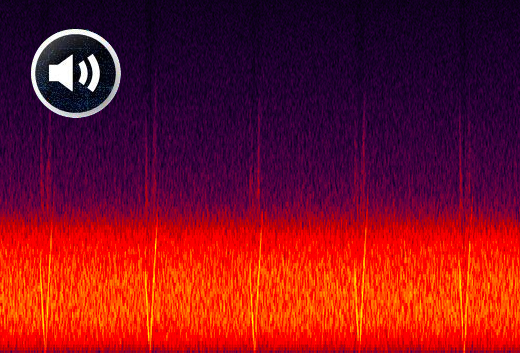
The same rhythmic pulse was heard across North America, Europe, and Australia. A selection of reports is listed below.
If the experiment worked, the pulses also reached asteroid 2010 XC15, which passed by Earth on Dec. 27th at a distance of 770,000 km. Researchers from NASA and the University of Alaska pinged 2010 XC15 with shortwave radio signals to probe the asteroid's interior--a first if it worked. We're still waiting for confirmation that the reflections were received, as expected, by antenna arrays in California and New Mexico.
Additional reports: from Marko Päätalo of Kaustinen, Finland (video); from Aub McKibben of Adelaide, Australia (audio); from Charlie Knutila/N7KN of Whidbey Island, Washington, USA (video); from Ron Masters in the midwestern USA (video); from Ed/LA5VUA of Drammen, Norway (audio); from Doug VanderClute/KB1MGL of Northfield New Hampshire, USA; (audio); from Bill Westphall/WB6YPF of Altadena, California, USA (audio);
More additional reports: from Jim Hale of central Virginia, USA (audio); from Ari Yleismies/OH3NU of Finland (audio, dynamic spectrum); from Thomas Carswell Jr/KT4WO of Whittier, NC, USA (audio); from Mark Willer of east Idaho, USA (audio); from François Théveneau of St Vincent de Tyrosse, France (audio, dynamic spectrum); from Dennis Williams/N0MND of Rapid City, South Dakota, USA (audio);

Realtime Space Weather Photo Gallery
Free: Spaceweather.com Newsletter
THE LIGHT CURVE OF COMET ZTF: Soon, Comet ZTF (C/2022 E3) may be visible to the naked eye. Bum-Suk Yeom of Iksan, South Korea, created this light curve showing how the comet's brightness is rapidly increasing:
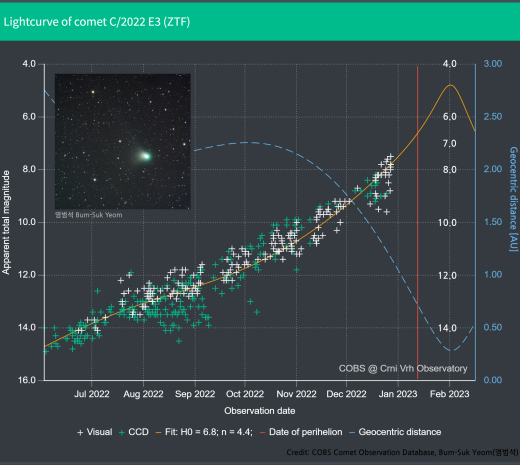
The comet is brightening because it is approaching Earth. Closest approach: 0.28 AU on Feb. 1, 2023. By that time, it will glow like a 5th magnitude star, a naked-eye smudge from dark-sky sites.
The comet is already an easy target for backyard telescopes. Yeom's own photo of the comet is inset in the plot, above. He took it using a 3.5-inch refracting telescope. Currently, the comet is glowing like an 8th magnitude star in the constellation Corona Borealis. Point your optics here.
more images: from Chris Schur of Payson, Arizona; from the Sormano Astronomical Observatory in Italy; from Gregg Ruppel of Animas, New Mexico; from Dalibor Hanžl of Pavlovice, Czech Republic; from Jan Curtis of Oracle, Arizona; from Nello Ruocco of Sorrento, Italy;
THE NORTHERN LIGHTS PENDANT: Are you looking for a far-out gift? Consider this: The Northern Lights Pendant. Here it is, hitching a ride to the stratosphere onboard an Earth to Sky Calculus cosmic ray balloon:
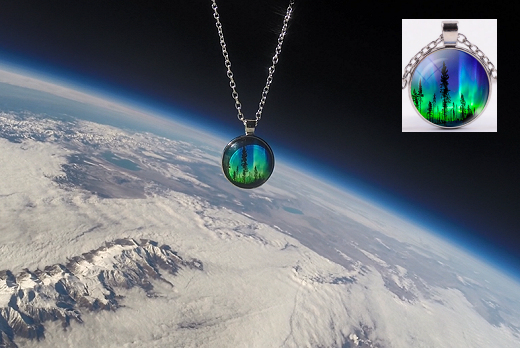
You can have it for $129.95. The students are selling these pendants to support their cosmic ray ballooning program. Each one comes with a greeting card showing the pendant in flight and telling the story of its journey to the edge of space. It makes an out-of-this-world birthday, anniversary, or Mother's Day gift!
Far Out Gifts: Earth to Sky Store
All sales support hands-on STEM education
Realtime Aurora Photo Gallery
Free: Spaceweather.com Newsletter