MINOR GEOMAGNETIC STORMS UNDERWAY: Minor G1-class geomagnetic storms are underway on Dec. 30th following the impact of a CIR (co-rotating interaction region). CIRs are transition zones between slow- and fast-moving streams of solar wind. They contain shock waves and enhanced magnetic fields that often do a good job sparking high-latitude auroras. Aurora alerts: SMS Text.

COSMIC RAYS SINK TO A 6-YEAR LOW: Cosmic rays reaching Earth just hit a six-year low. Neutron counters in Oulu, Finland, registered the sudden decrease on Dec. 26th when a coronal mass ejection (CME) hit Earth's magnetic field:
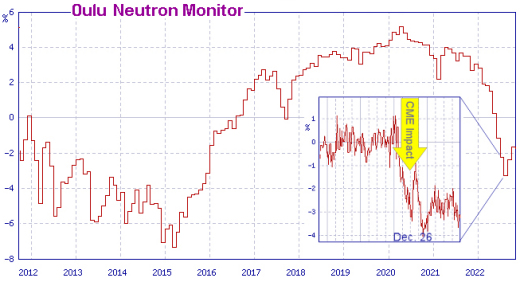
The CME swept aside galactic cosmic rays near our planet, abruptly reducing radiation levels. Researchers call this a "Forbush Decrease," after American physicist Scott Forbush, who studied cosmic rays in the early 20th century.
The Dec. 26th event continues a trend that began in 2020. Since then, cosmic ray fluxes have been fitfully decreasing as one CME after another hit Earth. The reason is Solar Cycle 25, which began around that time and has been gaining strength. The Forbush Decreases are adding up.
Scott Forbush was the first to notice the yin-yang relationship between solar activity and cosmic rays. When one goes up, the other goes down. CMEs play a big role in this relationship. The solar storm clouds contain tangled magnetic fields that do a good job scattering cosmic rays away from our planet.
A recent paper in the Astrophysical Journal looked at the last two solar cycles and compared the daily rate of CMEs to the strength of cosmic rays near Earth. This plot shows the results:

At the peak of Solar Cycle 24, the sun was producing more than 5 CMEs per day. At the same time, galactic cosmic rays (GCRs) dropped more than 60%.
Neutron counts are now at their lowest level since 2016. If current trends continue, cosmic ray levels will plunge even further in the years ahead, perhaps even lower than Solar Cycle 24. This is good news for astronauts and polar air travelers who will benefit from less radiation.
FAQ: Why neutrons? When cosmic rays strike Earth’s atmosphere, they produce a spray of secondary particles that rain down on Earth. Among these particles are neutrons, which can make it all the way down to Earth's surface. Researchers at the Sodankyla Geophysical Observatory in Oulu, Finland, have been counting neutrons every day since 1964, providing an unparalleled record of cosmic rays for almost 60 years.
Realtime Space Weather Photo Gallery
Free: Spaceweather.com Newsletter
COSMIC RAY YIN-YANG PENDANT: To celebrate the yin-yang relationship between solar activity and galactic cosmic rays, the students of Earth to Sky Calculus launched a yin-yang pendant to the stratosphere. Here it is, flying 104,265 ft high onboard a cosmic ray research balloon:
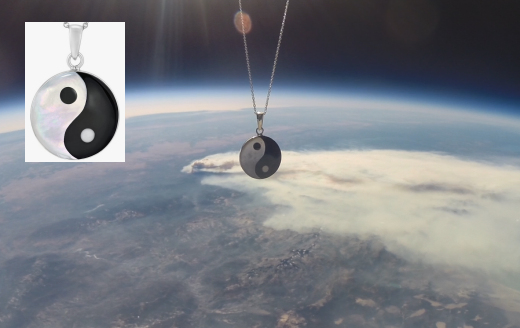
You can have it for $142.95. The pendant's sterling silver frame surrounds balancing swirls of black onyx and mother of pearl--all suspended from a matching 18-inch sterling silver chain. It makes a great anniversary, birthday or belated Christmas gift.
The students are selling yin-yang pendants to support their cosmic ray ballooning program. Each one comes with a greeting card showing the pendant in flight and telling the story of its journey to the edge of space and back again.
Far Out Gifts: Earth to Sky Store
All sales support hands-on STEM education
LUNAR OCCULTATION OF MARS: Mark your calendar. On Jan. 30-31, 2023, the Moon will pass directly in front of Mars, producing an occultation visible across southern US states, all of Mexico and Central America.
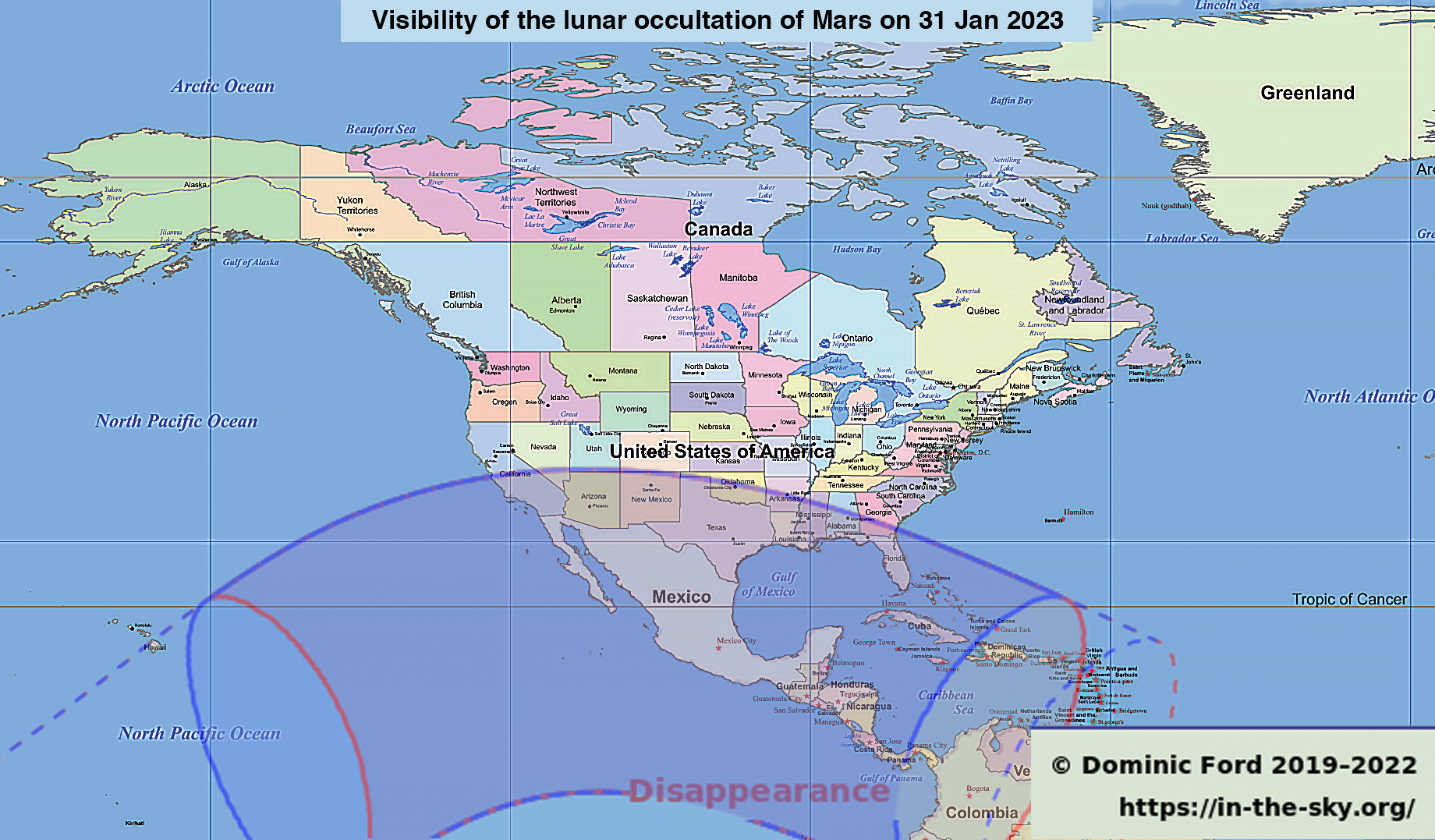
At the time of the occultation, the gibbous Moon will be 74% illuminated. Mars will disappear behind the unilluminated side of the Moon and reappear from behind the illuminated side. Because Mars is so bright, it can be seen even near the bright edge of the Moon. Photo-op!
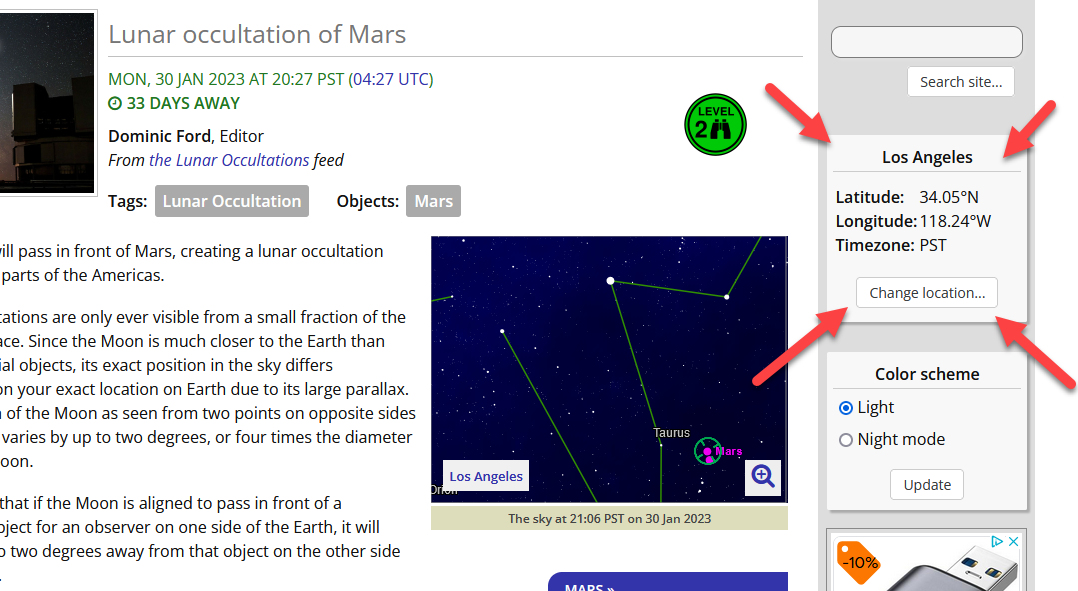
In Los Angeles, Mars will disappear at 20:36 PST and reappear at 21:30 PST on Jan. 30th. To find your local times, visit in-the-sky.org and set the location to your home town.
Realtime Space Weather Photo Gallery
Free: Spaceweather.com Newsletter
Realtime Aurora Photo Gallery
Free: Spaceweather.com Newsletter