GEOMAGNETIC STORM WATCH: Minor G1-class geomagnetic storms are possible on Jan. 4th when a slow-moving CME is expected to hit Earth's magnetic field. It was hurled in our direction by an M3.7-class solar flare (movie) in the magnetic canopy of sunspot AR3176 on Dec. 30th. Aurora alerts: SMS Text.

NEW YEAR'S COMET: Astronomically speaking, 2023 begins with a comet. Bill Williams photographed it from the Chiefland Astro Village in Florida:

"What better way to ring in 2023 than with an enchanting New Year's Comet?" asks WIlliams. "Comet ZTF is approaching Earth, and it looks great through my 14.5 inch telescope."
Discovered in March 2022 by the Zwicky Transient Facility, Comet ZTF is falling in from the outer solar system. Perihelion (closest approach to the sun) will occur on Jan. 12, 2023, at a distance of 1.11 AU. Closest approach to Earth follows on Feb. 1, 2023, at a distance of 0.28 AU. Between those two dates, the comet could hit magnitude 5 or 6, technically visible to the unaided eye.
The comet is currently shining like an 8th magnitude in the constellation Corona Borealis. It's already an easy target for mid-sized backyard telescopes, and it will only get easier as 2023 unfolds. Point your optics here.
Realtime Space Weather Photo Gallery
Free: Spaceweather.com Newsletter
GIANT PLASMA BUBBLE: The sun just blew a bubble--a really big one. It billowed away from the sun's southwestern limb on New Year's Eve:

Australia's Learmonth Solar Observatory recorded the eruption, probably caused by magnetic instabilities in an unseen farside sunspot. The eruption inflated a dome of plasma more than 400,000 km in diameter. It quickly popped, but the debris will not hit Earth because of the bubble's farside center. Maybe next time.
Realtime Aurora Photo Gallery
Free: Spaceweather.com Newsletter
A BLACK PEARL IN THE STRATOSPHERE: It came from Tahiti--and now it's been to the edge of space. This genuine Black Tahitian South Sea Cultured Pearl flew to the stratosphere onboard an Earth to Sky Calculus cosmic ray balloon, soaring more than 100,000 feet above the Sierra Nevada mountains of central California:
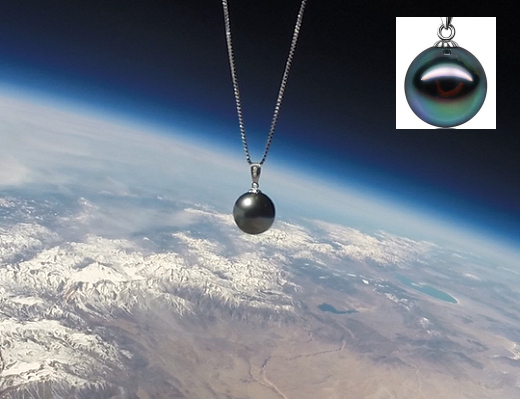
You can have it for $229.95. The students are selling exotic space pearls to fund their cosmic ray monitoring program. Measuring 10 mm in diameter, the pearl has an 18K white gold clasp and is suspended from a matching 925 Sterling Silver chain. Each pearl comes with a greeting card showing the pendant in flight and telling the story of its journey to the edge of space.
Far Out Gifts: Earth to Sky Store
All sales support hands-on STEM education
Realtime Aurora Photo Gallery
Free: Spaceweather.com Newsletter