GEOMAGNETIC STORM WATCH: Minor G1-class geomagnetic storms are possible on Jan. 5th as Earth passes through the wake of a CME that struck our planet yesterday. Arctic sky watchers should remain alert for auroras. Aurora alerts: SMS Text.

FARSIDE SUNSPOT EMERGES: As expected, a large sunspot and complex sunspot group is emerging over the sun's southeastern limb. Current images from NASA's Solar Dynamics Observatory reveal a primary dark core approximately 3 times wider than Earth:
crop.jpg)
This is the same sunspot group that produced a significant farside explosion on Jan. 3rd. No one knows exactly how intense that explosion was, but circumstantial evidence suggests it was X-class.
Now that the active region is turning toward Earth, our planet could be in the line of fire for the next blast--*if* there is a next blast. Solar Cycle 25 is notorious for producing active regions that explode on the farside, then quiet down when they turn to face Earth. Time will tell if a geoeffective flare is in the offing.
Meanwhile, amateur astronomers are targeting the behemoth using backyard solar telescopes. Philippe Tosi sends this picture from Nîmes, France:

Tosi used an H-alpha filter tuned to the red glow of solar hydrogen. It reveals considerable turmoil surrounding the sunspot's primary core. Monitoring is encouraged .Solar flare alerts: SMS Text.
Realtime Space Weather Photo Gallery
Free: Spaceweather.com Newsletter
COMET ZTF UPDATE: One week from today, Jan. 12th, Comet ZTF (C/2022 E3) makes its closest approach to the sun (1.11 AU). Puffed up with solar heat, it will then head toward Earth for an even closer encounter (0.28 AU) on Feb. 1st. Here's what it looks like right now, photographed by Michael Jaeger of Jauerling, Austria:

The comet has a bright green atmosphere, a fan-shaped tail of dust, and a gaseous blue streamer sculpted by solar wind into a narrow plume more than 3 degrees long. Experienced observers say it is about as bright as a 7th magnitude star--invisible to the naked eye, but an easy target for backyard telescopes.
To find Comet ZTF, wake up before sunrise and look east for the constellation Corona Borealis. It's right there.
Realtime Comet Photo Gallery
Free: Spaceweather.com Newsletter
A BLACK PEARL IN THE STRATOSPHERE: It came from Tahiti--and now it's been to the edge of space. This genuine Black Tahitian South Sea Cultured Pearl flew to the stratosphere onboard an Earth to Sky Calculus cosmic ray balloon, soaring more than 100,000 feet above the Sierra Nevada mountains of central California:
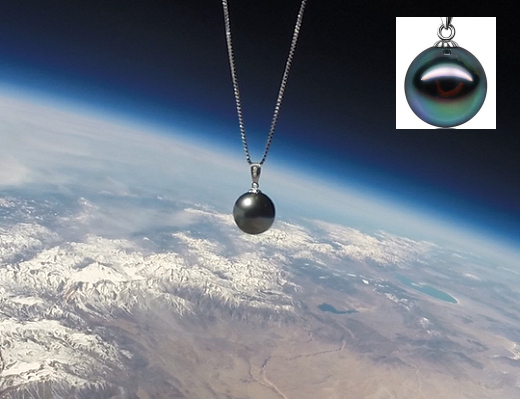
You can have it for $229.95. The students are selling exotic space pearls to fund their cosmic ray monitoring program. Measuring 10 mm in diameter, the pearl has an 18K white gold clasp and is suspended from a matching 925 Sterling Silver chain. Each pearl comes with a greeting card showing the pendant in flight and telling the story of its journey to the edge of space.
Far Out Gifts: Earth to Sky Store
All sales support hands-on STEM education
Realtime Aurora Photo Gallery
Free: Spaceweather.com Newsletter