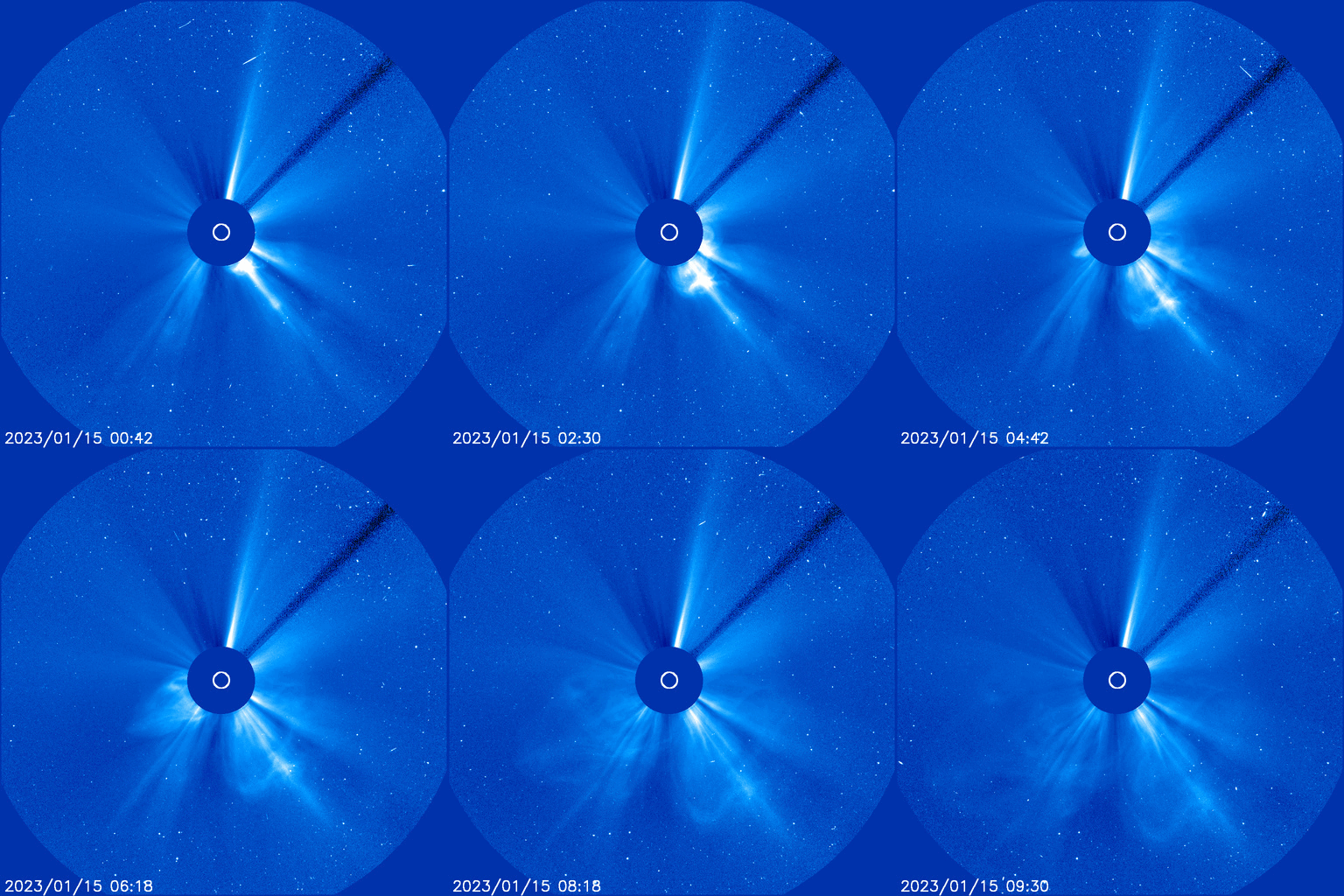
POSSIBLE CME IMPACT: Arriving earlier than expected, a CME appears to have struck Earth's magnetic field on Jan. 17th around 2200 UT. Its arrival was signaled by an abrupt shift in the interplanetary magnetic field (IMF) near Earth. South-pointing IMF has lowered our planet's defenses against the solar wind and could spark a G1-class geomagnetic storm in the hours ahead. Aurora alerts: SMS Text.

NAKED-EYE SUNSPOT: One of the biggest sunspots in years (AR3190) is crossing the solar disk--and you can see it with the naked eye. "Be sure to use safe solar glasses to protect your eyes," says Bum-Suk Yeom of Iksan, South Korea. "I tried it myself today, and I could see the sunspot clearly."
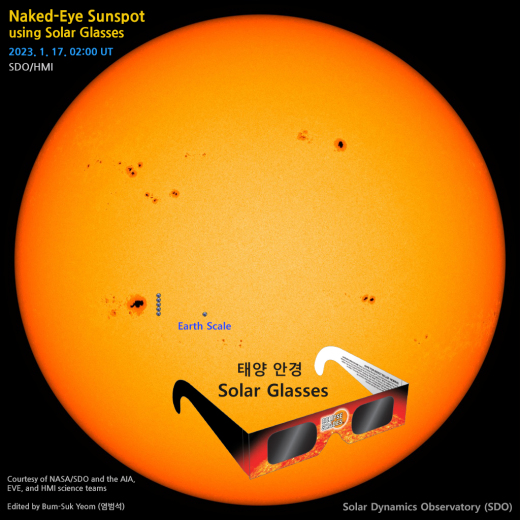
As shown in Yeom's infographic, the sunspot is four times wider than Earth. It's twice as big as any other spot on the sun, visible to the naked eye, and a magnificent target for backyard solar telescopes.
Best of all, it's about to explode. AR3190 has an unstable 'beta-gamma-delta' magnetic field that harbors energy for X-class solar flares. Any eruptuions will be geoeffective because the sunspot is almost directly facing Earth. Solar flare alerts: SMS Text.
more images: from Benji Barnes of Honolulu Hawai’i; from Mike Borman of Evansville, Indiana; from Pepe Manteca of Begues, Catalunya, Spain; from Eduardo Schaberger Poupeau of Rafaela, Santa Fe, Argentina; from Sylvain Weiller of Jerusalem, Israel
Realtime Space Weather Photo Gallery
Free: Spaceweather.com Newsletter
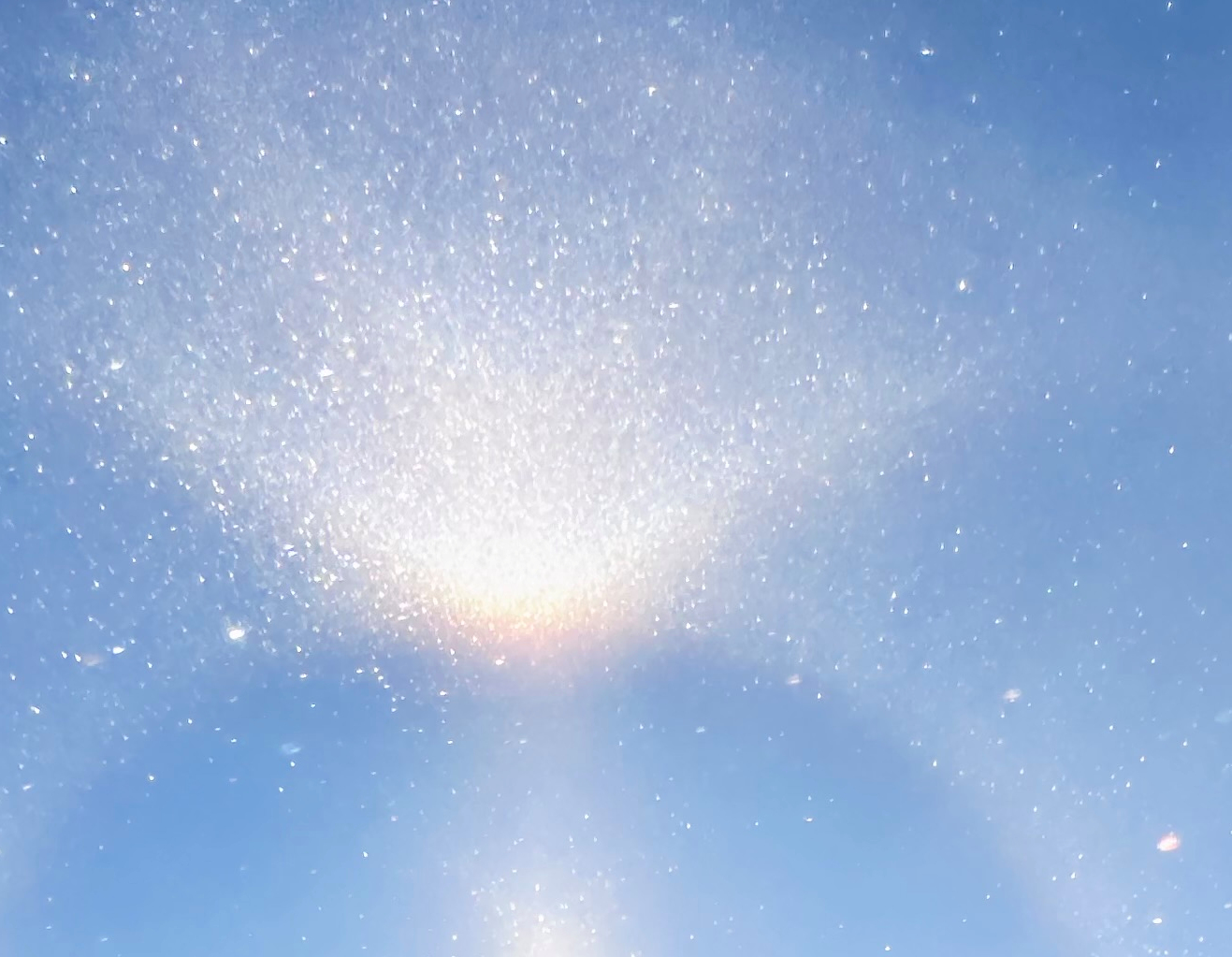
DIAMOND DUST SKI HALO: Ski resorts are great places to see sun halos--rings of light that surround the sun when ice crystals fill the air. Spaceweather.com reader Christian Schartner was skiing at Reiteralm ski resort in Austria this morning when he witnessed this specimen:

"Winter has finally returned to Austria," says Schartner. "Today, I skied at -10°C. Several nearby snow cannons created sparkling crystals, creating the perfect conditions for 'ski halos.'"
Snow cannons were key to this display. Ordinary sun halos are caused by ice crystals forming naturally in high cirrus clouds. Snow making machines create a spcial type of crystal called "diamond dust." These man-made crystals tend to be more optically perfect than natural crystals in clouds, producing extra-bright, extra-sharp halos.
A close look at Schartner's picture shows specks of light in the air. Those are the glittering crystals of diamond dust which make ski halos so beautiful.
Realtime Space Weather Photo Gallery
Free: Spaceweather.com Newsletter
VALENTINE'S CRYSTAL BEAR AND ROSE: Valentine's Day is coming. Looking for a far-out gift? This Crystal Bear and Rose flew to the stratosphere onboard a cosmic ray research balloon on Dec. 17th:
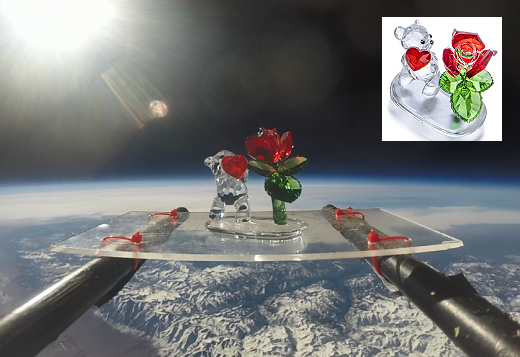
You can have it for $129.95. The students of Earth to Sky Calculus are selling space bears to support their high-altitude ballooning program. Each one comes with a greeting card showing the ursine astronaut in flight and telling the story of its journey to the edge of space and back again.
Far Out Gifts: Earth to Sky Store
All sales support hands-on STEM education
Realtime Aurora Photo Gallery
Free: Spaceweather.com Newsletter