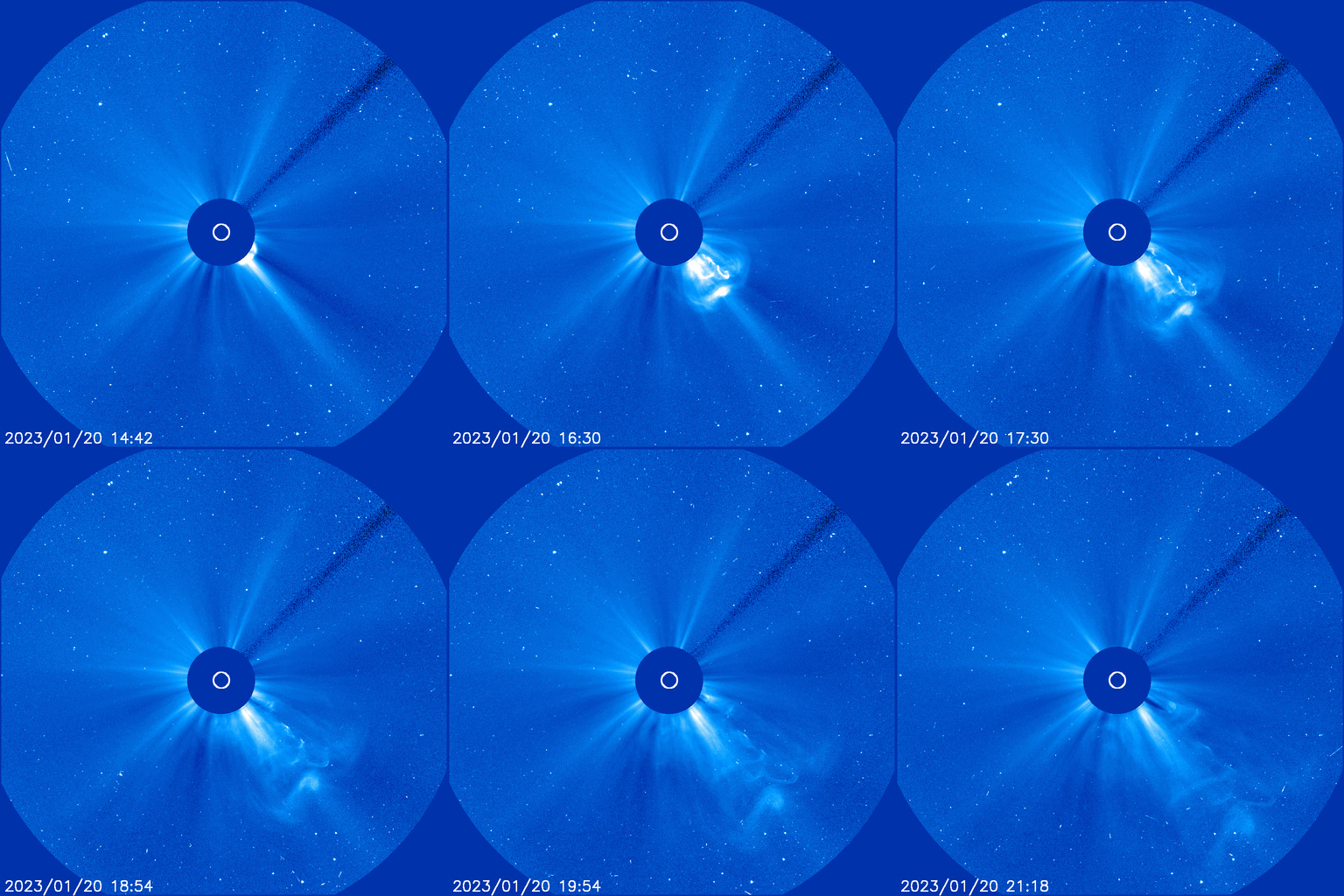
POSSIBLE CME IMPACT NEXT WEEK: A CME (movie) that left the sun yesterday could pass near Earth on Jan.24-25, possibly delivering a glancing blow to our planet's magnetic field. It was hurled into space by the eruption of a magnetic filament in the sun's southern hemisphere, and could spark minor G1-class geomagnetic storms when it arrives. Aurora alerts: SMS Text.

'NIGHT SPIRAL' OVER HAWAII: On Wednesday night, Jan. 18th, a luminous spiral spun across the night sky. It was photographed by the "Subaru-Asahi Star Camera" on Mauna Kea:
It looks like a giant galaxy. In fact, it came from SpaceX. Earlier the same day, a Falcon 9 rocket launched from Cape Canaveral carrying a US Space Force GPS satellite (GPS 3 SV-06). The spiral was the aftermath.
"Space X spirals" are becoming commonplace over the Pacific where Falcon 9 rocket stages are often deorbitted. They are created by plumes of unused fuel venting from the rocket's spinning second stage before they plunge into the ocean.
Realtime Space Weather Photo Gallery
Free: Spaceweather.com Newsletter
SUNSPOT SUNRISE: Giant sunspot AR3190 continues to attract attention. Astronomer Paul D. Maley saw it at sunrise this morning in Carefree, Arizona:
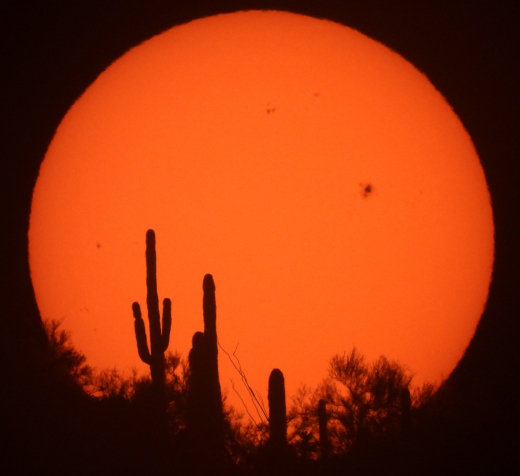
"This super impressive sunspot could be seen rising against a background of saguaro cactus, ocotillo and palo verde trees on Black Mountain this morning," says Maley.
AR3190 is one of the largest sunspots of surging Solar Cycle 25. It is almost five times the diameter of Earth, a dimension that makes it an easy target for amateur astronomers. You don't even need a solar telescope. Eclipse glasses work, too. You might have some old ones left over from 2017; if not, here's where you can get a new pair.
Be careful! Sunrise photos like Maley's are possible for novice photographers, but be careful. Even when the sun is dimmed by low clouds or haze, looking directly through the camera can damage your eyes. Always use the LCD screen for viewfinding.
more images: from Philippe Tosi of Nîmes, France; from Honor Wheeler of Kent, UK; from Adrian Ross of Canberra, Australia
Realtime Space Weather Photo Gallery
Free: Spaceweather.com Newsletter
VALENTINE'S CRYSTAL BEAR AND ROSE: Valentine's Day is coming. Looking for a far-out gift? This Crystal Bear and Rose flew to the stratosphere onboard a cosmic ray research balloon on Dec. 17th:
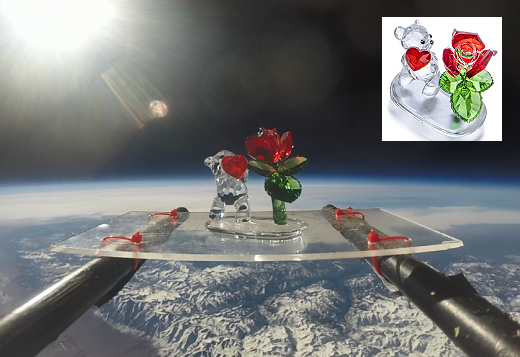
You can have it for $129.95. The students of Earth to Sky Calculus are selling space bears to support their high-altitude ballooning program. Each one comes with a greeting card showing the ursine astronaut in flight and telling the story of its journey to the edge of space and back again.
Far Out Gifts: Earth to Sky Store
All sales support hands-on STEM education
Realtime Aurora Photo Gallery
Free: Spaceweather.com Newsletter