EXTREMELY CLOSE ASTEROID FLYBY: There's no danger of a collision, but... Newly-discovered asteroid 2023 BU will make an extremely close approach to Earth this Thursday. On Jan 26th at 21:17 UTC (16:17 EST), the 5-meter-wide space rock will be just 3500 km above South America, well within our planet's belt of geosynchronous satellites. Europe's Virtual Telescope Project will live stream the flyby.
THE ANTI-TAIL OF COMET ZTF: Comet tails are supposed to point away from the sun. Last night, Comet ZTF (C/2022 E3) sprung a tail in the opposite direction--an anti-tail. It's the narrow spike pointing out of the comet's head in this picture taken by Italian amateur astronomer Graziano Ventre:
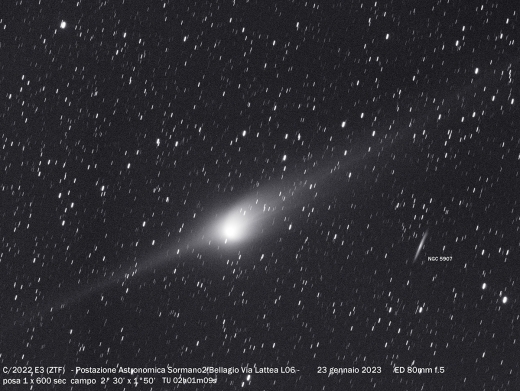
What happened? Actually, nothing. Anti-tails are an optical illusion. They appear when Earth passes through a comet's orbital plane, which, for Comet ZTF, happened last night. At the moment of crossing, the sharp edge of the comet's fan-shaped dust tail appears to point toward the sun. It really doesn't.
Comet ZTF will continue to look a little unusual for days as the orbital plane geometry slowly returns to normal. Astrophotographers, point your optics here.
more images: from Jose Carrillo Gomez of Andalucia España; from Michel Saint-Laurent of Québec, Canada; from Göran Strand of Östersund, Sweden; from Thomas Eby of Red Rock, Arizona; from Ruslan Merzlyakov at National Park Thy, Denmark;
Realtime Space Weather Photo Gallery
Free: Spaceweather.com Newsletter
POLAR STRATOSPHERIC CLOUDS: The most beautiful clouds on Earth just made an appearance over Norway. "I've been on the lookout for polar stratospheric clouds (PSCs) all winter," reports Fredrik Broms from Kvaløya. "This morning, I caught a split-second glimpse of some really colourful PSCs, and within an hour another gap in the storm clouds revealed a bigger display."
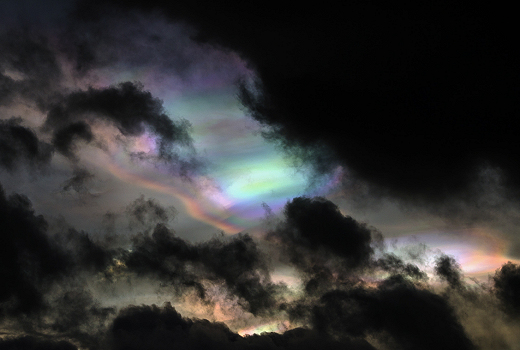
"Some of the clouds were very colourful, including an absolutely stunning greenish cloud surrounded by purple," says Broms.
Polar stratospheric clouds are very rare. Normally the stratosphere has no clouds at all. PSCs form when the temperature in the Arctic stratosphere drops to a staggeringly-low -85 C. Then, and only then, can widely-spaced water molecules begin to coalesce into tiny ice crystals -- the "stuff" of PSCs. High-altitude sunlight shining through the crystals creates iridescent colors more intense and pure than any other cloud on Earth.
In a typical Arctic winter, PSCs appear two or three times at most. If you see one, it's definitely worth taking a picture and submitting it here.
Realtime PSC Photo Gallery
Free: Spaceweather.com Newsletter
VALENTINE'S CRYSTAL BEAR AND ROSE: Valentine's Day is coming. Looking for a far-out gift? This Crystal Bear and Rose flew to the stratosphere onboard a cosmic ray research balloon on Dec. 17th:
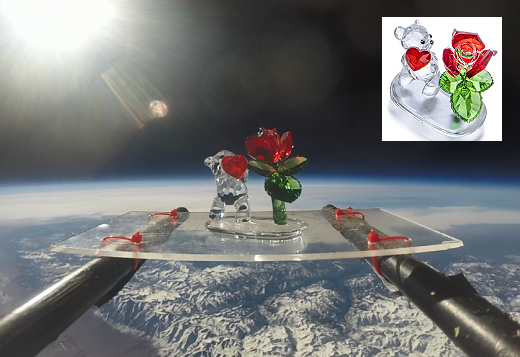
You can have it for $129.95. The students of Earth to Sky Calculus are selling space bears to support their high-altitude ballooning program. Each one comes with a greeting card showing the ursine astronaut in flight and telling the story of its journey to the edge of space and back again.
Far Out Gifts: Earth to Sky Store
All sales support hands-on STEM education
Realtime Aurora Photo Gallery
Free: Spaceweather.com Newsletter