EXTREMELY CLOSE ASTEROID FLYBY: There's no danger of a collision, but... Newly-discovered asteroid 2023 BU will make an extremely close approach to Earth this Thursday. On Jan 26th at 21:17 UTC (16:17 EST), the 5-meter-wide space rock will be just 3500 km above South America, well within our planet's belt of geosynchronous satellites. Europe's Virtual Telescope Project will live stream the flyby.
POLAR STRATOSPHERIC CLOUDS: Arctic skies are filling with color today--but it's not the aurora borealis. A rare outbreak of polar stratospheric clouds (PSCs) is underway. Jónína Óskarsdóttir photographed the display from Fáskrúðsfjörður, Iceland:

"We have been seeing these clouds for a couple of days," reports Óskarsdóttir. "In this picture, Mt. Jökultindur is silhouetted by a sky-full of nacreous color."
Polar stratospheric clouds are rare. Earth's stratosphere is very dry and normally it has no clouds at all. PSCs form when the temperature in the Arctic stratosphere drops to a staggeringly-low -85 C. Then, and only then, can widely-spaced water molecules begin to coalesce into tiny ice crystals. High-altitude sunlight shining through the crystals creates intense iridescent colors often likened to auroras.
NASA models of the polar stratosphere show that temperatures have indeed dropped into the very low range required for Type II PSCs:
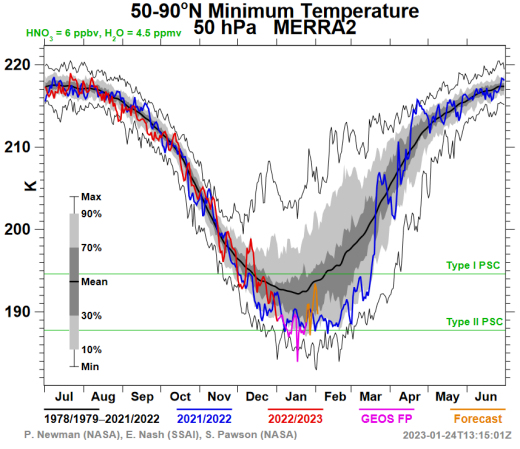
However, the forecast (yellow) calls for warming as January comes to an end, so now is the time to look. During a typical Arctic winter, PSCs appear no more than two or three times. If you see one, it's definitely worth taking a picture.
more images: from Fredrik Broms of Kvaløya, Norway; from Jónína Óskarsdóttir of Fáskrúðsfjörður, Iceland; from Francois Guilhaume-Bohl of Nellim, Finland
Realtime PSC Photo Gallery
Free: Spaceweather.com Newsletter
A BIG UNSTABLE SUNSPOT: Giant sunspot AR3190 is turning away from Earth. It's still dangerous. The reason why is shown in this magnetic map from NASA's Solar Dynamics Observatory:
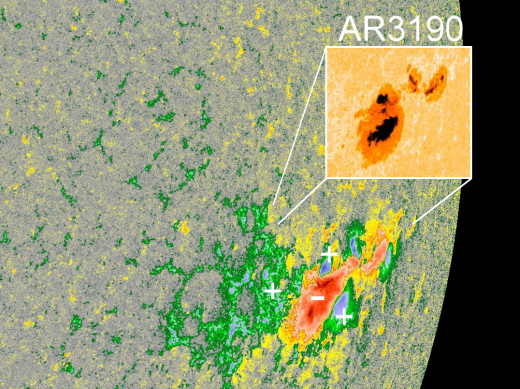
The sunspot's primary dark core is actually a huge pole of negative (-) magnetism closely surrounded by multiple islands of positive (+) polarity. This is exactly how solar flares get started. When + and - bump together in close proximity, magnetic reconnection can cause tremendous explosions. AR3190 poses a threat for X-class solar flares.
Even though AR3190 is not facing Earth, the broad spray of any X-flare will still illuminate our planet with X-rays and extreme UV radiation. Radio blackouts and other effects remain possible as long as we can see the departing sunspot.
Realtime Space Weather Photo Gallery
Free: Spaceweather.com Newsletter
PREMIUM VALENTINE'S PENDANT: Are you looking for an unforgettable Valentine's Day gift? Consider the Always and Forever Space Pendent. The students of Earth to Sky Calculus launched it to the stratosphere onboard a cosmic ray research balloon:
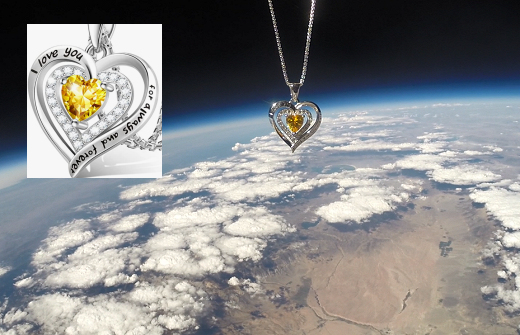
You can have it for $199.95. Engraved with the words "I love you always and forever", this 18K gold-plated pendant has a heart-shaped citrine crystal in the middle surrouunded by a ring of glittering 5A cubic zirconia nuggets. It is a visually striking premium pendant that makes a once-in-a-lifetime Valentine's, anniversary or birthday gift.
The students are selling space pendants to pay the helium bill for their cosmic ray ballooning program. Each one comes with a greeting card showing the jewelry in flight and telling the story of its trip to the stratosphere and back again.
Far Out Gifts: Earth to Sky Store
All sales support hands-on STEM education
Realtime Aurora Photo Gallery
Free: Spaceweather.com Newsletter