EXTREMELY CLOSE ASTEROID FLYBY: There's no danger of a collision, but... Newly-discovered asteroid 2023 BU will make an extremely close approach to Earth this Thursday. On Jan 26th at 21:17 UTC (16:17 EST), the 5-meter-wide space rock will be just 3500 km above South America, well within our planet's belt of geosynchronous satellites. Europe's Virtual Telescope Project will live stream the flyby.
THE COMET REPORT: Comet ZTF (C/2022 E3) is approaching Earth for a close encounter (0.28 AU) on Feb. 1st. "The comet is just visible to the naked eye--if you know where to look," reports Alan Dyer of Gleichen, Alberta. He photographed it last night about midway between the Big and Little Dippers:
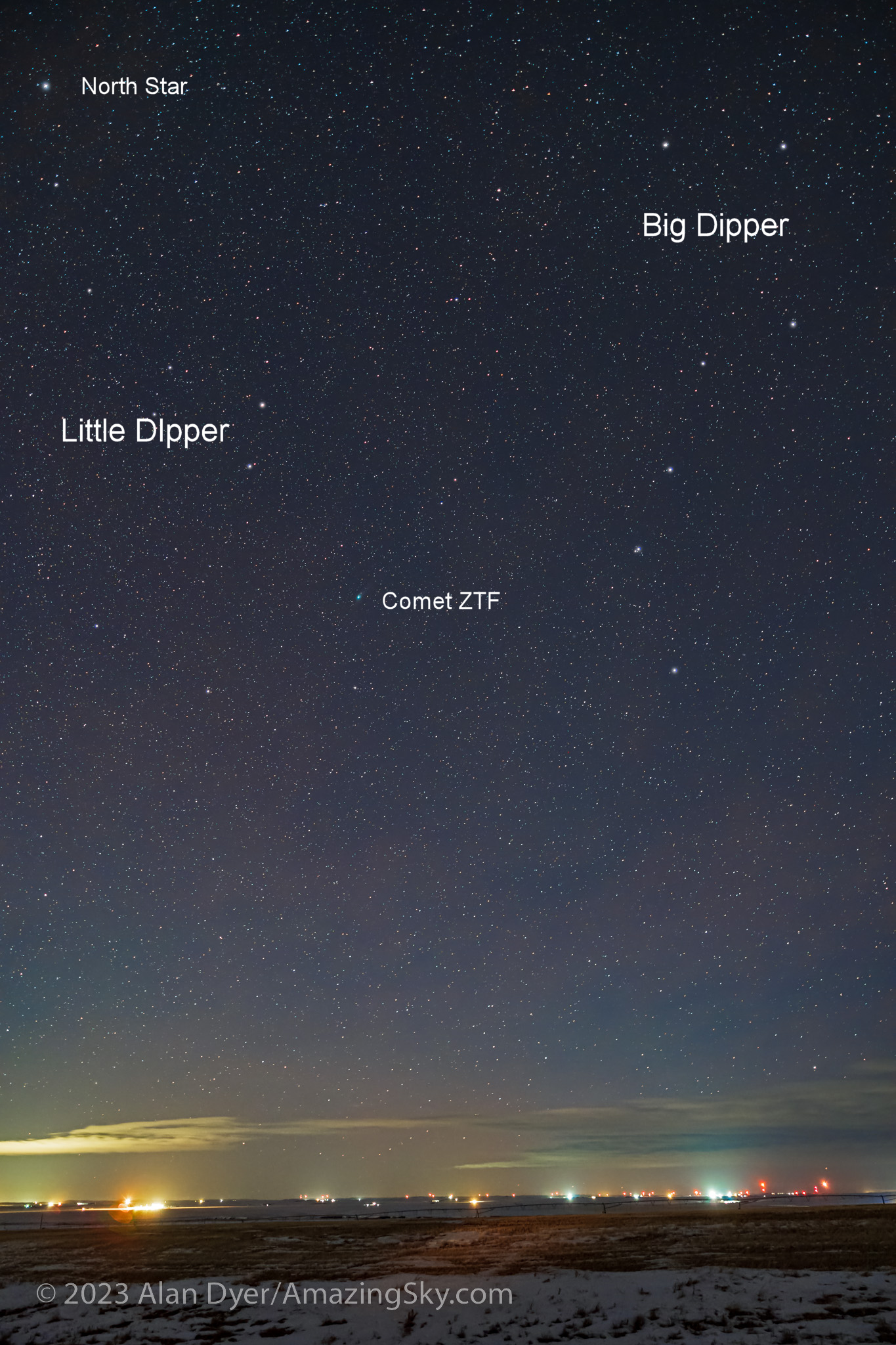
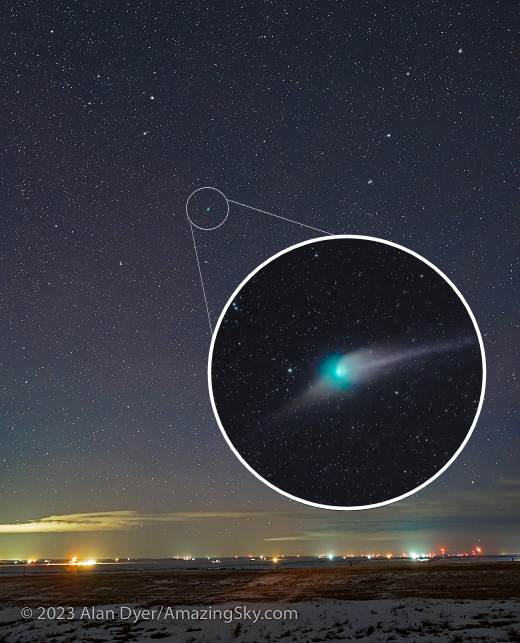
"The dust tail, anti-tail and long ion tail were visible to the camera, but in binoculars only a short stubby dust tail was obvious," Dyer says. "Otherwise, the comet looked like a large fuzzy glow in binoculars."
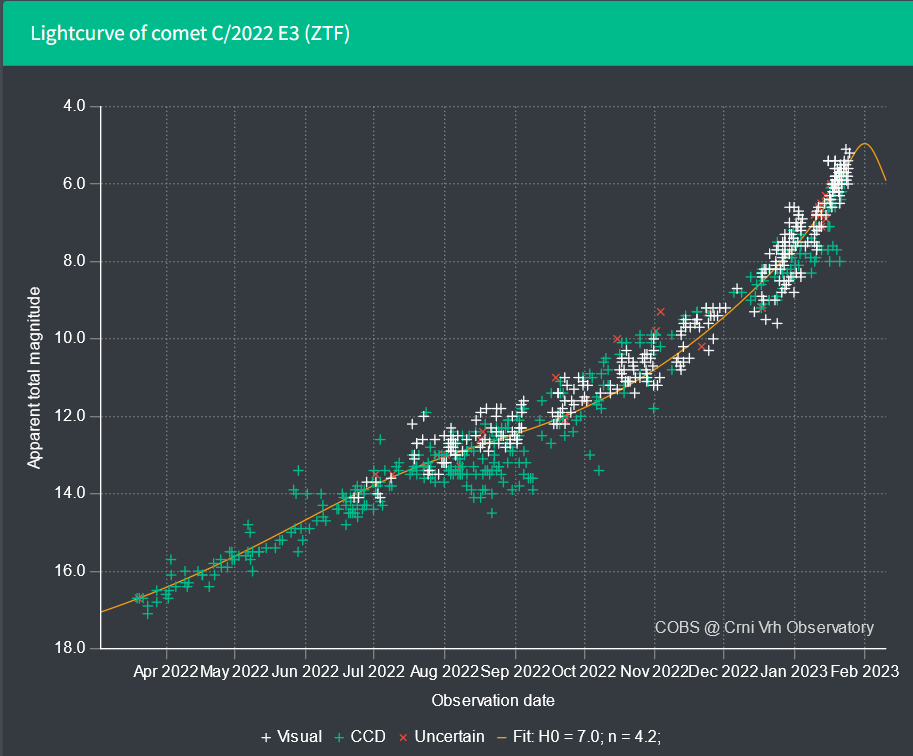
Jan Curtis of Oracle, Arizona, also photographed the comet last night. "I saw it under near-perfect skies," he says. "The comet is now moving 9.8 arcmin/hour (the Moon's diameter in just 3 hours). I'd estimate the comet's brightness at +5.3 with the gaseous ion tail extending more than 5 degrees."
The comet's motion across the sky will accelerate as it approaches Earth, making it harder to track but easier to see. If current trends continue, the comet's brightness will peak on Feb. 1-2 around magnitude +5, an easy target for backyard astrophotographers. Look for it in the constellation Draco.
Realtime Comet ZTF Photo Gallery
Free: Spaceweather.com Newsletter
POLAR STRATOSPHERIC CLOUDS: Arctic skies are filling with color today--but it's not the aurora borealis. A rare outbreak of polar stratospheric clouds (PSCs) is underway. Jónína Óskarsdóttir photographed the display from Fáskrúðsfjörður, Iceland:
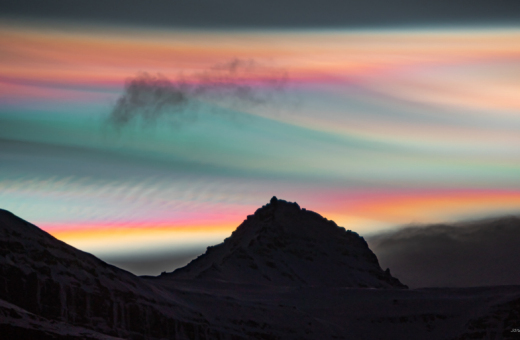
"We have been seeing these clouds for a couple of days," reports Óskarsdóttir. "In this picture, Mt. Jökultindur is silhouetted by a sky-full of nacreous color."
Polar stratospheric clouds are rare. Earth's stratosphere is very dry and normally it has no clouds at all. PSCs form when the temperature in the Arctic stratosphere drops to a staggeringly-low -85 C. Then, and only then, can widely-spaced water molecules begin to coalesce into tiny ice crystals. High-altitude sunlight shining through the crystals creates intense iridescent colors often likened to auroras.
NASA models of the polar stratosphere show that temperatures have indeed dropped into the very low range required for Type II PSCs:
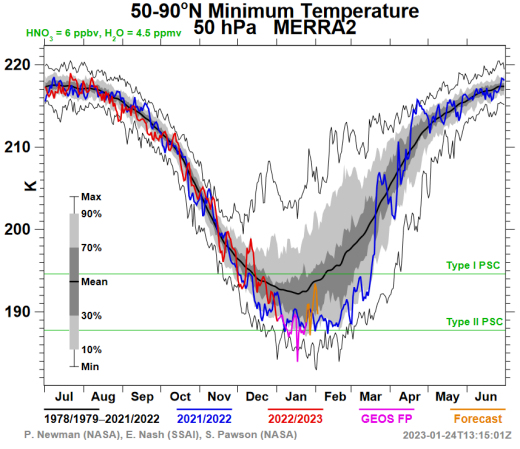
However, the forecast (yellow) calls for warming as January comes to an end, so now is the time to look. During a typical Arctic winter, PSCs appear no more than two or three times. If you see one, it's definitely worth taking a picture.
more images: from Fredrik Broms of Kvaløya, Norway; from Jónína Óskarsdóttir of Fáskrúðsfjörður, Iceland; from Francois Guilhaume-Bohl of Nellim, Finland
Realtime PSC Photo Gallery
Free: Spaceweather.com Newsletter
ROCKET LAB LAUNCH: Last night, small-satellite specialist Rocket Lab launched its Electron rocket for the first time from Wallops Island, Virginia. Mike Carroll was walking along the beach in Highlands, New Jersey, when he saw it fly by:
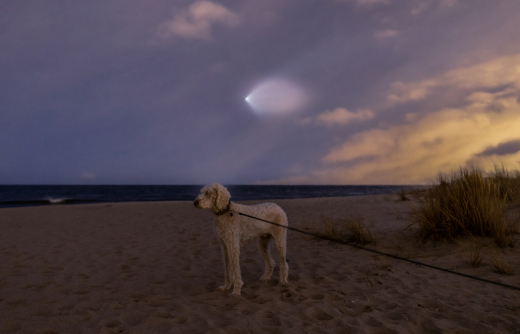
"It was great that my buddy Erik had his dog with him, and he posed for the photo," says Carroll.
Rocket Lab is a private company launching small satellites to Earth orbit; typical payloads weigh less than 1000 lb. Founded in Auckland in 2006 by New Zealander Peter Beck, the company established a second headquarters in Huntington Beach, California, in 2013. Rocket Lab has launched many rockets from New Zealand; last night was its first from the United States.
One of the most successful space start-ups since SpaceX, Rocket Lab hopes to sharply increase its launch rate from USA. Last night's successful launch of 3 small communication satellites from NASA's Flight Facility on Wallops Island is a good start.
Realtime Space Weather Photo Gallery
Free: Spaceweather.com Newsletter
PREMIUM VALENTINE'S PENDANT: Are you looking for an unforgettable Valentine's Day gift? Consider the Always and Forever Space Pendent. The students of Earth to Sky Calculus launched it to the stratosphere onboard a cosmic ray research balloon:
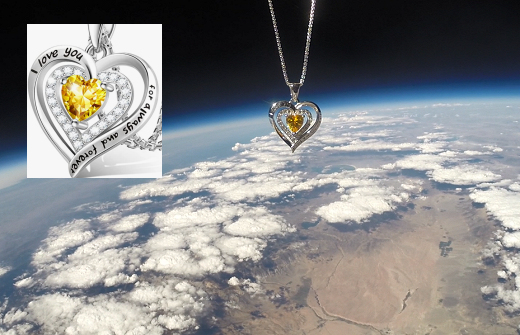
You can have it for $199.95. Engraved with the words "I love you always and forever", this 18K gold-plated pendant has a heart-shaped citrine crystal in the middle surrouunded by a ring of glittering 5A cubic zirconia nuggets. It is a visually striking premium pendant that makes a once-in-a-lifetime Valentine's, anniversary or birthday gift.
The students are selling space pendants to pay the helium bill for their cosmic ray ballooning program. Each one comes with a greeting card showing the jewelry in flight and telling the story of its trip to the stratosphere and back again.
Far Out Gifts: Earth to Sky Store
All sales support hands-on STEM education
Realtime Aurora Photo Gallery
Free: Spaceweather.com Newsletter