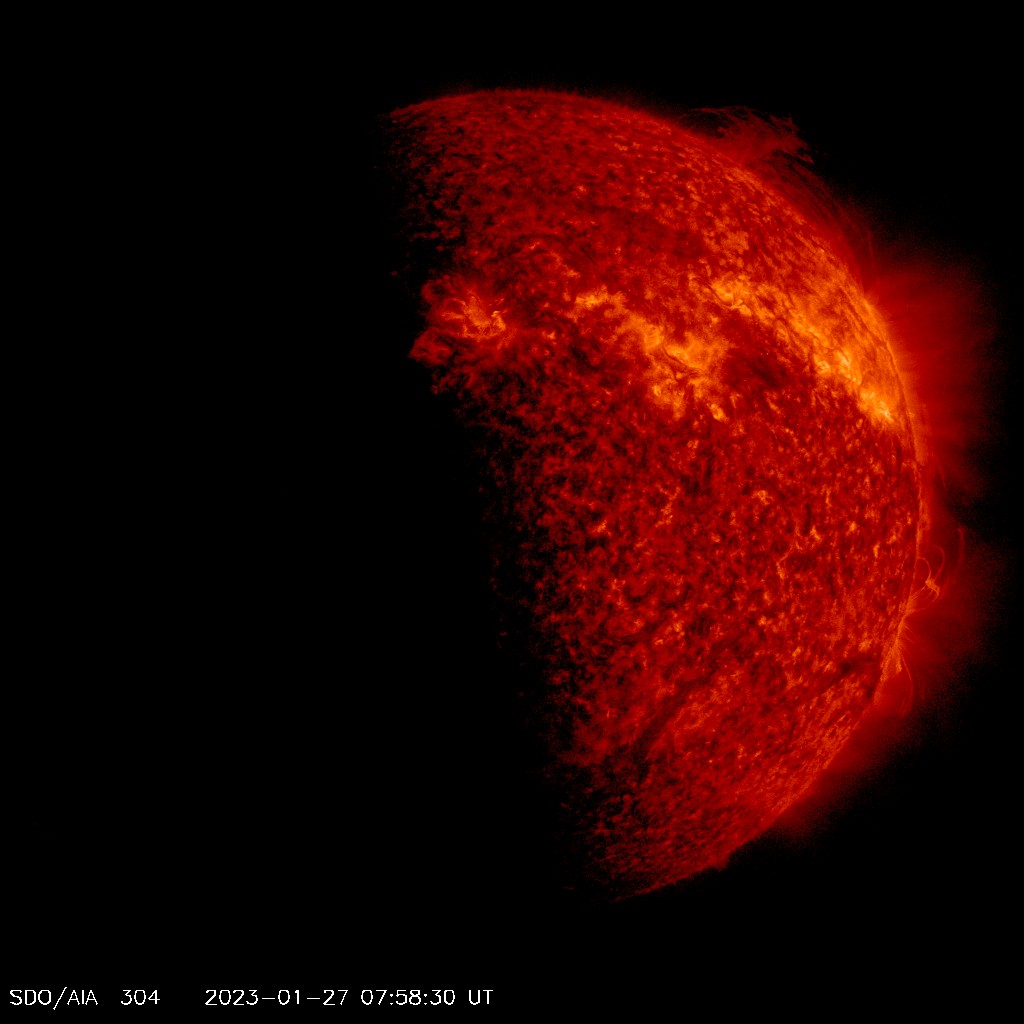
SDO ECLIPSE SEASON: Take a look at this. That's what the sun looked like this morning to NASA's Solar Dynamics Observatory (SDO). It means SDO eclipse season is underway. "Eclipse season" is a three-week period that comes twice a year near the equinoxes during which Earth blocks SDO's view of the sun for a short while (72 minutes at most) each day. The current season started on Jan. 20th and will be finished in mid-February. Solar flare alerts: SMS Text
A COMET BETWEEN THE DIPPERS: Comet ZTF (C/2022 E3) is now visible to the naked eye. Where should you look? Between the Dippers. "For northerners the position of the comet in the sky cannot be better: You can easily find it between two large asterisms, the Big and Little Dippers (from constellations Big and Small Bears)," says Petr Horálek of the Institute of Physics in Opava, Slovakia.
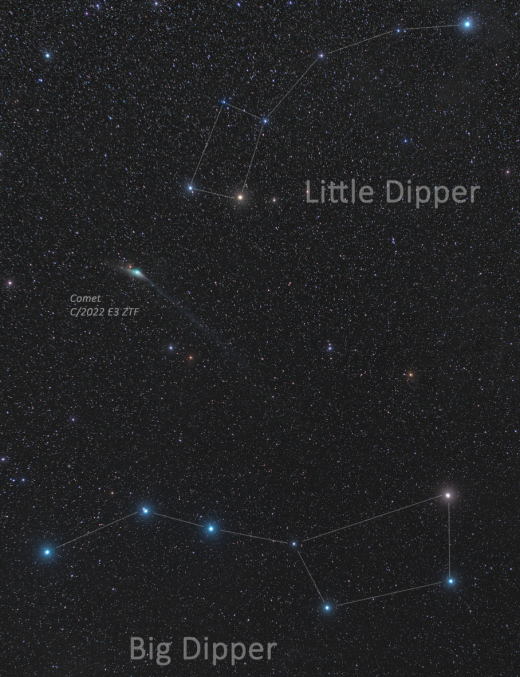
Horálek took this picture on Jan. 26th. "Shining like a 5th magnitude star, the comet has reached the threshold of visibility to the naked eye," he notes. "However it looks much nicer in a small telescope."
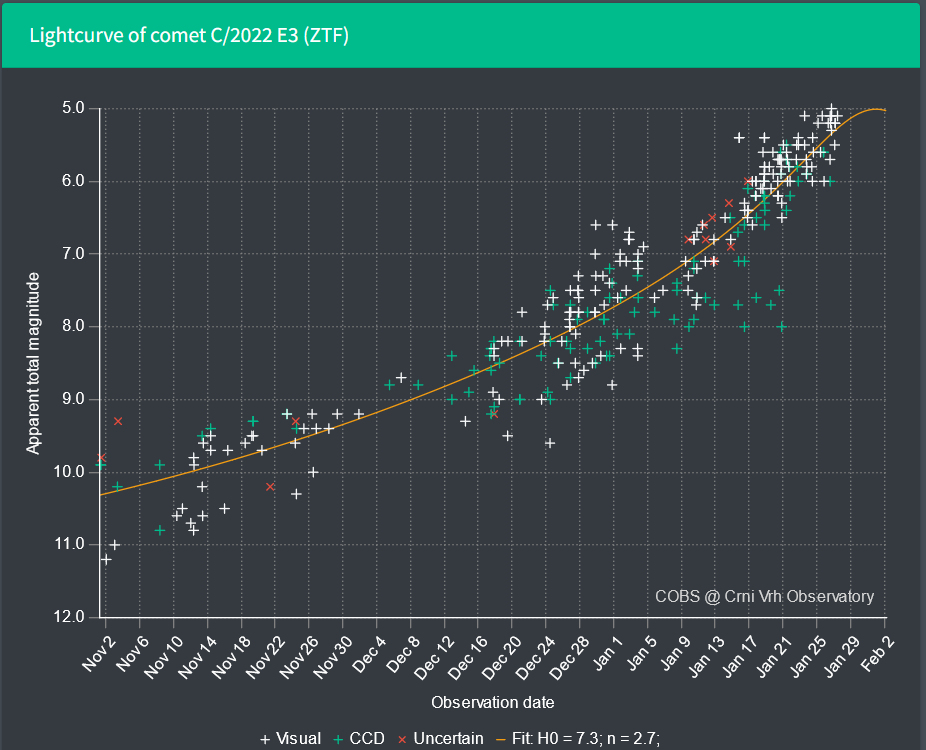
Comet ZTF is approaching Earth for a close encounter (0.28 AU) on Feb. 1st. As it gets closer, the comet will move faster and faster across the sky, so it won't remain between the Dippers for long--only a few more days. Up-to-date positions may be found here.
Realtime Comet ZTF Photo Gallery
Free: Spaceweather.com Newsletter
POLAR STRATOSPHERIC CLOUDS: The outbreak continues. "Today is Day 3 with polar stratospheric clouds (PSCs) here in Tromsø," reports Fredrik Broms from Norway. "The clouds were shining bright long before sunrise."
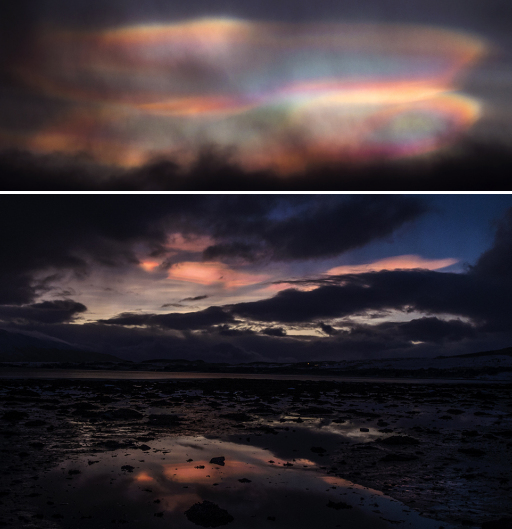
"While most people here in Tromsø haven`t seen the sun yet this year, it doesn`t mean the skies are dark," he says.
Polar stratospheric clouds are rare. Earth's stratosphere is very dry and normally it has no clouds at all. PSCs form when the temperature in the Arctic stratosphere drops to a staggeringly-low -85 C. Then, and only then, can widely-spaced water molecules begin to coalesce into tiny ice crystals. High-altitude sunlight shining through the crystals creates iridescent colors more intense and pure than any other cloud on Earth.
During a typical Arctic winter, PSCs appear no more than two or three times. If you see one, please take a picture and submit it here.
more images: from Paul Botten of Tromso, Norway; from Matti Helin in Southern Finland; from Göran Strand of Östersund, Sweden; from Robbin Gälliner of Frösön, Sweden;
Realtime Space Weather Photo Gallery
Free: Spaceweather.com Newsletter
PREMIUM VALENTINE'S PENDANT: Are you looking for an unforgettable Valentine's Day gift? Consider the Always and Forever Space Pendent. The students of Earth to Sky Calculus launched it to the stratosphere onboard a cosmic ray research balloon:
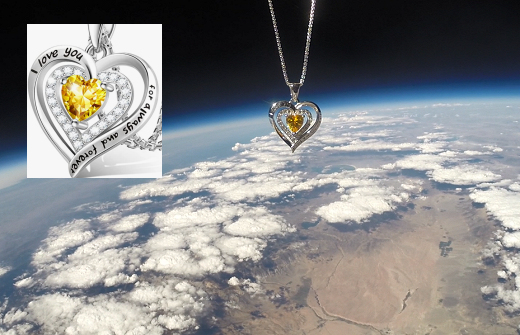
You can have it for $199.95. Engraved with the words "I love you always and forever", this 18K gold-plated pendant has a heart-shaped citrine crystal in the middle surrouunded by a ring of glittering 5A cubic zirconia nuggets. It is a visually striking premium pendant that makes a once-in-a-lifetime Valentine's, anniversary or birthday gift.
The students are selling space pendants to pay the helium bill for their cosmic ray ballooning program. Each one comes with a greeting card showing the jewelry in flight and telling the story of its trip to the stratosphere and back again.
Far Out Gifts: Earth to Sky Store
All sales support hands-on STEM education
Realtime Aurora Photo Gallery
Free: Spaceweather.com Newsletter