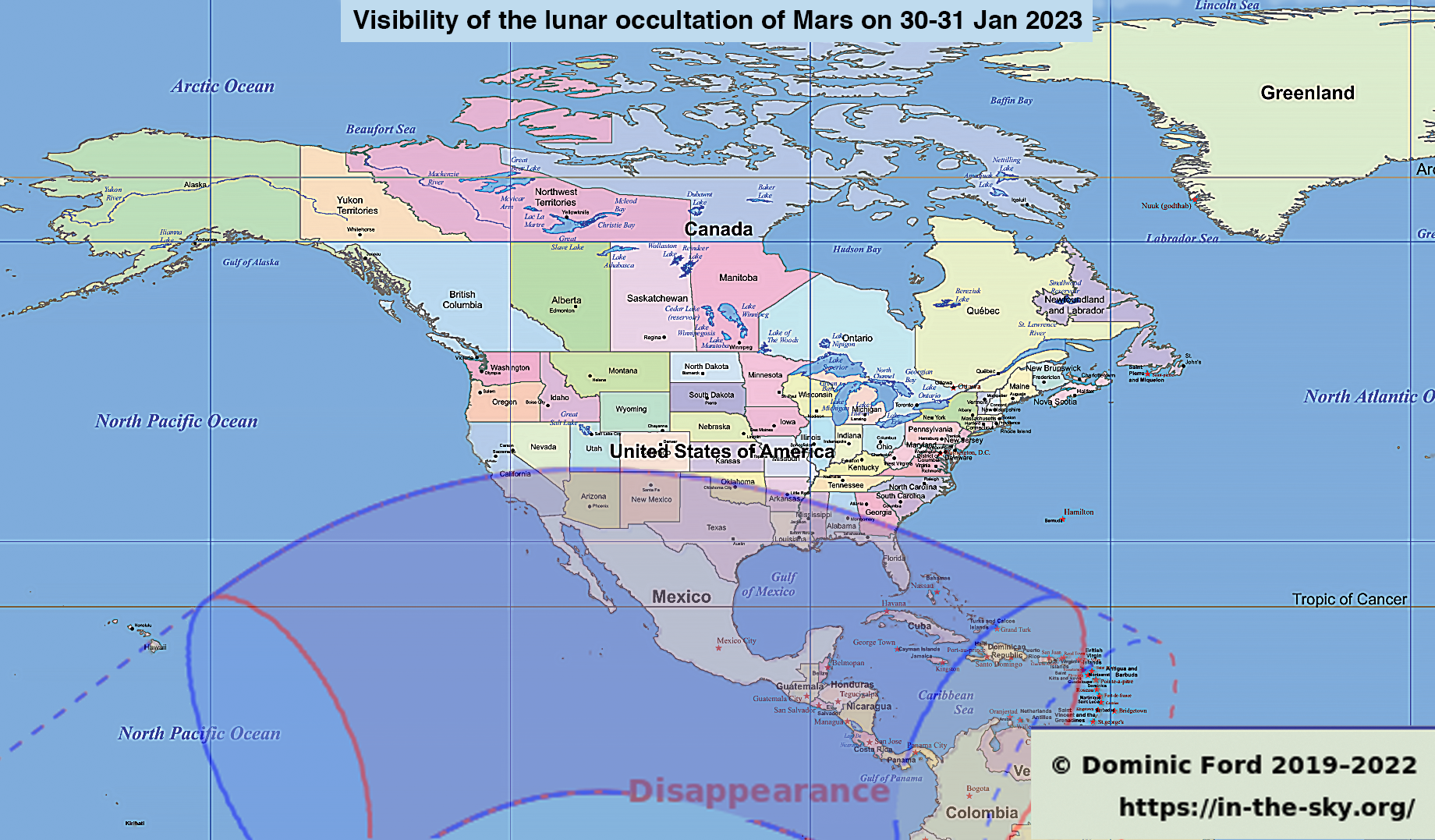
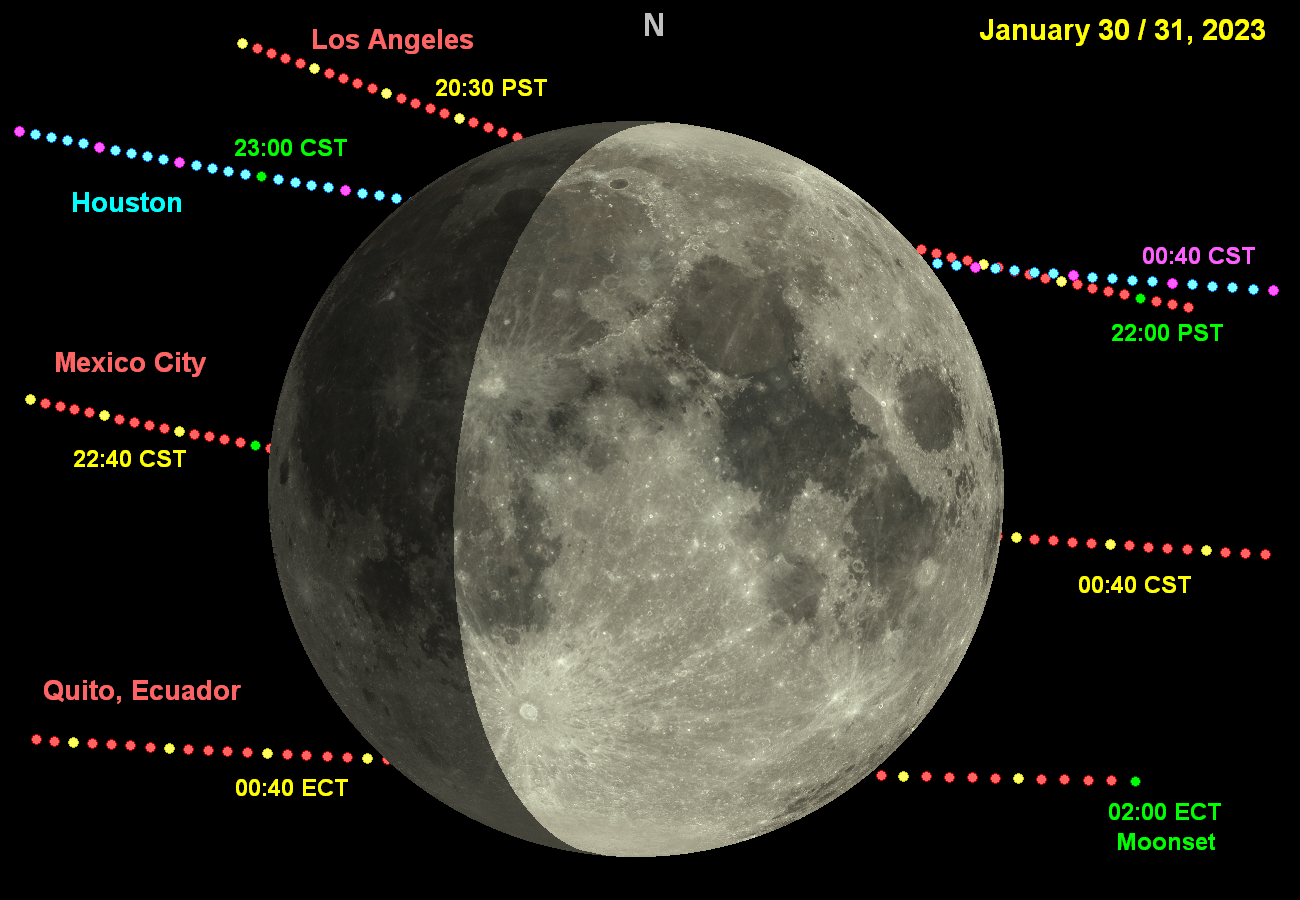
LUNAR OCCULTATION ALERT: Tonight, Jan. 30-31, the Moon will pass directly in front of Mars, producing a lunar occultation visible across southern parts of the USA and all of Central America. Mars will vanish for as much as two hours with great photo-ops when it is near the edge of the Moon. The action begins at approximately 8:30 pm Pacific Time. Resources: visibility map; major cities; cool video!
A LARGE COMET IS STREAKING TOWARD THE SUN (UPDATED): Comet 96P/Machholz is streaking toward the sun for a close encounter inside the orbit of Mercury. Coronagraphs onboard the Solar and Heliospheric Observatory (SOHO) are monitoring its approach:
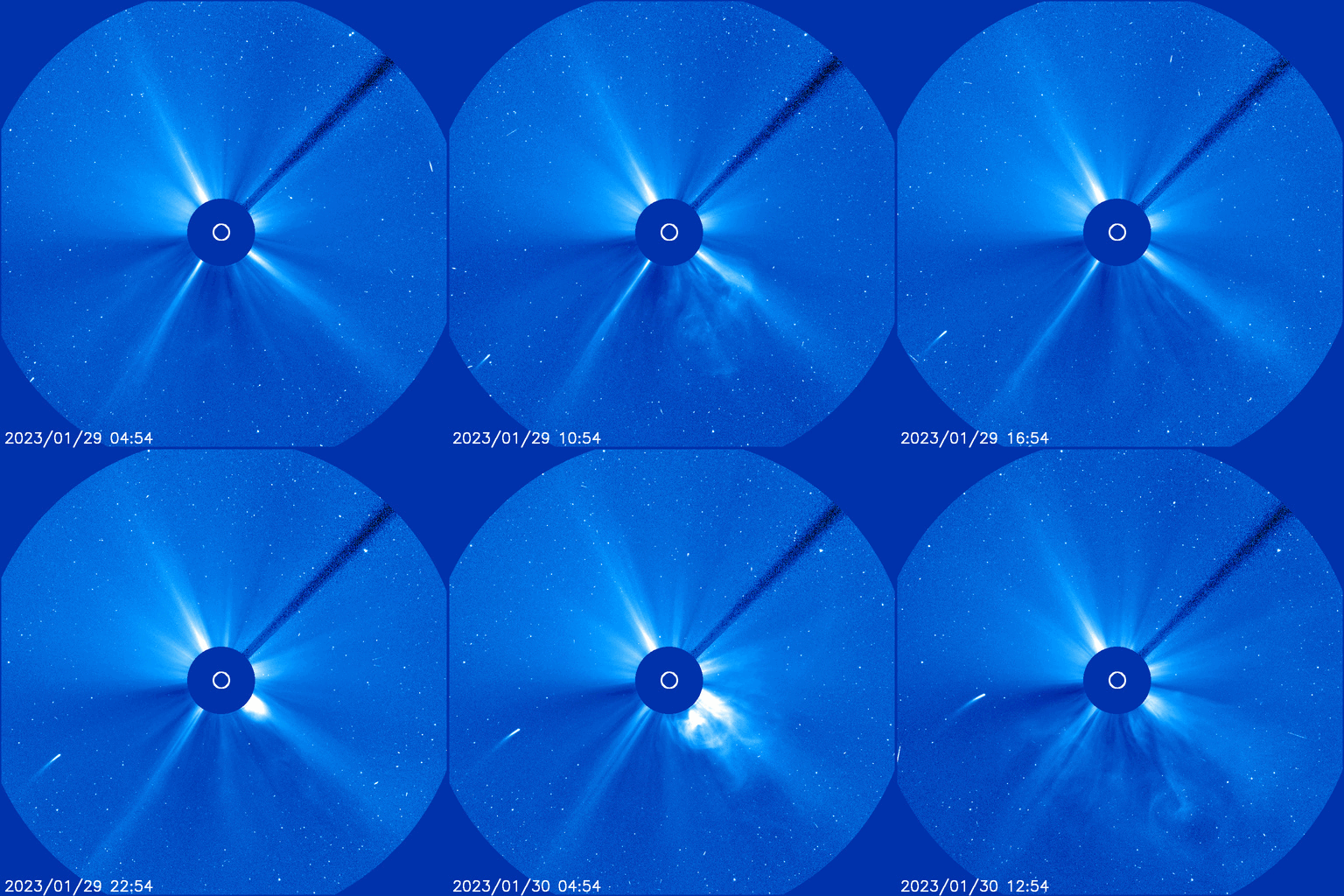
This is no ordinary comet flyby. Most comets that fall toward the sun are small (~10 meters) and rapidly evaporate; SOHO has seen thousands of these doomed sungrazers. Comet 96P is different. Measuring 6 kilometers across, it is big enough to survive close proximity to the sun. Perihelion (closest approach to the sun) on Jan. 31st is only 0.12 AU away.
Some researchers think 96P might be an Alien. Chemically, it is unlike other comets in the Solar System, lacking normal amounts of carbon and cyanogen. It also has a strangely-tilted orbit that takes it very close to the sun. Two orbits ago, unexpected fragments appeared ahead of the comet; researchers aren't sure how they were produced.
"96P is a very atypical comet, both in composition and in behavior, so we never know exactly what we might see," says Karl Battams of the Naval Research Lab in Washington DC. "Accordingly, we’re running a special observing program with SOHO to maximize the science return, so the normal flow of public coronagraph data will be slowed for a few days (to six images/hour). Hopefully we can get some beautiful science out of this and share with everyone as soon as we can."
"By the way," adds Battams, "this comet is named for Don Machholz, who was an extraordinary ground-based 'amateur' astronomer, and also an extremely great guy. He passed away unexpectedly last year, so there's some poignancy to this passage of his 'premier' comet discovery--he made many."
Realtime Space Weather Photo Gallery
Free: Spaceweather.com Newsletter
POLAR STRATOSPHERIC CLOUDS OVER SCOTLAND: Polar Stratospheric Clouds (PSCs) are supposed to stay inside the Arctic Circle. Last night they broke out and made a rare appearance over Scotland. Alan C. Tough photographed the display from Elgin, Moray:
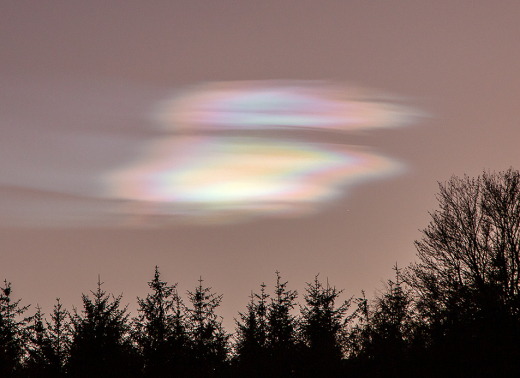
"Thanks to a heads-up from SpaceWeather.com and Jonathan Shanklin (Emeritus Fellow of the British Antarctic Survey) I've been keeping an eye open for these clouds," says Tough. "This beauty between between rain showers on the evening of Jan 29th. Note Venus to the lower right of the cloud."
Polar stratospheric clouds are rare. Earth's stratosphere is very dry and normally it has no clouds at all. PSCs form when the temperature in the stratosphere drops to a staggeringly-low -85 C. Then, and only then, can widely-spaced water molecules begin to coalesce into tiny ice crystals. High-altitude sunlight shining through the crystals creates intense iridescent colors visible in twilight or even dark-night sky.
Usually such low stratospheric temperatures happen only inside the Arctic Circle, but this week extreme cold is drifting over the UK as well. Sky watchers in the area are encouraged to submit pictures here.
more images: from Graeme Whipps of Bennachie, Aberdeenshire, Scotland; from Alan C. Tough of Elgin, Moray, Scotland; from Steven McCarron of Peterhead, Scotland; from Paul Warrener of Forres, Scotland; from Eric Schandall of Oslo, Norway; from Paul Cura of Cornhill, Aberdeenshire, Scotland
HOWLING WOLF HEART PENDANT: It's the perfect Valentine's gift for a Nature lover. On Jan. 6, 2023, this Howling Wolf Heart Pendant flew to the stratosphere onboard an Earth to Sky cosmic ray research balloon, floating more than 105,546 ft above the snow-capped Sierras of central California:
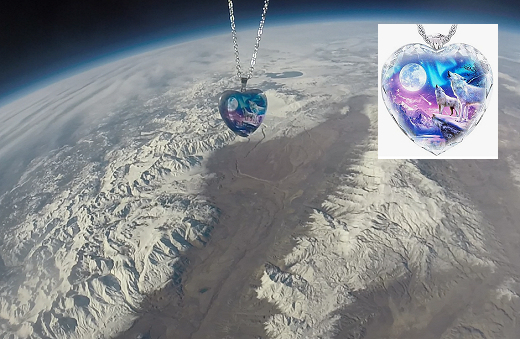
You can have it for $99.95. The hypoallergenic heart-shaped pendant features a loving pair of howling Arctic wolves, a shooting star, the full Moon, and sheets of aurora borealis. It comes with a greeting card showing the pendent in flight and telling the story of its trip to the edge of space and back again.
Far Out Gifts: Earth to Sky Store
All sales support hands-on STEM education
Realtime Aurora Photo Gallery
Free: Spaceweather.com Newsletter