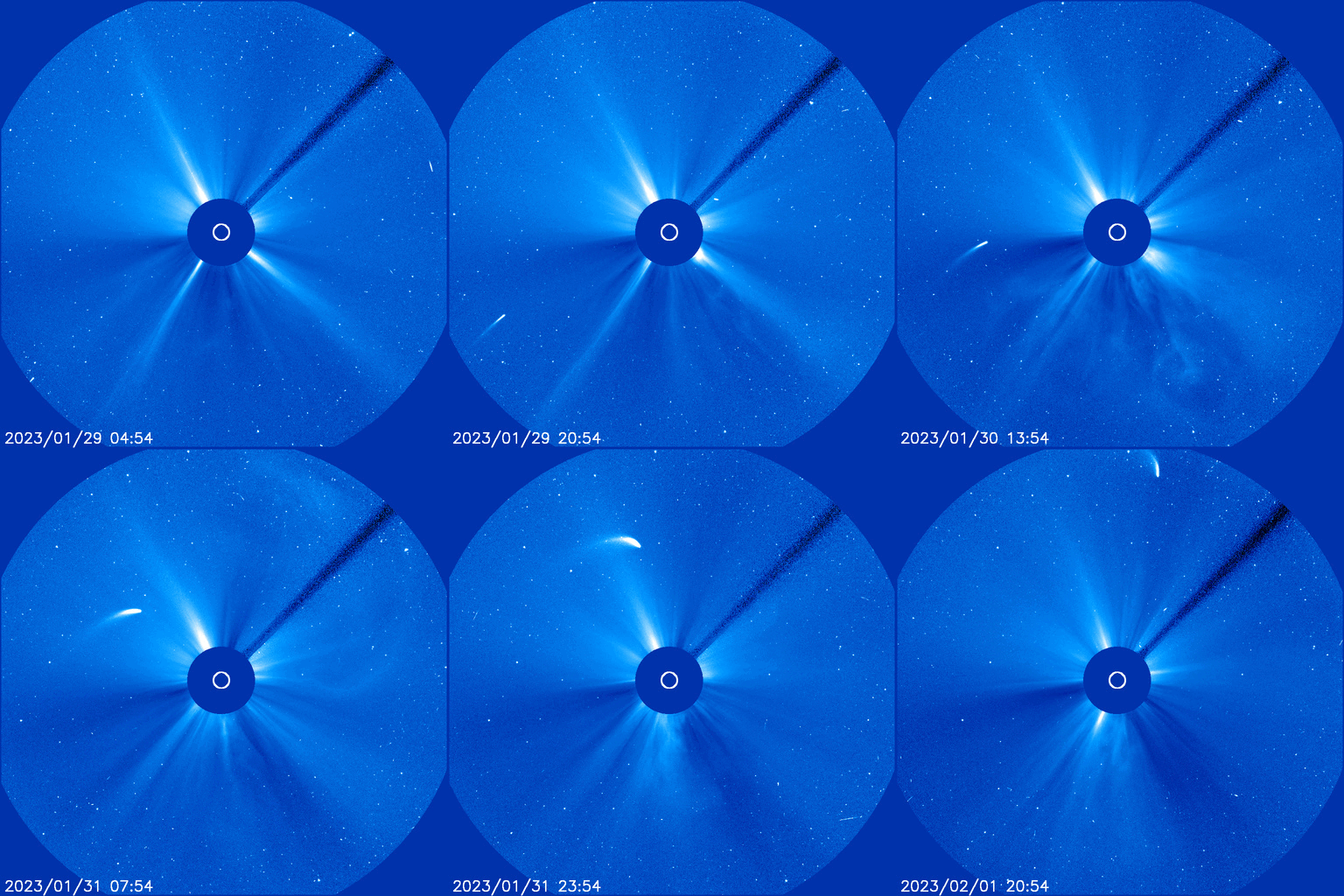
THE SOLAR FLYBY OF COMET 96P: Some comets like it hot--especially comet 96P/Machholz. The 6-km-wide dirty snowball just flew past the sun deep inside the orbit of Mercury and survived. Play this movie from the Solar and Heliospheric Observatory (SOHO) to see the entire flyby. Researchers working with the SOHO data say they may have a surprise to share in the days ahead. Stay tuned!
SUNSPOT COUNTS HIT A 9-YEAR HIGH: In a continued sign of strength for Solar Cycle 25, sunspot counts just hit a 9-year high. This plot from NOAA shows how the monthly sunspot number skyrocketed in January 2023:
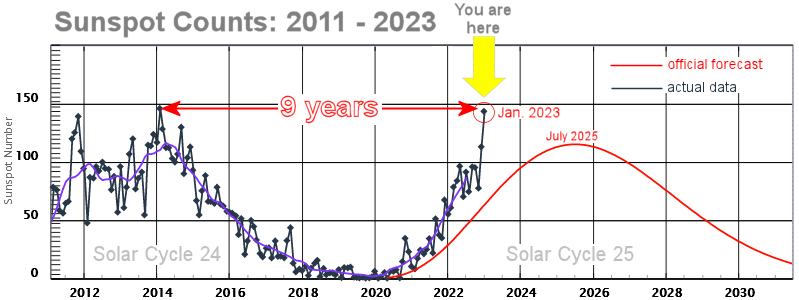
The monthly sunspot number of 144 in January 2023 was only percentage points away from topping the previous solar cycle, Solar Cycle 24, which peaked in Feb. 2014 with a monthly value of 146.
Originally, forecasters thought Solar Cycle 25 would be about the same as Solar Cycle 24, one of the weakest solar cycles in a century. Current trends suggest Solar Cycle 25 will surpass that low threshold, at least. Solar Maximum is not expected until 2024 or 2025, so it has plenty of time to strengthen further, bringing X-flares, geomagnetic storms and auroras. You can follow the progression here.
Realtime Space Weather Photo Gallery
Free: Spaceweather.com Newsletter
"WEAK" CME IMPACT SPARKS AURORAS: An unexpected CME hit Earth's magnetic field on Feb. 1st at 18:54 UTC, causing a 10 nanoTesla jolt in magnetometer readings from Canberra, Australia. This is considered to be a weak impact. Nevertheless, it was enough to spark auroras around the Arctic Circle:
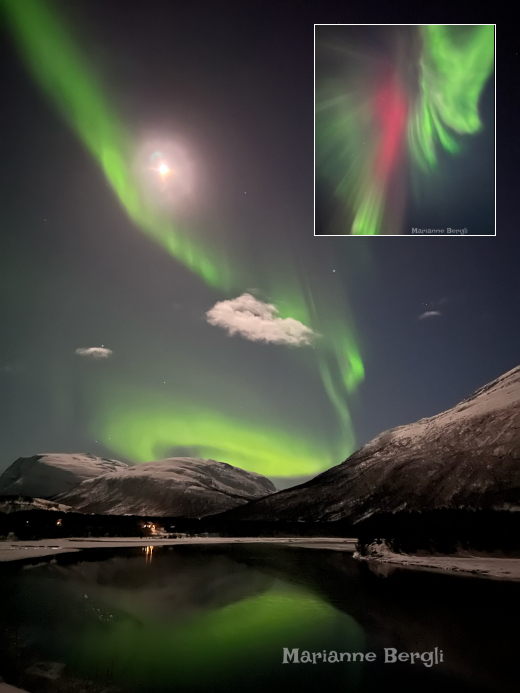
"What an amazing night!!!" says Marianne Bergli, who photographed the display from Storfjord, Norway. "It looked like a green serpent was dancing around the Moon."
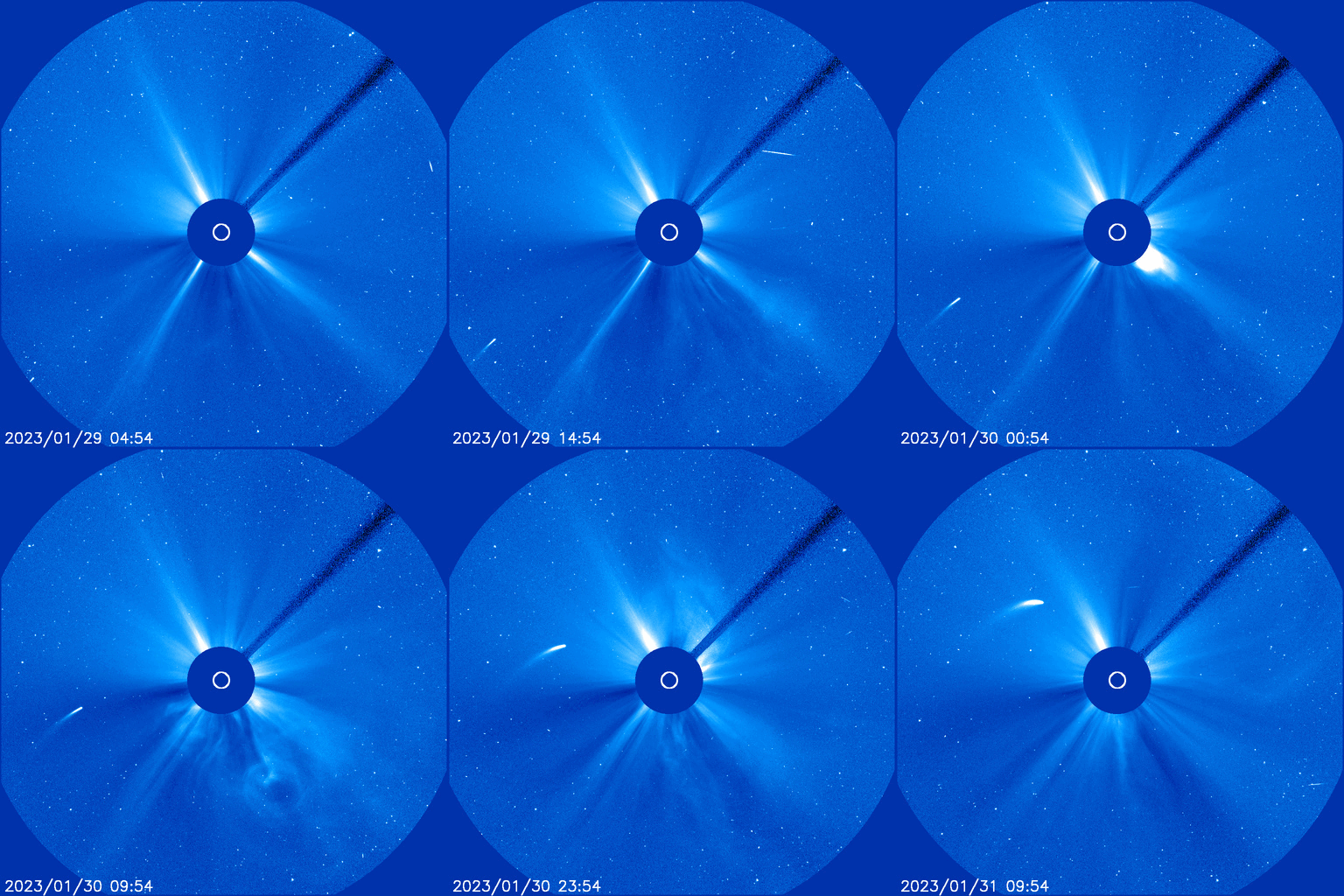
The instigating CME may have been one of many CMEs that left the sun in recent days (watch this movie) but which, initially, did not appear to be Earth directed. When multiple CMEs overlap in coronagraph images, it can be difficult to sort out their individual trajectories. As a result of such confusion, more minor impacts are possible in the days ahead. Aurora alerts: SMS Text.
Realtime Aurora Photo Gallery
Free: Spaceweather.com Newsletter
HOWLING WOLF HEART PENDANT: It's the perfect Valentine's gift for a Nature lover. On Jan. 6, 2023, this Howling Wolf Heart Pendant flew to the stratosphere onboard an Earth to Sky cosmic ray research balloon, floating more than 105,546 ft above the snow-capped Sierras of central California:
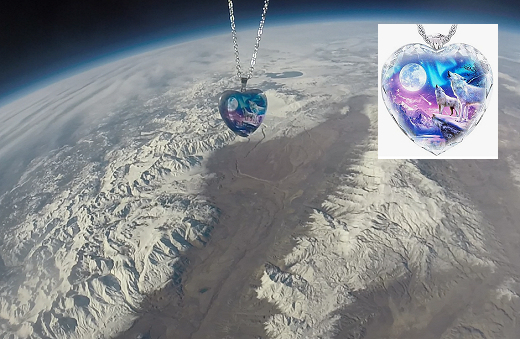
You can have it for $99.95. The hypoallergenic heart-shaped pendant features a loving pair of howling Arctic wolves, a shooting star, the full Moon, and sheets of aurora borealis. It comes with a greeting card showing the pendent in flight and telling the story of its trip to the edge of space and back again.
Far Out Gifts: Earth to Sky Store
All sales support hands-on STEM education
LUNAR OCCULTATION OF MARS: On Monday night, Jan. 30th, the Moon passed directly in front of Mars, producing a lunar occultation visible from southern parts of the USA and all of central America. Juan José Ortiz photographed the event from Metepec, Mexico:
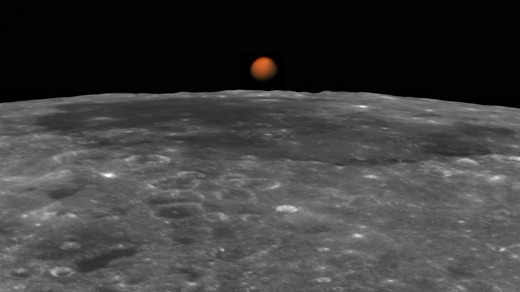
"I captured Mars rising over Mare Smythii as it was emerging from behind the Moon," says Ortiz. "What a view!"
The next good lunar occultation of Mars isn't until Jan. 13, 2025.
Until then, here are some more images: from Gregg Ruppel of Oro Valley Arizona; from Eliot Herman of Tucson AZ; from Dr. Gilbert Plumer of Rockledge, Florida; from Bob Beal of St. George, Utah; from John Ashley of Rio Rico, Arizona; from Andres Paez Joannis of Chihuahua, Chih. Mexico; from John Vertson of Clovis, CA;
Realtime Space Weather Photo Gallery
Free: Spaceweather.com Newsletter
Realtime Aurora Photo Gallery
Free: Spaceweather.com Newsletter