A NOTE TO READERS: Spaceweather.com is written by Dr. Tony Phillips from a location in the Sierra Nevada mountains at 8500 ft elevation. This winter's record-setting snowfall, avalanches, and frequent evacuations are impacting the production of the web site. You're going to see more typos than usual. Proofreading is appreciated--but please report the errors in a respectful way, mindful of the fact that we're stretched thin, working in the middle of a disaster zone. Now for the good news: It's almost spring! And auroras love equinoxes.

SUNSPOT MITOSIS: Sunspot AR3245 is splitting in two. This 24-hour movie from NASA's Solar Dynamics Observatory shows the sunspot's primary core dividing like a eukaryotic cell as it turns toward Earth:
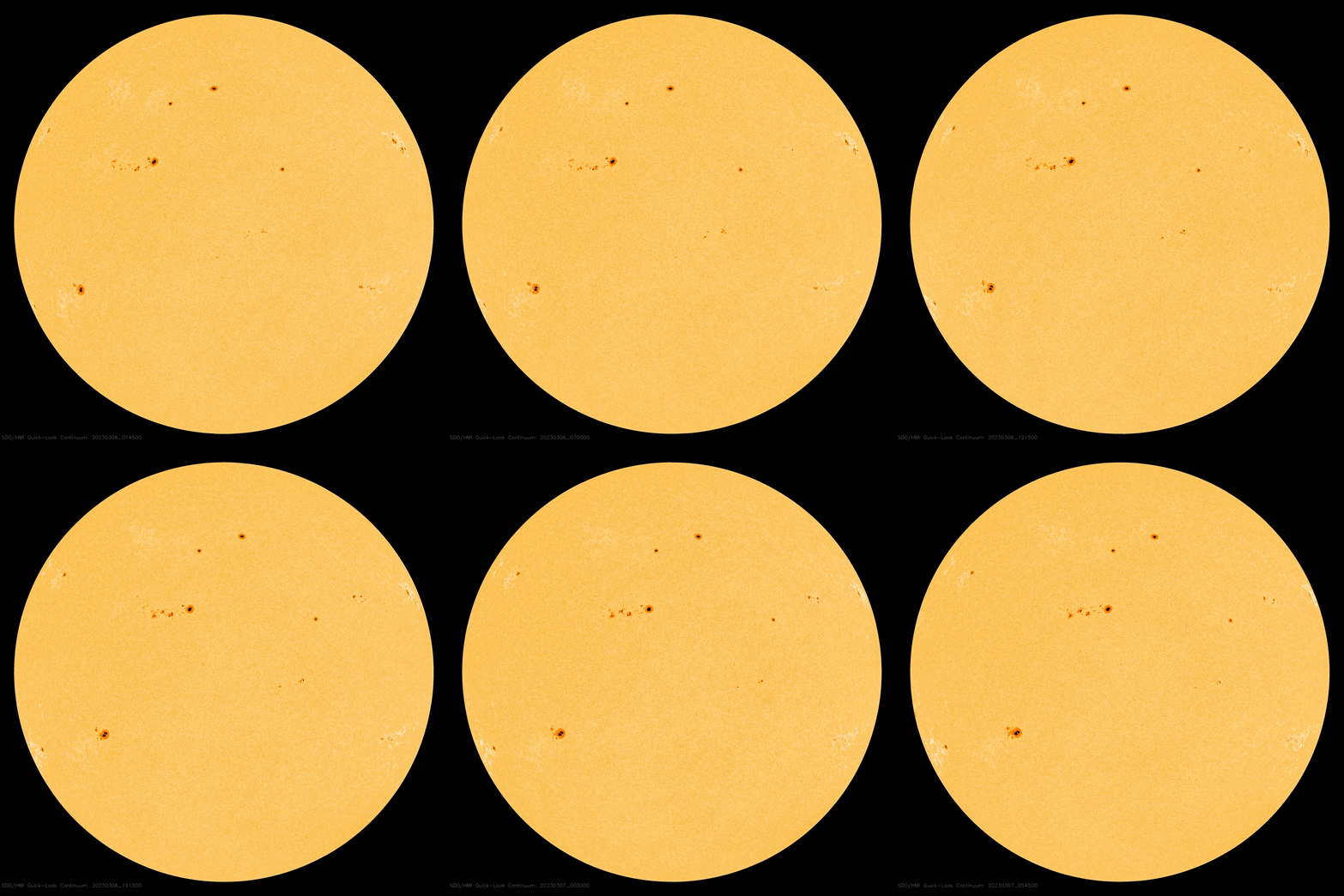
The bright, linear gap between the sunspot's two halves is known as a "light bridge." It measures 20,000 km from end to end.

The nature of light bridges is not fully understood. They often herald the break-up of a sunspot, with jets of plasma shooting up from the chasm as the sunspot decays. Some research suggests that magnetic fields at the base of a light bridge are busy cross-crossing and reconnecting--the same explosive process that sparks solar flares.
Does this mean sunspot AR3245 will explode--or quietly fall apart? No one can say. Readers with solar telescopes are encouraged to monitor developments. Solar flare alerts: SMS Text.
Realtime Space Weather Photo Gallery
Free: Spaceweather.com Newsletter
RE-VISITING A BLUE JET: Last July 28th, photographers in Texas witnessed a remarkable blue jet emerging from the top of a huge thunderstorm. Storm chaser "Pecos Hank" has just made a video re-visiting the event:
Blue jets might look like lightning, but they are not the same. Normal lightning carves a scorching-hot path through the atmosphere, heating the air to 30,000 degrees Celsius. Blue jets are made of cold plasma akin to gas inside a flourescent light bulb. You could touch one with your hand and it might not hurt.
Photos taken from the International Space Station (ISS) show that blue jets reach astonishing altitudes, as high as 170,000 feet. This is high enough to touch the ionosphere, possibly forming a new and poorly understood branch of Earth's global electrical circuit. Blue jets also produce NOx and ozone, potentially affecting the chemistry of the upper atmosphere.
Blue jets are still poorly understood and only sparsely documented. Yet they are clearly important to study. The spring season for blue jets is only weeks away. Here's how to catch them.
THE CRESCENT VENUS PENDANT: Are you looking for a far-out gift? Nothing says "I love you" like a Venus Pendant from the edge of space. This one flew to the stratosphere onboard a cosmic ray research balloon on Jan. 8, 2022:
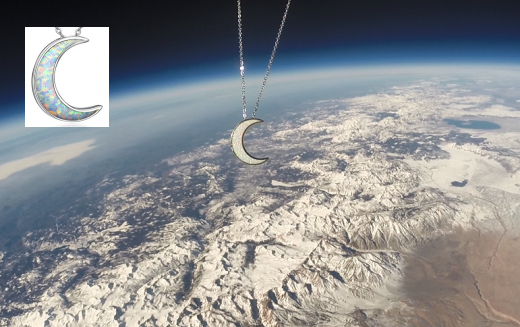
You can have it for $142.95. The opal crescent is framed by sterling silver with a matching hypoallergenic chain. It comes with a greeting card showing the pendant in flight and telling the story of its journey to the stratosphere.
Why is it a crescent? Because Venus itself was a crescent on the date of the flight. On Jan. 8, 2022, the second planet was at inferior conjunction with the sun. From Earth it looked like a slender crescent--the most beautiful phase of the Goddess of Love.
Far Out Gifts: Earth to Sky Store
All sales support hands-on STEM education
Realtime Aurora Photo Gallery
Free: Spaceweather.com Newsletter