NOTE TO READERS: Please be patient with slower-than-usual updates on Spaceweather.com for the next two to three days. Author Dr. Tony Phillips, his family, and team of sled dogs are being evacuated due to an extreme avalanche hazard in the Sierra Nevada mountains of central California where the site is produced. If you see any typos or other errors, please let us know, and they will be tended to as soon as possible.
THIS IS PROBABLY NOTHING TO WORRY ABOUT: On Valentine's Day 2046, almost every telescope in the world will be doing the same thing: Watching asteroid 2023 DW streak past Earth. The newly-discovered space rock will come perilously close to our planet with an approximately 1/560 chance of actually hitting, according to NASA. Red dots in this map show possible impact sites on Feb. 14, 2046:
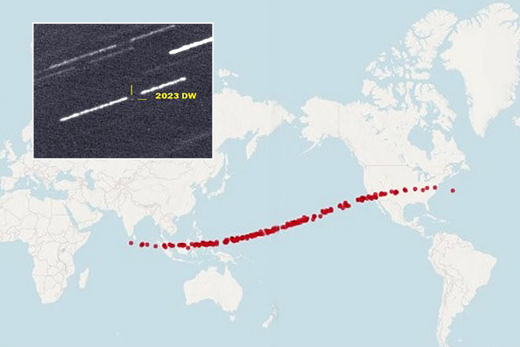
Above: The impact zone of asteroid 2023 DW and (inset) an image of the space rock from the Sormano Observatory in Italy
Now for the good news: This is probably nothing to worry about. The odds of a collision are only 0.18%, which means there is a 99.82% of a miss. These odds will probably tilt further in our favor as the asteroid's orbit is refined by additional observations.
"I have worked out almost 65,000 different possible orbits of 2023 DW and
only 150 of these indicate an impact," says astronomer Enrico Colzani of the Sormano Observatory in Italy, who made the map shown above. "New observations in the coming days will probably eliminate even this small possibility."
Discovered by Georges Attard and Alain Maury in San Pedro de Atacama on Feb. 26th, asteroid 2023 DW is approximately 50 meters in diameter, roughly the size of the object that caused the Tunguska event in 1908. So if it *did* hit, people in the impact zone would notice. Stay tuned for updates.
PLASMA FALLS: Imagine a waterfall made of hot plasma falling from a precipice tall enough to swallow Earth 10 times. Here it is:
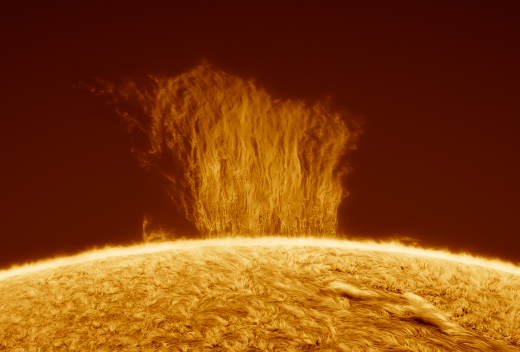
"I had the privilege of observing and photographing this magnificent wall of plasma on March 9th," says photographer Eduardo Schaberger Poupeau of Rafaela, Argentina. "It rose some 100,000 km above the solar surface. On my computer screen it looked like hundreds of threads of plasma were dripping down a wall. It really was a spectacle that left me speechless."
These structures have been seen on the sun many times before. They frequently appear in rings around the sun's poles, and are called "polar crown prominences." Researchers still don't fully understand them.
Mysteriously, the "plasma threads" Poupeau sawplummet faster than ambient magnetic forces seem to allow. Nuclear engineers would like to figure out how this happens, because it also happens on a smaller scale in fusion reactors on Earth, frustrating their efforts to sustain an energy-producing reaction. Studies of these prominences could lead to practical breakthroughs.
The plasma is still falling today. Amateur astronomers with solar telescopes can see the structure on the sun's southeastern limb, right here. Take a look!
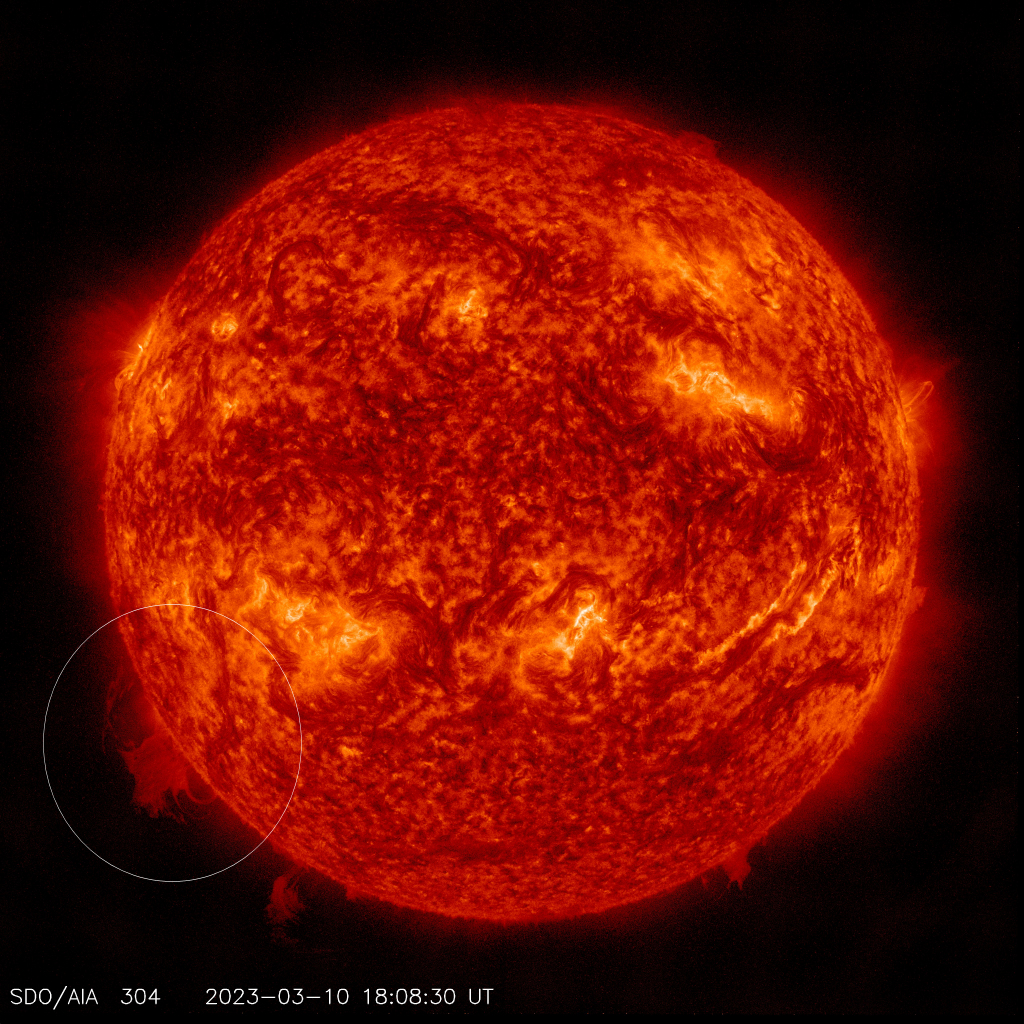
more images: from David Leong of Hong Kong; from Rossana Miani of Padova, Italy; from David Wilson of Inverness, Scotland; from Martin Wise of Trenton, Florida; from Selín Alejandro of Toluca, Mexico;
Realtime Space Weather Photo Gallery
Free: Spaceweather.com Newsletter
18K GOLD CUPID'S COMPASS: Are you looking for a romantic gift? Consider Cupid's Compass. This premuim 18K gold-filled pendant flew to the stratosphere on Jan. 6th onboard an Earth to Sky Calculus cosmic ray research balloon:
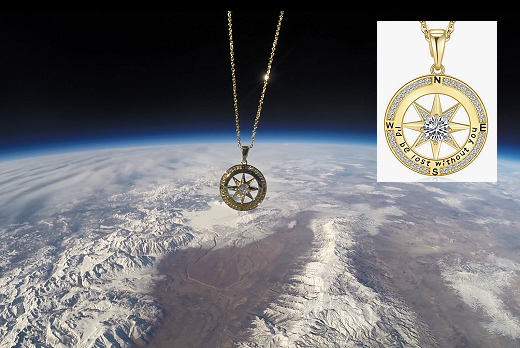
You can have it for $259.95. Engraved with the words "I'd be lost without you", the hypoallergenic pendant has a 5-star cubic zirconia crystal in the middle surrounded by a ring of equally high-grade 5A cubic zirconia nuggets. It is a visually striking pendant that makes a once-in-a-lifetime Valentine's, anniversary or birthday gift.
The students are selling space pendants to pay the helium bill for their cosmic ray ballooning program. Each one comes with a greeting card showing the jewelry in flight and telling the story of its trip to the stratosphere and back again.
Far Out Gifts: Earth to Sky Store
All sales support hands-on STEM education
Realtime Aurora Photo Gallery
Free: Spaceweather.com Newsletter