AURORAS LOVE EUINOXES: The vernal equinox is only 3 days away. That's good news, because auroras love equinoxes. Researchers call it the "Russell-McPherron effect." At this time of year, cracks form in Earth's magnetic field. Even a weak stream of solar wind can penetrate to spark a good display. Aurora alerts: SMS Text.
THE AFTERGLOW OF A CME: Sometimes the second night is best. Finnish photographer Matti Helin didn't see anything immediately on March 15th when a CME struck Earth's magnetic field. Twenty-four hours later, however, the sky filled with auroras:

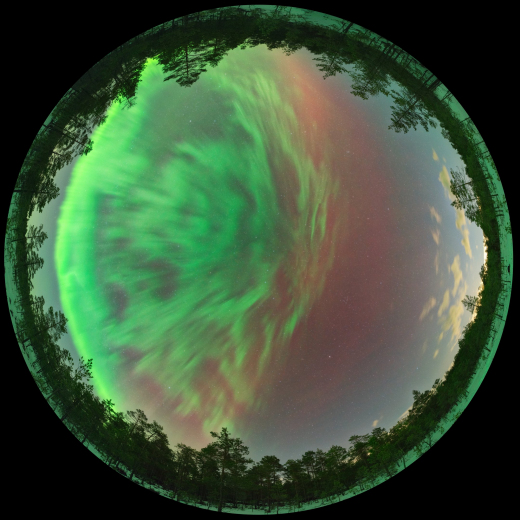
"It was a surprisingly nice display," says Helin. "For a moment, the auroras got very bright."
Helin witnessed the CME's afterglow--the delayed appearance of auroras that sometimes happens when Earth is passing through a CME's wake. Within the slipstream, strong magnetic fields can open a crack in Earth's magnetosphere, allowing solar wind to penetrate and paint the sky with light.
Realtime Aurora Photo Gallery
Free: Spaceweather.com Newsletter
SUPERIOR CONJUNCTION OF MERCURY: Are you looking for Mercury? Don't. Today it is only 1.5 degrees from the blinding sun. Using an opaque disk to block the glare, the Solar and Heliospheric Observatory (SOHO) is monitoring the close encounter:
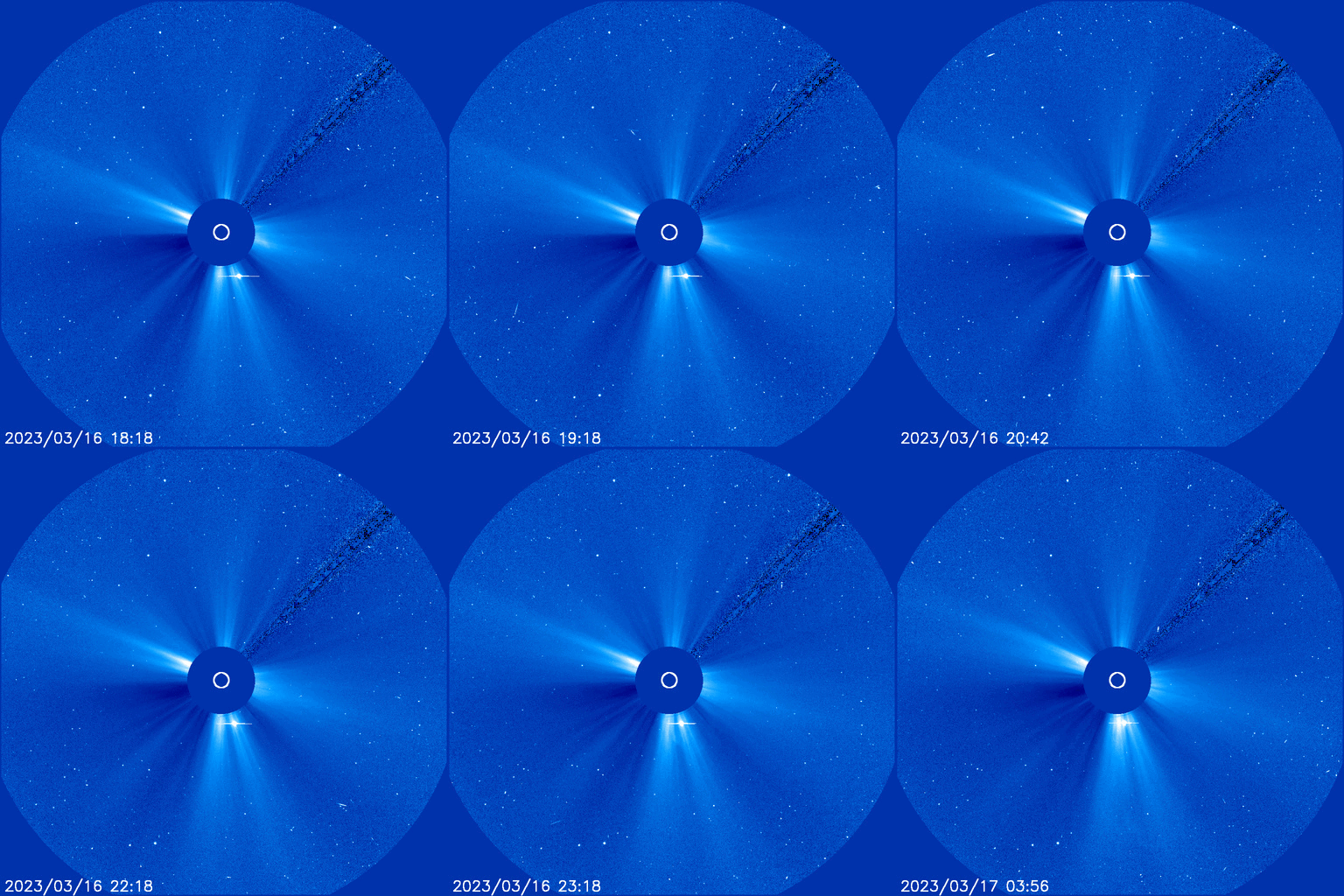
Astronomers call this event a "superior conjunction of Mercury." Right now, the first planet is on the farside of the sun, passing almost directly behind, so it appears to be close to the solar disk. "Inferior conjunctions," when Mercury is on the nearside of the sun, look much the same.
In the movie, above, Mercury has a short horizontal line running through it. The planet has not sprouted wings. This is a digital artifact caused by Mercury's brightness saturating the pixels in SOHO's digital camera.
Realtime Space Weather Photo Gallery
Free: Spaceweather.com Newsletter
"ALWAYS AND FOREVER" SPACE PENDANT: Are you looking for a romantic gift? Consider the Always and Forever Space Pendent. The students of Earth to Sky Calculus launched it to the stratosphere onboard a cosmic ray research balloon:
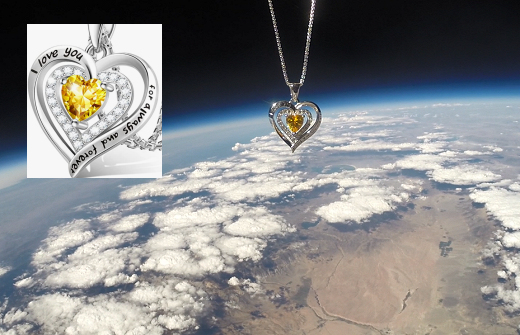
You can have it for $199.95. Engraved with the words "I love you always and forever", this 18K gold-plated pendant has a heart-shaped citrine crystal in the middle surrouunded by a ring of glittering 5A cubic zirconia nuggets. It is a visually striking premium pendant that makes a once-in-a-lifetime anniversary or birthday gift.
The students are selling space pendants to pay the helium bill for their cosmic ray ballooning program. Each one comes with a greeting card showing the jewelry in flight and telling the story of its trip to the stratosphere and back again.
Far Out Gifts: Earth to Sky Store
All sales support hands-on STEM education
Realtime Space Weather Photo Gallery
Free: Spaceweather.com Newsletter