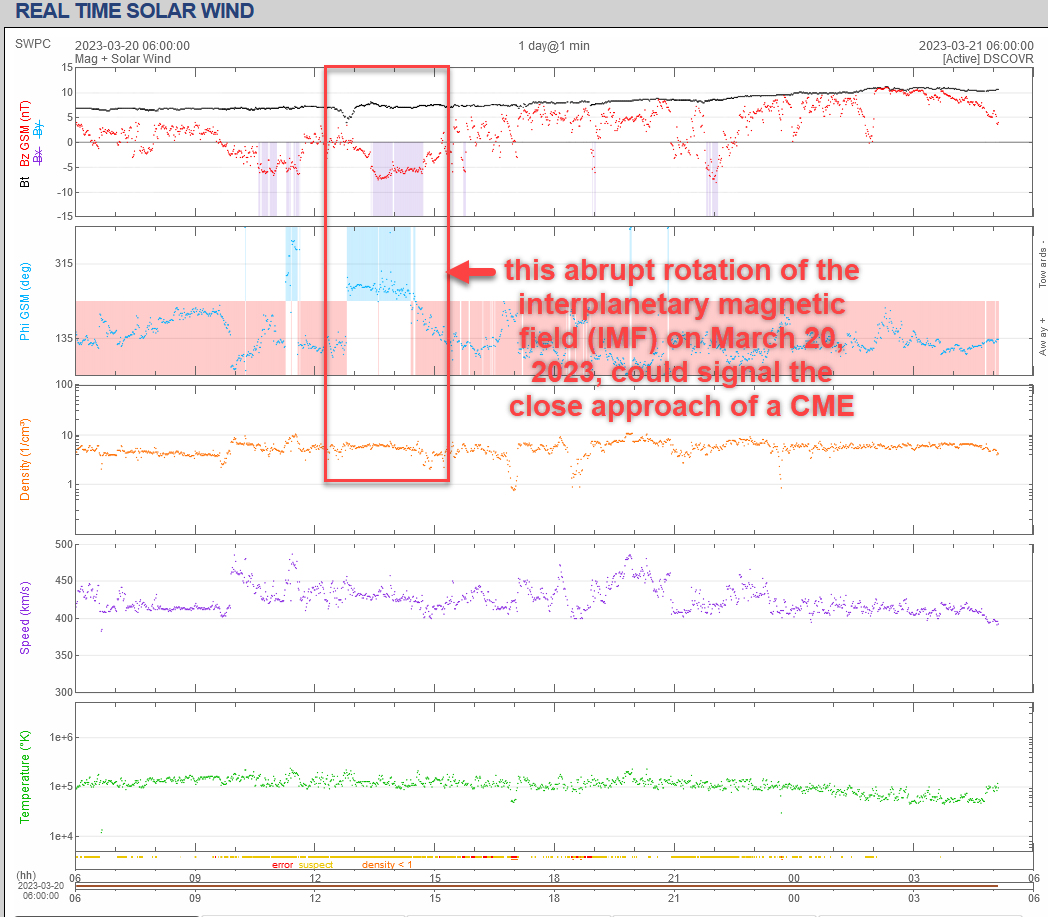
CLOSE ENCOUNTER WITH A CME: Even a near miss from a CME can spark beautiful auroras. Case in point: Yesterday, March 20th, the interplanetary magnetic field (IMF) near Earth suddenly rotated by almost 180 degrees. This kind of magnetic ripple is a typical sign of a CME passing nearby. The "ripple effect" ignited colorful lights inside the Arctic Circle. Aurora alerts: SMS Text.
SUNRISES DON'T LOOK THE SAME ANYMORE: Solar Cycle 25 is changing the appearance of sunrises. It's making them spotted. David J. Kriegler sends this example from Gulf Shores, Alabama:

"This morning I photographed the sunrise from a pier overlooking the Gulf of Mexico," says Kriegler. "I could see sunspots AR3256 and AR3257 through the marine haze."
Over the past two months, sunspot numbers have shot up to their highest values in nearly 10 years--a sign of the intensification of Solar Cycle 25. We're nowhere near the apex of the sunspot curve, however. Solar Max isn't expected until 2024 or 2025. This means sunrises (and sunsets) will become even more spotted in the years ahead. Aurora alerts: SMS Text.
more images: from C.S. McKiness of Des Moines, IA
Realtime Space Weather Photo Gallery
Free: Spaceweather.com Newsletter
A LARGE HOLE IN THE SUN'S ATMOSPHERE: A large hole has opened in the sun's atmosphere, and it is spewing a stream of solar wind toward Earth. NASA's Solar Dynamics Observatory photographed the structure on March 20th:
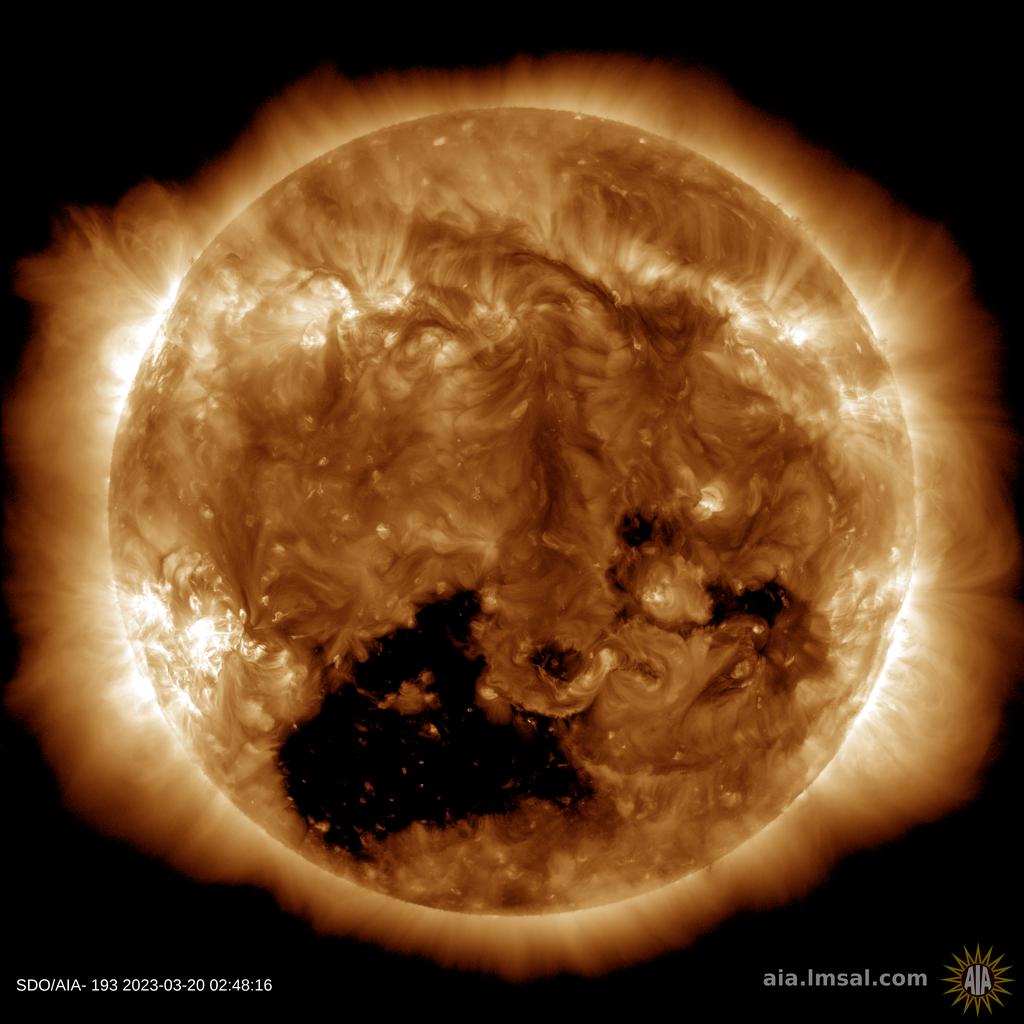
This is a "coronal hole" -- a region in the sun's atmosphere where magnetic fields open up and allow solar wind to escape. It looks dark in this ultraviolet image because glowing-hot gas normally contained there is missing.
The solar wind will reach Earth on March 24, only a few days after the vernal equinox. This is perfect timing for aurora chasers. Because of the Russell-McPherron effect, even a slight gust of solar wind around the equinoxes can spark a good display of high-latitude auroras. Aurora alerts: SMS Text.
Realtime Aurora Photo Gallery
Free: Spaceweather.com Newsletter
RARE MR. SPOCK MUG: It's the logical way to wake up in the morning: Coffee in a rare Mr. Spock mug. This unique ceramic collector's item flew to the stratosphere onboard an Earth to Sky Calculus cosmic ray research balloon:

You cannot buy these mugs anywhere on the internet--not even Amazon. But you can have one from Earth to Sky Calculus for $170.10. That's the serial number of the Enterprise divided by 10. The mug comes with a greeting card showing the item in flight and telling the story of its journey to the edge of space and back again. It's a great gift for any Trekkie!
Far Out Gifts: Earth to Sky Store
All sales support hands-on STEM education
Realtime Aurora Photo Gallery
Free: Spaceweather.com Newsletter