HIGH LATITUDE AURORA WATCH: Today's surprise geomagnetic storm, described below, is subsiding a little, but it is far from over. Solar wind conditions favor continued storminess; currently, indices are fluctuating between category G1 (Minor) and G2 (Moderate). These storm levels could produce auroras in northern-tier US states after nightfall especially during the hours around local midnight. Aurora alerts: SMS Text.


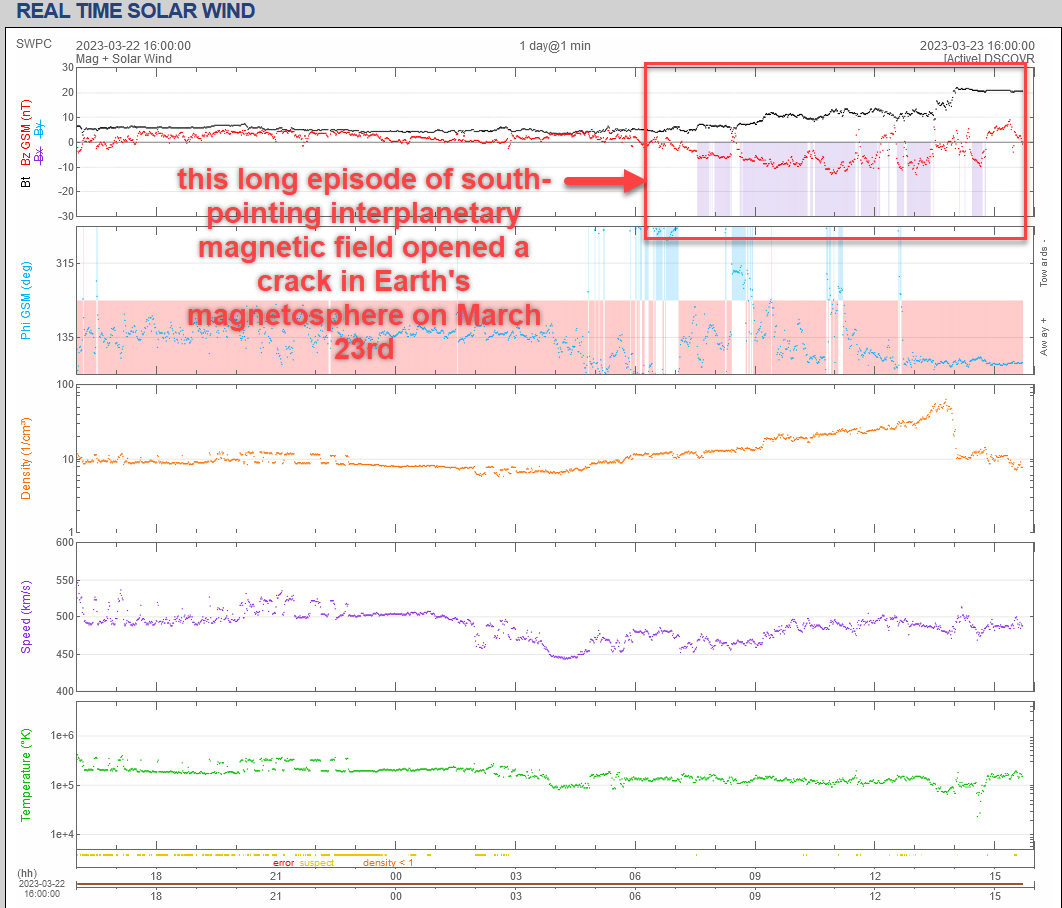
SURPRISE GEOMAGNETIC STORM: The forecast did not call for this. During the early hours of March 23rd, a crack opened in Earth's magnetic field, and stayed open for more than 8 hours. Solar wind poured through the gap to fuel a strong G3-class geomagnetic storm. The sun was coming up in Kalispell, Montana, when Philip Granrud saw bright auroras shining through the twilight:

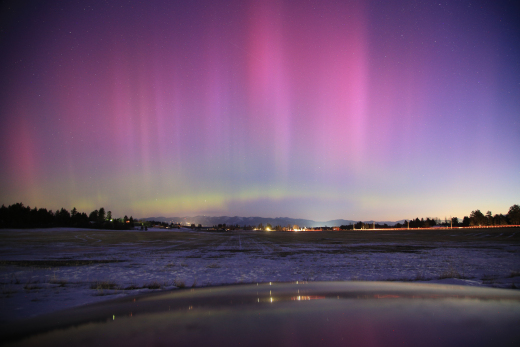
"The auroras started peaking around 6:30 am, which is when this photo was taken," he says. "What really set this apart from other displays was how colorful they were! I could easily see bright reds and purples despite the approaching dawn. These photos are straight outta the camera!"
more images: from Jonathan Cooper of Shap, Cumbria, UK; from Alan C Tough of Elgin, Moray, Scotland; from Matti Helin in southern Finland;
Realtime Aurora Photo Gallery
Free: Spaceweather.com Newsletter
A SOLAR RADIO BURST AT NIGHT: Something rare and strange happened last month. On Feb. 23rd, growing sunspot AR3234 produced an M-class solar flare. It was nearly midnight in Florida when the explosion occurred, so you'd expect no one there to notice. On the contrary, in the community of High Springs, FL, amateur radio astronomer Dave Typinski recorded a strong shortwave radio burst.
"You CAN see the sun at midnight in Florida... sometimes," says Typinski. This is what his instruments recorded while the flare was underway:
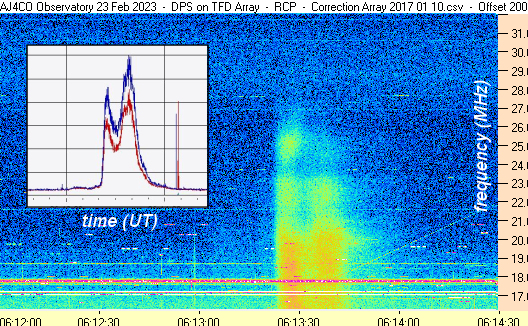
A double wave of static washed over Florida, filling the radio spectrum with noise at all frequencies below 25 MHz. "The Sun was 69° below the horizon when this happened," he marvels.
How is this possible? The entire body of our planet was blocking the event from Typinski's antenna. It's called "antipodal focusing." First postulated by Marconi more than 100 years ago, antipodal focusing is a mode of radio propagation in which a signal starts out on one side of the planet, gets trapped between Earth's surface and the ionosphere, and travels to the opposite hemisphere. Waves converging at the antipode can create a surprisingly strong signal.
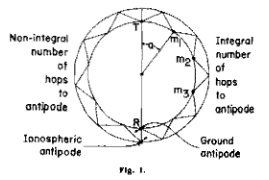 Right: This diagram from a declassified US Gov.report shows the basic geometry of antipodal focusing.
"This is the second or maybe third midnight solar radio burst I've seen in ten years, but it's by far the strongest," says Typinski. "The previous events happened at the height of Solar Cycle 24. They're quite rare."
Pause: Yes, solar flares can produce radio signals. Typinski's midnight burst was a "Type V," caused by streams of electrons shooting through the sun's atmosphere in the aftermath of the flare. Plasma waves rippling away from the streams emited intense bursts of natural radio static. The burst was first observed in broad daylight at the Learmonth Solar Observatory in Australia, then it curved around Earth to reach Typinski.
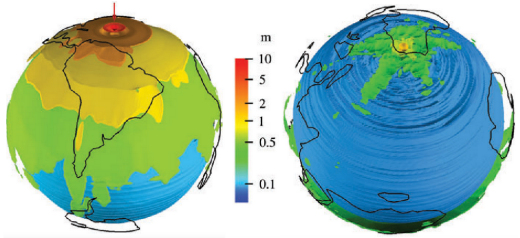
Above: An example of antipodal focusing of seismic waves caused by the Chicxulub asteroid impact. The geometry is the same as for radio waves. [more].
"This propagation mode was used during the Cold War," notes Typinski. "The U.S. would park a SIGINT ship in the south Pacific to grab signals from the Eastern Bloc. The Soviets probably did the same thing, parking in the southern Indian ocean."
Turns out, this method of spying works for radio astronomers, too. Would you like to record an event like this? NASA's Radio JOVE program makes it easy. Off-the-shelf radio telescope kits allow even novices to monitor radio outbursts from the sun, which are becoming more frequent as Solar Cycle 25 intensifies.
Realtime Space Weather Photo Gallery
Free: Spaceweather.com Newsletter
AMBER BUMBLEBEE SPACE PENDANT: Bumblebees don't usually fly so high. On Oct 15, 2022, the students of Earth to Sky Calculus launched this one to the stratosphere onboard a cosmic ray research balloon. Here it is floating 115,158 feet above California's Sierra Nevada:
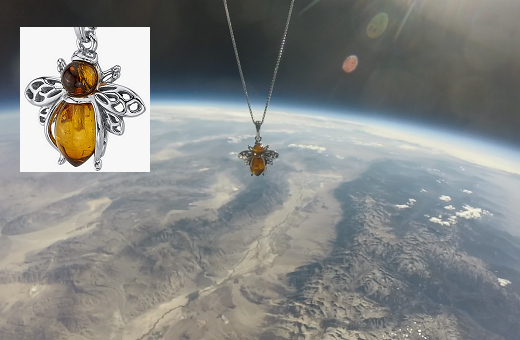
You can have it for $179.95. This bee is made of genuine Baltic Amber with a sterling silver exoskeleton. The rich Cognac-colored pendant measures 3/4 inch and comes with a matching 18-inch sterling silver chain.
The students are selling these unique pendants to support their cosmic ray ballooning program. Each one comes with a greeting card showing the bumblebee in flight and telling the story of its trip to the stratosphere and back again.
Far Out Gifts: Earth to Sky Store
All sales support hands-on STEM education
Realtime Aurora Photo Gallery
Free: Spaceweather.com Newsletter