SEVERE GEOMAGNETIC STORM: Forecasters did not see this one coming. On March 23-24, auroras spread into the United States as far south as New Mexico (+32.8N) during a severe (category G4) geomagnetic storm--the most intense in nearly 6 years. The cause of the storm is still unclear; it may have been the ripple effect of a near-miss CME on March 23rd.

"For about 30 minutes we watched as auroras danced and simmered in the sky above Yellowstone National Park," says Michael Underwood, who photographed the light show from the Mammoth Hot Springs at latitude +45 degrees:
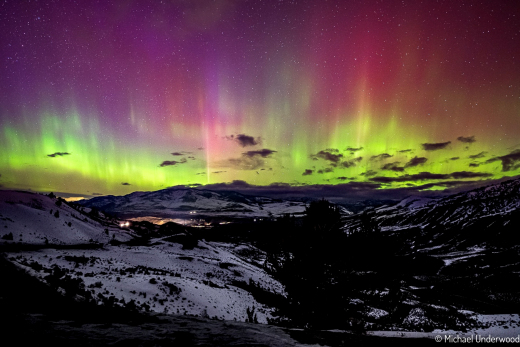
"This was my first time seeing the aurora and hopefully not the last," he says. "It was a truly unbelievable sight."
Other notable mid- to low-latitude sightings were made in Virginia (+38.7N), Colorado (+40.4N), Missouri (+40.2N), Colorado again (+40.6N), Nebraska (+42.4N), Nebraska again (+41N) and North Carolina (+36.2N). More than half of all US states were in range of the display.
Not every light in the sky was the aurora borealis. There was also STEVE. Alan Birdsell photographed the phenomenon from Spokane, Washington:
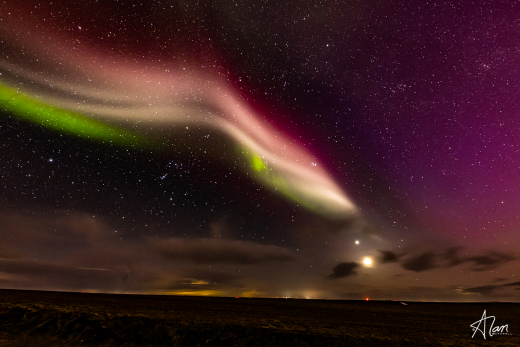
"This was the first time I have seen a severe geomagnetic storm here in Spokane," says Birdsell. "It was all a very profound and surreal experience."
STEVE (Strong Thermal Emission Velocity Enhancement) looks like an aurora, but it is not. The phenomenon is caused by hot (3000°C) ribbons of gas flowing through Earth’s magnetosphere at speeds exceeding 6 km/s (13,000 mph). These ribbons appear during strong geomagnetic storms, revealing themselves by their soft purple glow. STEVE also appeared over South Dakota, Washington State, Idaho, Idaho again, Montana, Montana again, and Scotland.
This remarkable and surprising storm began on March 23rd when magnetic fields in the space around Earth suddenly shifted. In the jargon of space weather forecasting "BsubZ tipped south." South-pointing magnetic fields can open a crack in Earth's magnetosphere and, indeed, that's what happened. Earth's "shields were down" for almost 24 hours, allowing solar wind to penetrate and the storm to build to category G4.

These developments may have been caused the close passage of an unexpected CME. The storm cloud could have left the sun on March 20-21 when SOHO coronagraph data were unusually sparse. We didn't know it was coming. For aurora watchers, it was a welcome surprise. Aurora alerts: SMS Text.
Realtime Aurora Photo Gallery
Free: Spaceweather.com Newsletter
ARCTIC NORTHERN LIGHTS PENDANT: Nothing says "I Love You" like a Northern Lights pendant from the Arctic stratosphere. On Jan. 22nd, the students of Earth to Sky Calculus launched a cosmic ray balloon to measure atmospheric radiation inside the Arctic Circle. This pendant hitched a ride, floating more than 75,000 feet above the frozen terrain of northern Sweden:
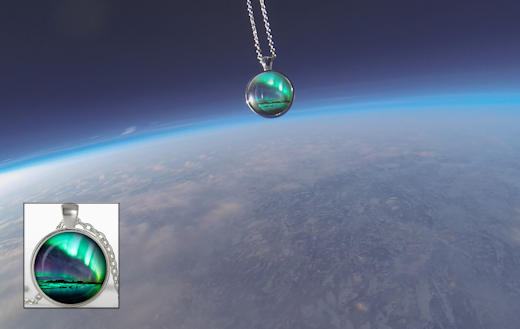
You can have it for $139.95. The students are selling these pendants to support their cosmic ray ballooning program. Each one comes with a romantic card showing the pendant in flight and telling the story of its journey to the edge of space and back again.
Far Out Gifts: Earth to Sky Store
All sales support hands-on STEM education
Realtime Space Weather Photo Gallery
Free: Spaceweather.com Newsletter