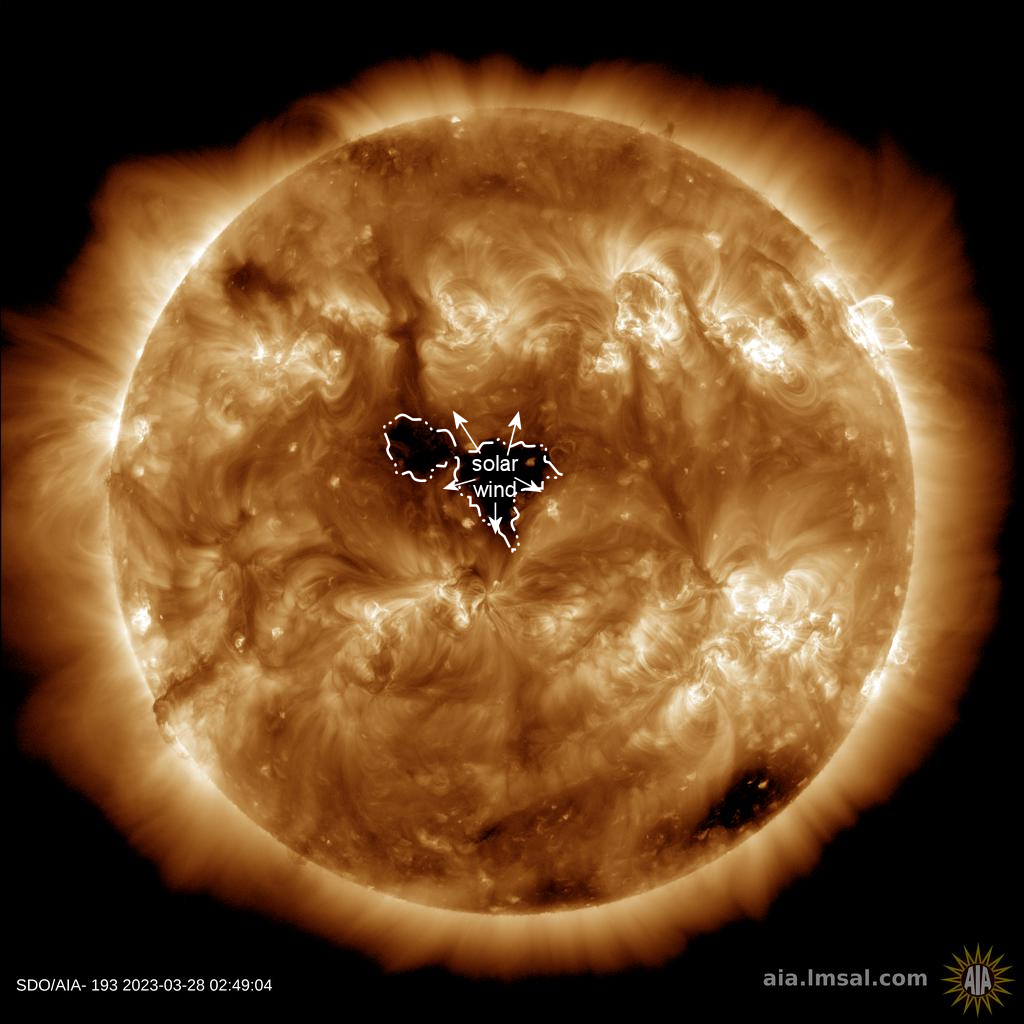
SOLAR WIND, INCOMING (UPDATED): A minor stream of solar wind is heading for Earth. ETA: March 31st. The gaseous material is flowing from a relatively small hole in the sun's atmosphere, now facing our planet. Arctic auroras are likely when the solar wind arrives. Aurora alerts: SMS Text.
ANOTHER X-CLASS SOLAR FLARE: This is becoming routine. The sun just produced another X-class solar flare, the 7th of 2023. The X1.2-category explosion came from sunspot AR3256 near the sun's southwestern limb:
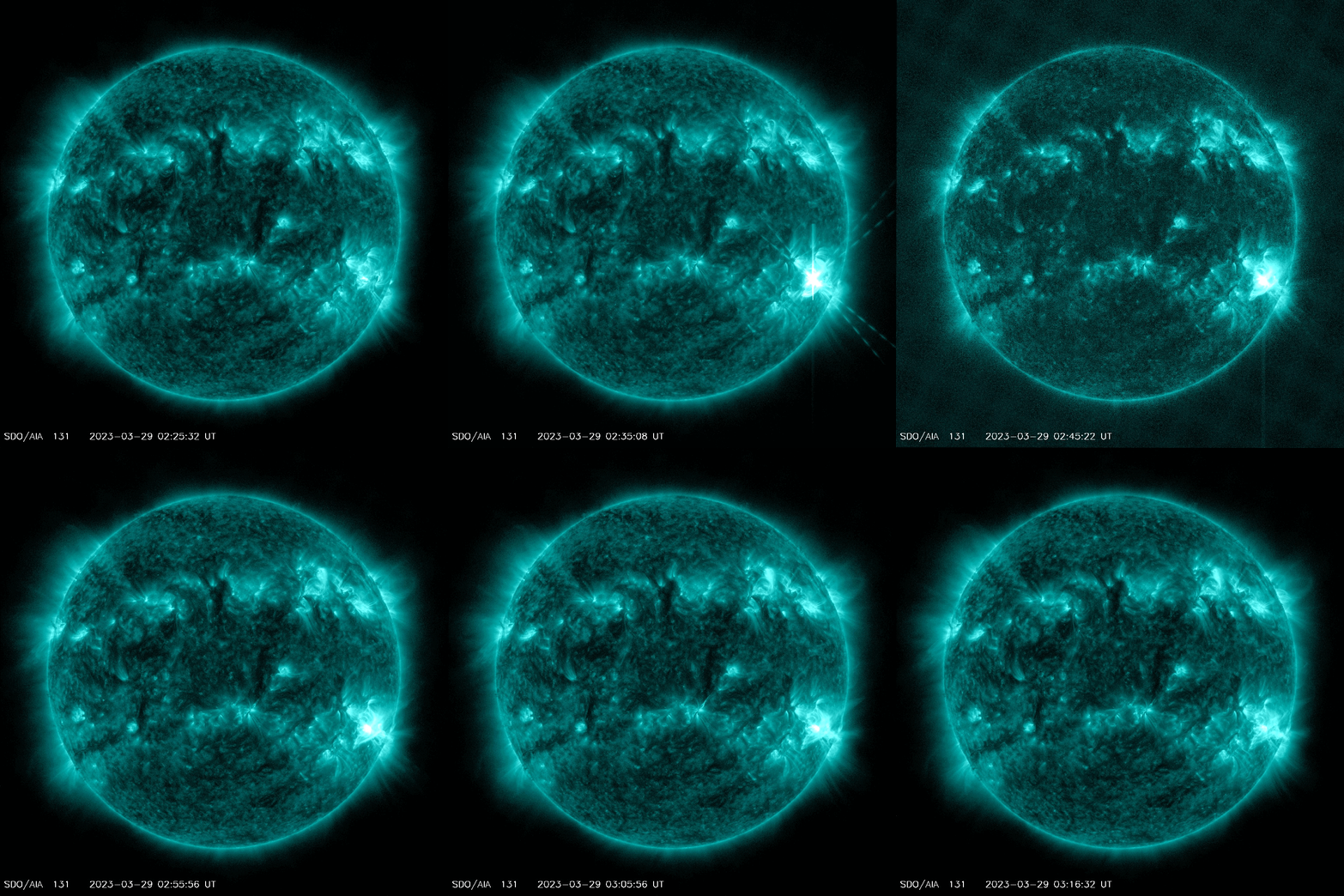
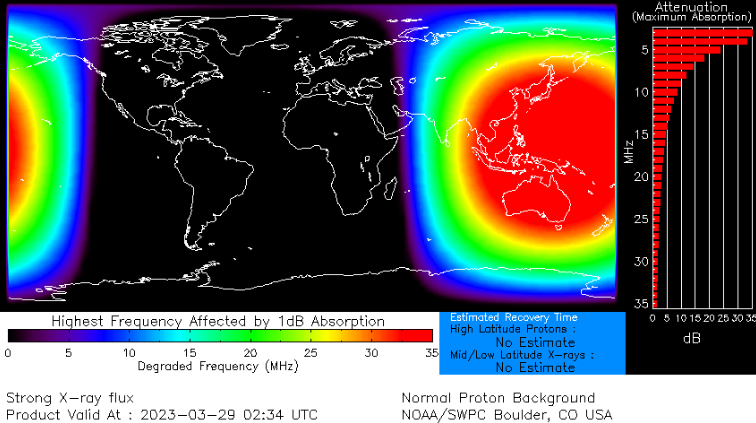
Radiation from the flare ionized the top of Earth's atmosphere, causing a strong shortwave radio blackout over southeast Asia, Australia and New Zealand. Ham radio operators may have noticed loss of signal and other propagation effects below 30 MHz for as much as an hour after the peak of the flare (March 29th @ 0233 UT).
A faint CME left the sun after the explosion. NOAA analysts have determined that it will miss Earth--no impact.
The real significance of this flare may be the number "7." That's the total number of X-flares in all of 2022. With today's flare, the sun has already matched that total in 2023--and it's only March.
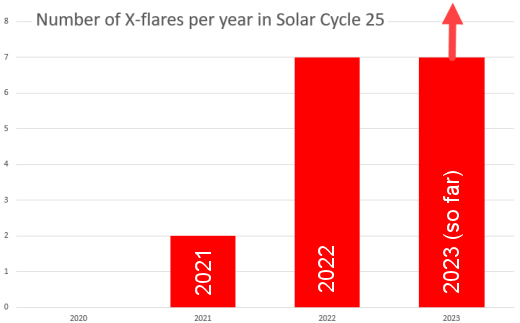
This is yet another sign that Solar Cycle 25 is rapidly intensifying. If the trend continues, we could have nearly 30 X-flares by the end of 2023, an order-of-magnitude greater activity than only two years ago. Official forecasts are calling for Solar Maximum to arrive in 2024 or 2025. If so, there is plenty of time for the solar cycle to intensify even more; X-flares could become routine, indeed. Solar flare alerts: SMS Text.
Realtime Space Weather Photo Gallery
Free: Spaceweather.com Newsletter
THIS AURORA IS NOT AN AURORA: During last week's severe geomagnetic storm, a pure red arc crossed over Denmark. It looked like an aurora, but it was not. Ruslan Merzlyakov photographed it from the Dark Sky Park in Møns Klint:

"On that night, March 23-24, Møns Klint was the only area in all of Denmark with clear skies, so naturally I wanted to try capturing the auroras. Instead I caught this wonderful 'SAR,'" says Merzlyakov.
SARs were discovered in 1956 at the beginning of the Space Age. At first, researchers didn’t know what they were and unwittingly gave them a misleading name: "Stable Auroral Red arcs" or SARs. They are neither auroral nor stable. While auroras are caused by charged particles raining down from space, SARs form differently. They are a sign of heat energy leaking into the upper atmosphere from Earth’s ring current system.
Nothing is more red than an SAR, with a monochromatic glow at 6300 Å that comes from atomic oxygen in the upper atmosphere. The human eye is relatively insensitive to light at this wavelength, so SARs are usually too faint to see. During an extreme geomagnetic storm, however, unusual things happen, and this SAR popped into view. Geomagnetic storm alerts: SMS Text.
Realtime Aurora Photo Gallery
Free: Spaceweather.com Newsletter
SOLAR ECLIPSE CRYSTAL PYRAMID: On Aug. 21, 2017, during the Great American Solar Eclipse, the students of Earth to Sky Calculus launched 11 space weather balloons from the path of totality. The armada soared into the stratosphere, touching the shadow of the Moon more than 100,000 feet above Earth's surface. This pyramid hitched a ride:
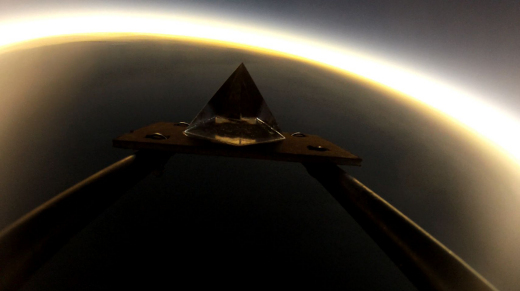
You can have it for $159.95. With the sun, Earth, and Moon perfectly aligned, the faces of the 5-sided crystal caught the reflection of the eclipsed sun. Watch the video! The pyramid comes with a gift card showing the crystal floating at the top of Earth's atmosphere and passing through the Moon's shadow. The interior of the card tells the story of the flight and confirms that this gift has been to the edge of space and back again.
Far Out Gifts: Earth to Sky Store
All sales support hands-on STEM education
Realtime Space Weather Photo Gallery
Free: Spaceweather.com Newsletter