MINOR GEOMAGNETIC STORM: A solar wind stream hit Earth's magnetic field during the early hours of March 31st, sparking a minor G1-class geomagnetic storm. Auroras were sighted across parts of Canada and northern Europe. Aurora alerts: SMS Text.

AN ELVE OVER ITALY: For a few milliseconds last Monday night, March 27th, an enormous red ring of light appeared in the sky over central Italy. Valter Binotto photographed it from the small town of Possagno in the foothills of the Italian Alps:
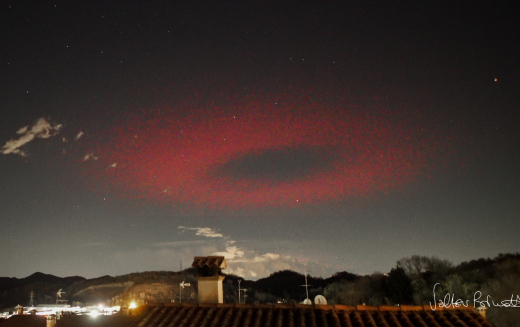
This is an "ELVE"--short for Emissions of Light and Very Low Frequency Perturbations due to Electromagnetic Pulse Sources. It's a rare species of sprite discovered in 1990 by cameras onboard the space shuttle. Binotto may have just taken the best ever picture of one from the ground.
"The ELVE was generated by intense lightning in a storm near Ancona about 285 km south of me," says Binotto. One bolt was so strong, it generated an intense electromagnetic pulse (EMP). The red ring marks the spot where the EMP hit Earth's ionosphere. Normal lightning bolts carry 10 to 30 kilo-ampères of current; this bolt was about 10 times stronger than normal.
Binotto created a graphic showing the scale of the ELVE:
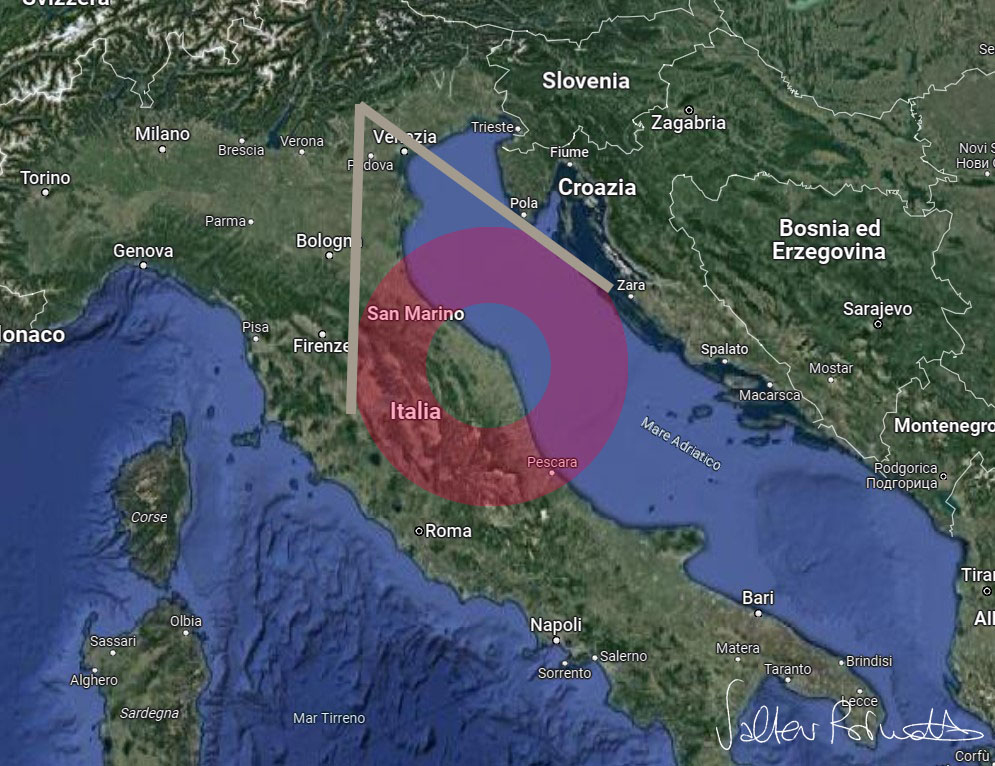
"It was about 100 km high and nearly 360 km wide," says Binotto. "I have been photographing upper atmospheric lightning and transient luminous events (TLEs) since 2019, hundreds of them, and this is one of the biggest structures I have ever seen."
ELVE season is just getting started in Europe and North America, where spring and summer thunderstorms will multiply in the months ahead. Photographers should be alert for red rings and many other things above the cloudtops. Look here.

Realtime Space Weather Photo Gallery
Free: Spaceweather.com Newsletter
AURORAS OVER OKLAHOMA: Add Oklahoma to the list of US states where auroras appeared during the severe geomagnetic storm of March 23-24. "As it got very dark, the northern horizon erupted in pillars I could see with my naked eyes," reports Paul Smith, who photographed the display from the southern part of the state:
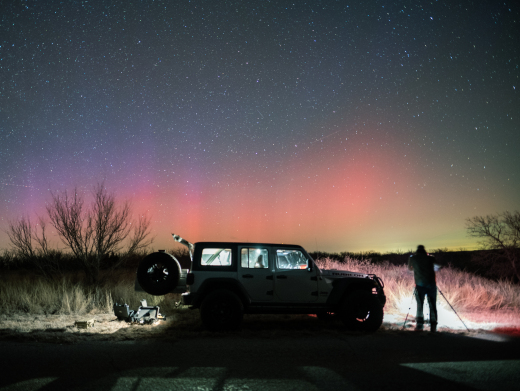
Smith is a world famous photographer of sprites and other transient luminous events. In fact, he was sprite-chasing at the time. "I had set up my camera with a clear view of the horizon, the better to see distant cloudtops where sprites emerge," he explains. This gave him a good view of the auroras as well.
"I definitely had a lump in my throat as emotions welled inside," he says. "Nature is always so giving."
Like other low-latitude displays on March 23-24, the auroras over Oklahoma were mostly red. This map shows the distribution of aurora photos submitted to Spaceweather.com, color coded by their dominant hue:
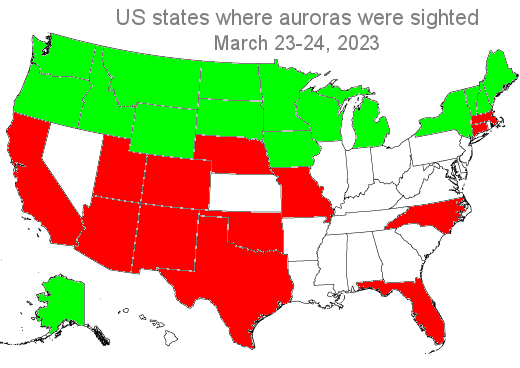
Most auroras are green, yet when auroras spread to low latitudes, the sightings are almost always red. There's a simple reason. Ordinary green auroras come from oxygen atoms about 150 km above Earth's surface. Red auroras are also caused by oxygen, but much higher up, between 150 km and 500 km. A picture taken by Andrew Morris in the UK nicely illustrates the red-on-green altitude structure. From relatively far-south places like Oklahoma, greens are mostly eclipsed by the northern horizon, leaving the higher reds to dominate the display.
Did *you* see red during the storm? Submit your photos here. Aurora alerts: SMS Text.
new images: from Andy Jones of Hope, New Mexico; from Nancy Tompkins of Prescott, Arizona; from Denys Wachterdorff of Tooele, Utah; from Geoff Markowski of Underhill Vermont; from Mariah Winterowd of Wyoming; from Wesley Luginbyhl of Amarillo, Texas; from Hunter Outten of Lewes, Delaware; from Johnny Coletta of Rockport, Massachusetts
Realtime Aurora Photo Gallery
Free: Spaceweather.com Newsletter
OCEAN BLUE CRYSTAL DOLPHIN PENDANT: Are you looking for a far-out gift? Consider the Ocean Blue Crystal Dolphin Pendant. It flew to the stratosphere onboard a cosmic ray research balloon:
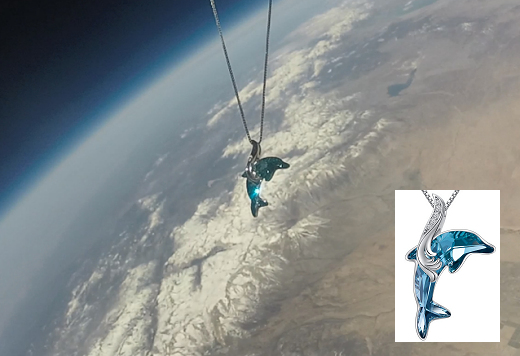
You can have it for $199.95. The students of Earth to Sky Calculus are selling these crystal cetaceans to support their cosmic ray monitoring program.
The dolphin is wrapped in a sterling silver wave and suspended from a matching 18-inch chain. It contains no nickel, no lead, no cadmium; the pendant is totally hypoallergenic. Each pendant comes with a greeting card showing the dolphin in flight, and telling the story of its trip to the edge of space and back again.
Far Out Gifts: Earth to Sky Store
All sales support hands-on STEM education
Realtime Space Weather Photo Gallery
Free: Spaceweather.com Newsletter