NO CMEs ARE HEADING FOR EARTH: Geomagnetic storms are unlikely this week. One CME just missed Earth and no others are heading our way. The best chance for an aurora-producing storm lies in sunspot AR3270, which has an unstable magnetic field that poses a threat for strong flares. Aurora alerts: SMS Text.
CRYOVOLCANIC COMET GOES QUIET, THEN ERUPTS: The British Astronomical Association (BAA) is reporting a strong eruption on cryovolcanic comet 29P/Schwassmann-Wachmann. "The new outburst on April 2nd was so intense] it now reflects more than 10 times the light reflected by the nucleus alone," writes Dr. Richard Miles of the BAA. Astronomers Maria Eleftheriou and Jose Manuel Perez Redondo used the 2.0-m Faulkes Telescope South and its twin robotic scope on Haleakala, Hawaii, to photograph the expanding cloud:
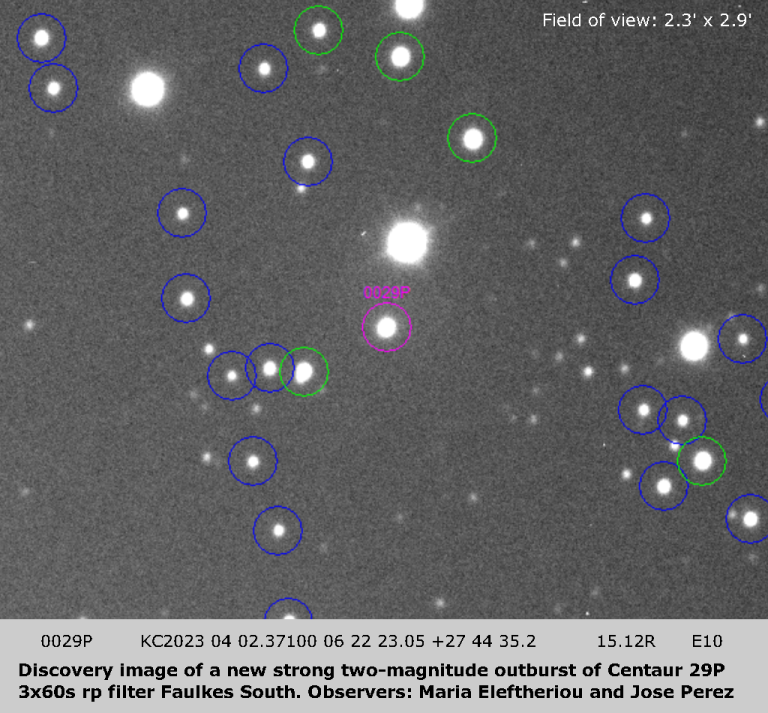
Cryovolcanos on 29P erupt unpredictably all the time. This eruption was unusual because researchers suspected it was coming. They predicted it.
"We have been watching 29P especially closely in recent days because the pseudo-nucleus had become very faint indicative of the crust sealing and preventing outgassing," says Miles. "In fact, photometry indicated the nucleus, and the region within a few hundred kilometres of it, was the faintest we had ever seen it."
The deep fading turned out to be the calm before the storm, just as Miles and colleagues suspected. Amateur astronomers who wish to help monitor this eruption can find 29P in the constellation Gemini, right here.
Realtime Aurora Photo Gallery
Free: Spaceweather.com Newsletter
ADD NEVADA TO THE LIST: We've been keeping track of all the US states where auroras were sighted during the severe geomagnetic storm of March 23-24--a tally based on pictures submitted to Spaceweather.com. Photographer Heidi Pinkerton just added Nevada to the list. "I was passing through Beatty NV when the sky started to glow," she says. A 10 second exposure with her Canon R5 caught the deep red-purple glow:

"They weren't easy to see with the naked eye, but the camera easily picked up the color," says Pinkerton, who also photographed the display across the California border in Death Valley National Park.
Adding Nevada to the list brings the total number of states to 33. This map shows the distribution of aurora photos color coded by their dominant hue:

By now many readers know why the colors are separated, north vs. south. Auroras are like a layer cake with red on top and green on the bottom. Green is usually brighter, so green dominates most photos taken in the north where the full display can be seen. People in the south, however, can't see the full display. Their northern horizon blocks the view of low-hanging greens, leaving only red to color the sky.
Is your state missing from this map? Send us an aurora photo and we will add it to the list. Aurora alerts: SMS Text.
Realtime Space Weather Photo Gallery
Free: Spaceweather.com Newsletter
"I LOVE YOU FOREVER" MOONSTONE PENDANT: Are you looking for a far-out gift? Consider the "I Love You Forever" Moonstone. This one hitched a ride to the stratosphere onboard a cosmic ray research balloon:
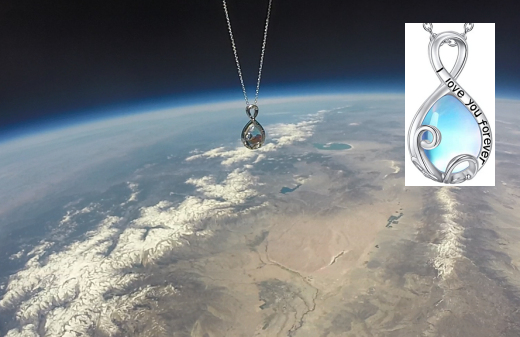
You can have it for $162.95. The moonstone's sterling silver infinity wrap is inscribed with the words "I love you forever." It makes a great anniversary or birthday gift. The moonstone comes with a greeting card showing the pendant in flight, telling the story of its trip to the edge of space and back again.
Far Out Gifts: Earth to Sky Store
All sales support hands-on STEM education
Realtime Space Weather Photo Gallery
Free: Spaceweather.com Newsletter