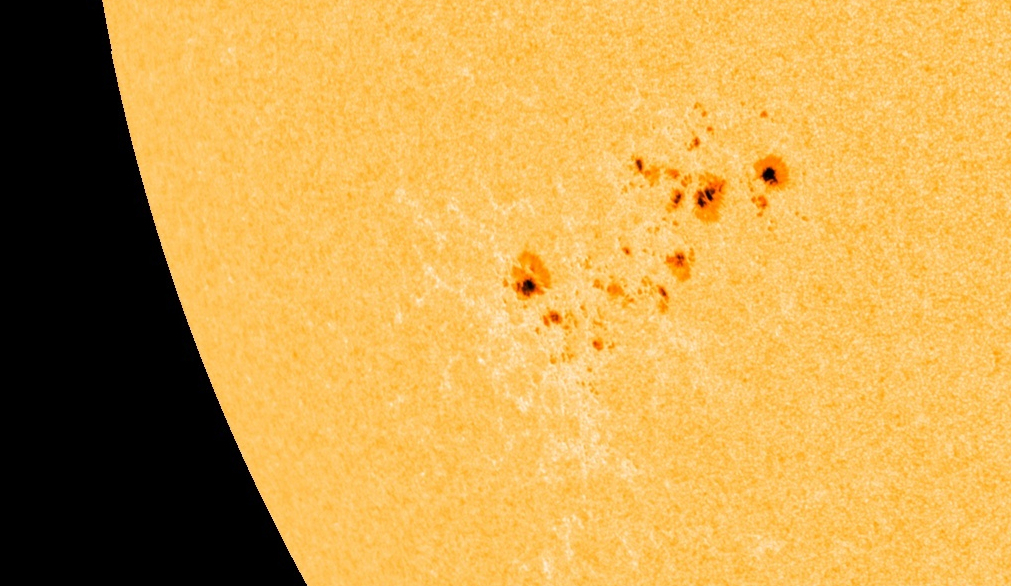
CHANCE OF FLARES TODAY: NOAA forecasters say there is a 30% chance of M-class solar flares today, April 9th. Almost certainly, the source would be sunspot AR3272, which has an unstable 'beta-gamma' magnetic field. Any explosions will be geoeffective as the sunspot is turning to face Earth. Solar flare alerts: SMS Text.
FARSIDE SUNSPOT: You might suppose that the farside of the sun is hidden from view. However, researchers using a technique called "helioseismology" can make crude maps of the sun's hidden hemisphere. Their latest map reveals a farside sunspot:
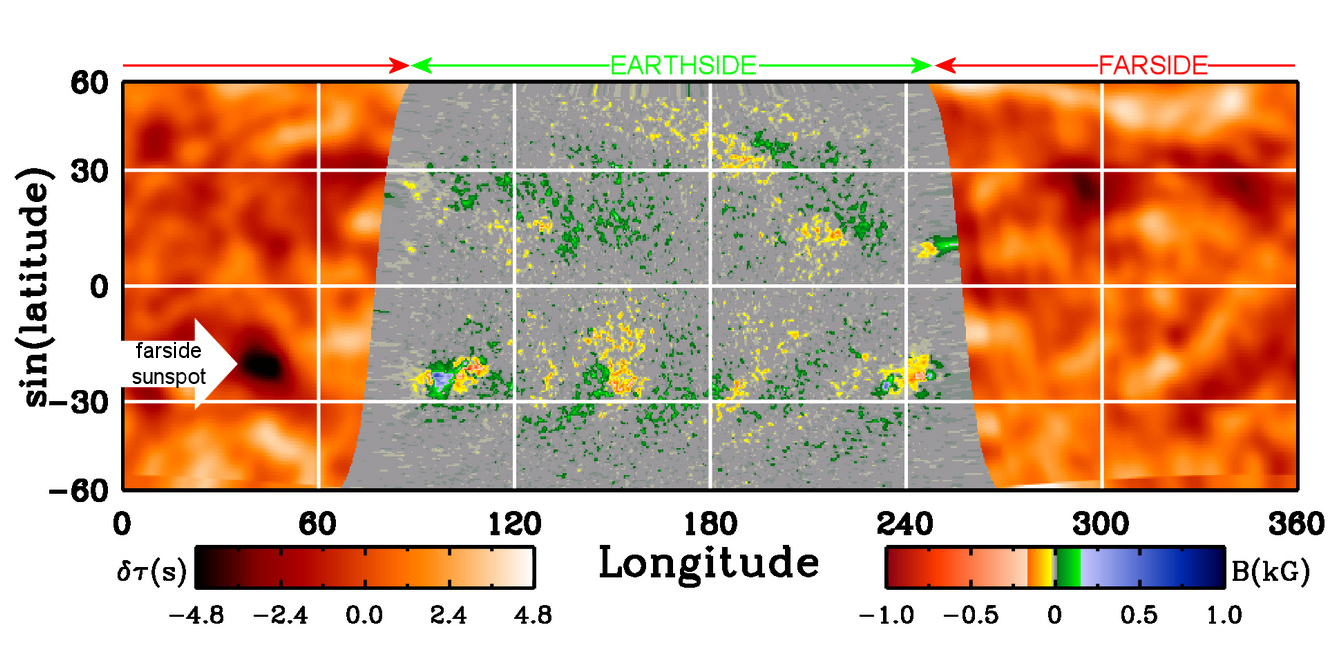
The black blob is a sunspot. It is the likely source of several jets and plumes of hot plasma flying over the sun's southeastern limb during the past 24 hours. The sunspot will turn to face Earth this week. Solar flare alerts: SMS Text.

Realtime Space Weather Photo Gallery
Free: Spaceweather.com Newsletter
JUPITER SPACECRAFT PHOTO-OP: The European Space Agency is about to launch a very important spacecraft: The Jupiter Icy Moons Explorer--"Juice" for short. Its mission is to probe Europa, Ganymede, and Callisto, moons with oceans larger than those of Earth and possible habitats for extraterrestrial life. Liftoff is scheduled for April 13th (12:15 UT) from French Guiana.
"It may be possible for experienced observers to photograph Juice as it recedes on the night after launch," says John H. Rogers, the Jupiter Section Director of the British Astronomical Association. "The solar panels should be deployed by 100 minutes after launch, with full deployment over the next 17 days. You can obtain an ephemeris from JPL-Horizons. Type 'Juice' in for the target body."
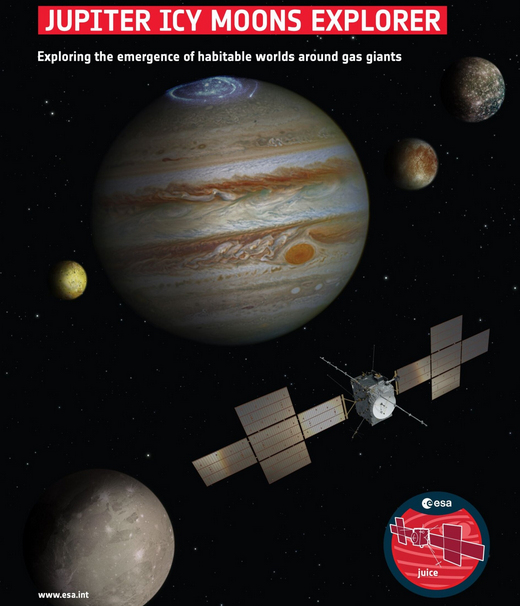
"The best views will be from the Far East and Australia, from about 14:00 UT onwards when solar panels are deployed," sys Rogers. "The brightness will then diminish as the distance from Earth increases; by the time it is visible from western Europe, approaching 150,000 km out, one experienced observer suggests that it might be around mag.13 or 14."
Juice will take 8 years to reach Jupiter. After a series of visits to Callisto and Europa, Juice will enter into a permanent orbit around Ganymede in 2034--the first time a spacecraft has ever held an orbit around a moon other than our own. Bigger than the planet Mercury, Ganymede is also the only moon in the solar system with its own magnetic field, providing a possible protective coccoon for life.
If you see Juice leaving Earth, please submit your photos here.
THE VERNAL EQUINOX PEARL: Are you looking for a far-out gift? Consider the Vernal Equinox Pearl, launched to the edge of space onboard an Earth to Sky Calculus cosmic ray balloon. Here it is, floating 111,202 feet above the Sierra Nevada mountains of central California:
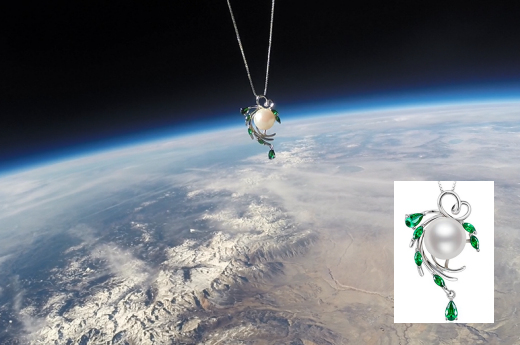
You can have it for $179.95. The 10mm cultured white pearl, surrounded by a crystalline splash of spring-green cubic zirconia, spent more than 2 hours in the stratosphere as sensors in the payload measured cosmic rays.
Each purchase comes with a greeting card showing the pearl in flight and telling the story of its journey to the stratosphere and back again.
Far Out Gifts: Earth to Sky Store
All sales support hands-on STEM education
Realtime Aurora Photo Gallery
Free: Spaceweather.com Newsletter