JUPITER SPACECRAFT PHOTO-OP--DELAYED: The European Space Agency is about to launch a spacecraft named "Juice" to explore the icy moons of Jupiter. If all goes well, it might discover new habitats for alien life. Amateur astronomers may be able to photograph Juice as it leaves Earth after launching from French Guiana on April 14th (delayed from April 13th due to weather). Get ready: Observing tips.
SOLAR MAX MIGHT ARRIVE EARLY: Solar Maximum is coming--maybe this year. New research by a leading group of solar physicists predicts maximum sunspot activity in late 2023 or early 2024, a full year earlier than other forecasts.
"This is based on our work with the Termination Event," explains Scott McIntosh, lead author of a paper describing the prediction, published in the January 2023 edition of Frontiers in Astronomy and Space Sciences.
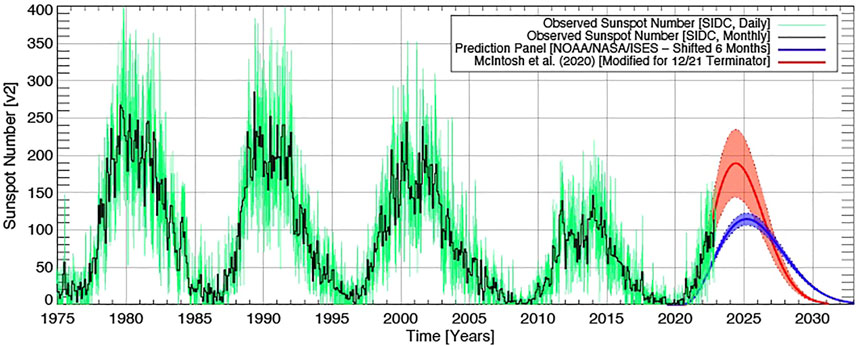
Above: The red curve shows McIntosh et al's new prediction of an early Solar Max.
The "Termination Event" is a relatively new concept in solar physics. It is a period of time on the sun as short as one month when magnetic fields from one solar cycle abruptly die (they are "terminated") allowing magnetic fields from the next solar cycle to take over. After a Termination Event, the new solar cycle skyrockets.
McIntosh and colleagues have studied termination events for many solar cycles, and they have discovered that its timing can predict the future. "Our latest work pinpoints the Termination Event between Solar Cycle 24 and Solar Cycle 25 at mid-Dec. 2021," explains McIntosh. "This tells us about the size and date of the next solar maximum."
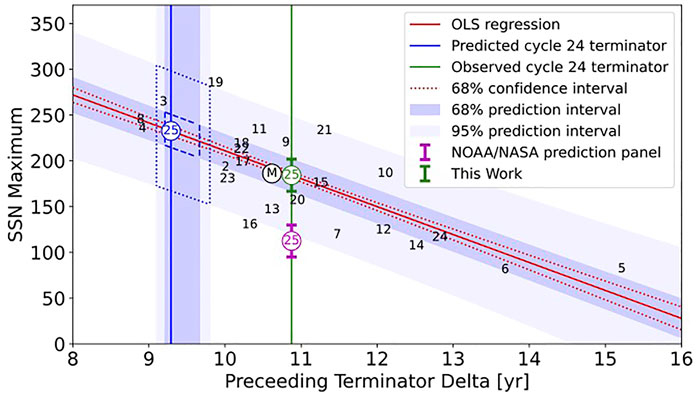
According to their paper, Solar Max is coming between late 2023 and mid 2024, with a peak total monthly sunspot number of 184±63 (95% confidence). This means Solar Cycle 25 could be twice as strong as old Solar Cycle 24, which peaked back in 2014.
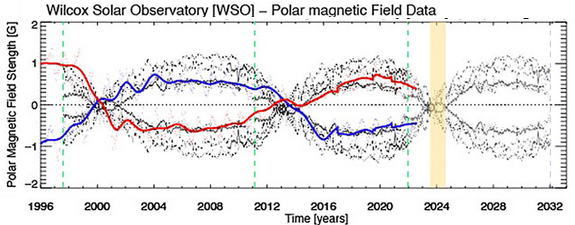
Above: The sun's polar magnetic field (red=N, blue=S) is weakening and will soon flip
Their forecast jibes with another big event now underway. The sun's global magnetic field is about to flip. This happens near the peak of every solar cycle. Magnetic fields near the sun's poles weaken, change sign, and start growing again in the opposite direction. It's like taking a bar magnet from your refrigerator and flipping it upside down--except this bar magnet is as big as a star.
Measurements from Stanford's Wilcox Solar Observatory (pictured above) confirm that the weakening is underway now, with polar magnetic fields probably crossing zero in no more than a few months. "Historically the zero crossing precedes actual sunspot number maximum by 6 to 12 months," says McIntosh, "so this is in accord with our prediction of an early Solar Max."
This forecast is about to be tested, with confirmation as little as 6 to 12 months away. Stay tuned for Solar Max.
Realtime Space Weather Photo Gallery
Free: Spaceweather.com Newsletter
STERLING SILVER HUMMINGBIRD PENDANT: This hummingbird has touched space. On Sept. 22, 2022, the students of Earth to Sky Calculus launched the sterling silver pendant to the stratosphere onboard a cosmic ray research balloon, more than 117,710 feet high:
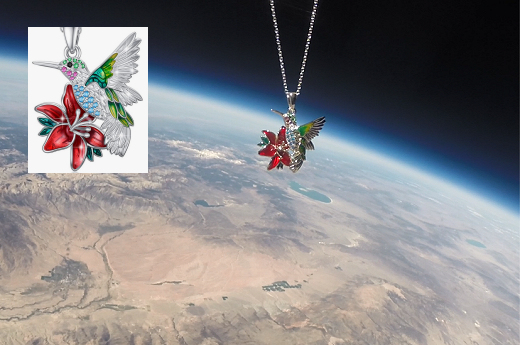
You can have it for $169.95. The students are selling hummingbird pendants to pay the helium bill for their cosmic ray ballooning program. Each one comes with a greeting card showing the bird and red lily in flight, and telling the story of their trip to the stratosphere and back again.
Far Out Gifts: Earth to Sky Store
All sales support hands-on STEM education
Realtime Aurora Photo Gallery
Free: Spaceweather.com Newsletter