JUPITER SPACECRAFT PHOTO-OP: The European Space Agency's Juice spacecraft is on its way to Jupiter on a mission to discover new habitats for alien life. It launched this morning from Europe's spaceport in Kourou, French Guiana. Amateur astronomers may be able to photograph Juice as it leaves Earth using these observing tips.
THE SODIUM TAIL OF MERCURY: Astronomy used to be so simple. Comets had tails, and planets did not. Mercury is making things complicated. When Dr. Sebastian Voltmer of Spicheren, France, photographed the planet this week, it exhibited a magnificent plume of gas flowing behind it:
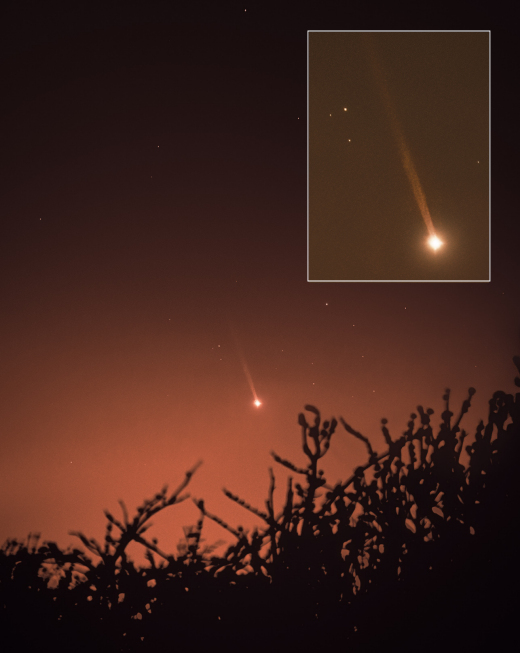
"Mercury is NOT a comet, but it sure looks like one," says Voltmer. "Solar wind and micro-meteorites hitting the planet eject sodium atoms from Mercury's surface. This creates a yellow-orange tail of sodium gas that is around 24 million kilometers long."
First predicted in the 1980s, Mercury's tail was discovered in 2001. The gaseous plume is made of many elements from Mercury's rocky surface, not only sodium. Sodium, however, dominates the scattering of sunlight and gives the tail its striking yellow hue.
People watching Mercury climb up the evening sky this month may be wondering "why didn’t I see a tail?" Answer: A special filter is required. "I used a 589 nanometer filter tuned to the yellow glow of sodium," says Voltmer. "Without such a filter, Mercury's tail is almost invisible to the naked eye."
Mercury's tail waxes and wanes in brightness as it orbits the sun. The predictable pattern is shown in this movie from NASA's MESSENGER spacecraft, which spent years observing Mercury’s tail from close range:
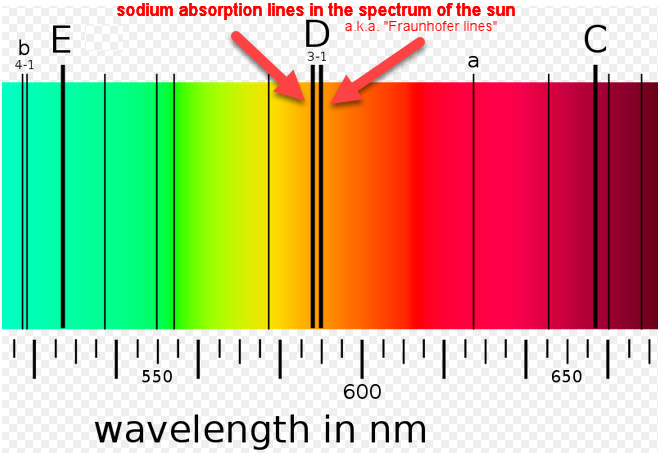
For reasons having to do with the Doppler shift of sodium absorption lines in the solar spectrum, Mercury's tail is most luminous when the planet is ±16 days from perihelion (closest approach to the sun).
This means the tail's maximum luminosity is only a few days away. Mercury will be 16 days past perihelion on Monday, April 17th, located in the sunset sky almost directly below Venus. If you have a sodium filter, take a look!
more images: from Nicolae-Adrian Corlaci of Bucharest, Romania; from Paul Robinson near Memphis, TN
Realtime Space Weather Photo Gallery
Free: Spaceweather.com Newsletter
STORM TROOPER WHISKEY GLASS: If you like your drink cold--really cold--this glass is for you. It has flown to the stratosphere onboard an Earth to Sky Calculus cosmic ray research balloon. At the apex of the flight (117,109 ft), the temperature was a frosty -63C:
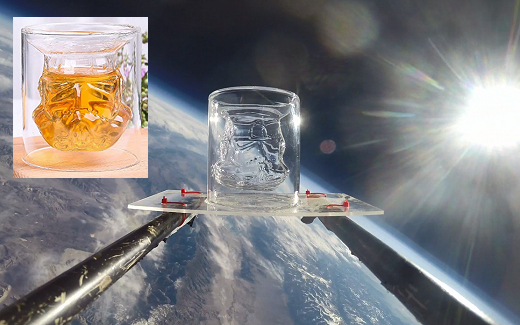
You can have it for $99.95. This double-walled whiskey glass is cast from one of the original molds for Storm Trooper helmets used in Star Wars: A New Hope in 1977. Made of high quality borosilicate, the glass is thin, hard and lead-free. It makes a great Christmas gift for Star Wars fans.
The glass comes with a greeting card showing the item in flight, and telling the story of its journey to the stratosphere and back again.
Far Out Gifts: Earth to Sky Store
All sales support hands-on STEM education
Realtime Aurora Photo Gallery
Free: Spaceweather.com Newsletter