SEVERE GEOMAGNETIC STORM IN PROGRESS: Arriving earlier than expected, a CME hit Earth's magnetic field today, April 23rd, at 1737 UT. The impact sparked a severe G4-class geomagnetic storm with auroras in Europe sighted as far south as France. The storm is still going on and could produce auroras over the USA after nightfall. Aurora alerts: SMS Text.

"My pulse is still racing!" says Heiko Ulbricht, who watched the aurora show from Saxony, Germany. "There were bright green spots dancing across the sky all the way up to the zenith." This is what he saw:
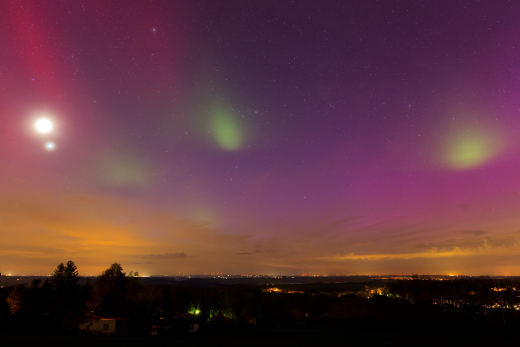
"I still can't breathe," he says. "This was a display not to be forgotten."
The auroras were so bright, they could be seen even from brightly-lit urban areas. Thomas Hunger sends this report from Berlin, Germany: "I run Northern Lights tours in Tromsø, Norway, but would have never dreamt of seeing auroras from my home town of Berlin. I stepped on the balcony and enjoyed a sight that in a city of 4 million inhabitants might just have been a once-in-a-lifetime experience."
Tomasz Adam had a similar experience in Kraków, Poland: "I saw auroras for the first time in my life," he says. "My photo might not look like much, but I took it from Kraków - one of the most light polluted cities of Poland."
Realtime Aurora Photo Gallery
Free: Spaceweather.com Newsletter
POLAR CAP ABSORPTION EVENT: Don't try to use a shortwave radio inside the Arctic Circle today. It might not work. A deep polar cap absorption (PCA) event is in progress:
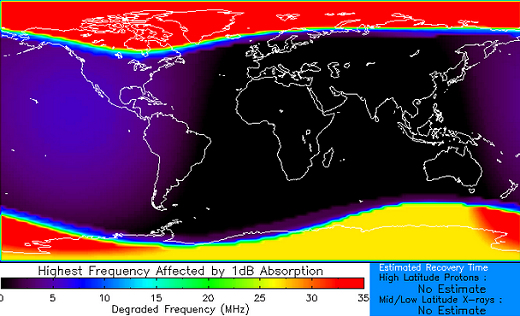
Red zones in this global map show where shortwave transmissions are being absorbed. Frequencies below 15 MHz are almost completely blacked out, while anything below 35 MHz is being attentuated, at least a little.
What's causing this? A CME hit Earth on April 23rd. Just before it arrived, shock waves at the leading edge of the CME accelerated a fusillade of high-energy protons straight toward our planet. Earth's magnetic field funneled the protons toward the poles where their ionizing effect causes the absorption of shortwave radio.
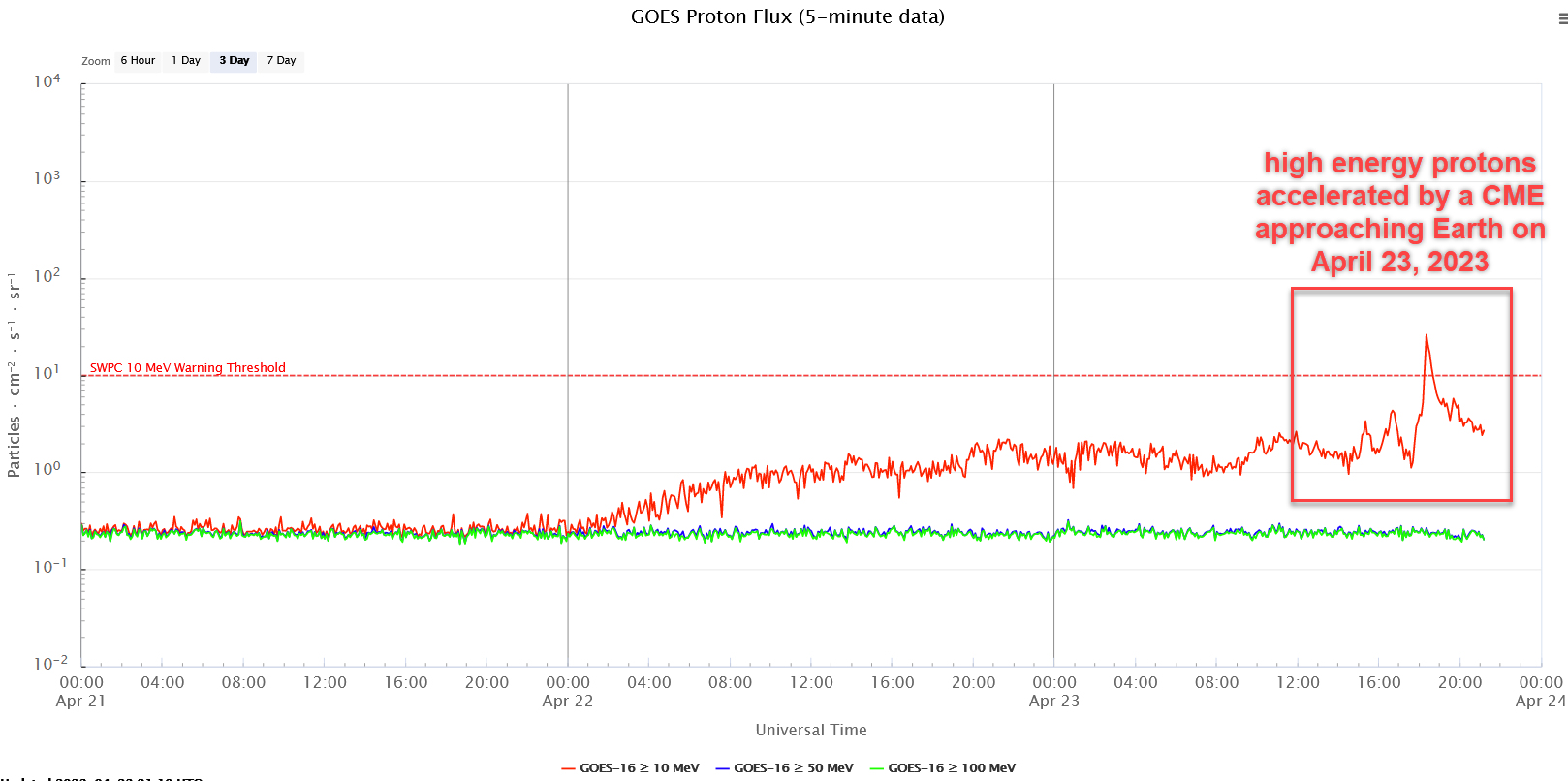
The PCA could continue for days; you can can monitor its progress here.
Realtime Space Weather Photo Gallery
Free: Spaceweather.com Newsletter
SILVER SNOOPY SPACE PENDANT: Snoopy has touched space. This sterling silver pendant flew to the stratosphere on April 15, 2023, floating on a cosmic ray balloon 117,400 feet above the Sierra Nevada mountains of central California:
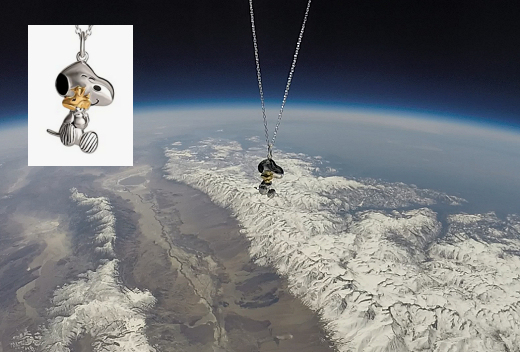
You can have it for $159.95. Space Snoopy makes a great birthday, anniversary or Mother's day gift. The students of Earth to Sky Calculus are selling space pendants to support their cosmic ray ballooning program. Each one comes with a greeting card showing the pendant in flight and telling the story of its journey to the stratosphere and back again
Far Out Gifts: Earth to Sky Store
All sales support hands-on STEM education
A BURST OF STATIC FROM THE SUN: The explosion that hurled a CME toward Earth on April 21st also illuminated our planet with an intense burst of shortwave radio static. Amateur astronomer Thomas Ashcraft of New Mexico recorded the outburst:
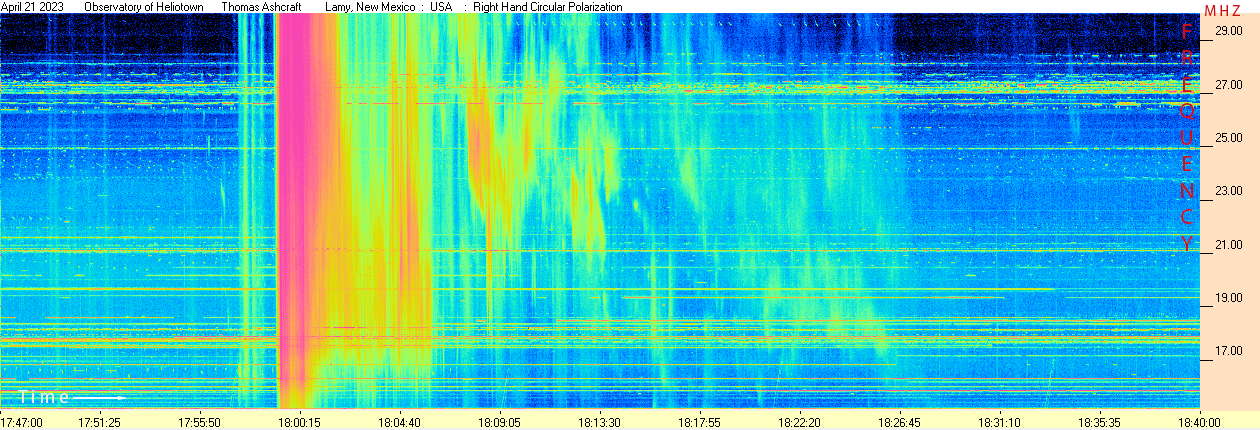
"Few solar radio bursts show as hot purple on my spectrograph, but this one 'rang the bell'," he says. "Here is an audio recording in stereo with 22 MHz in one channel and 19 MHz in the other."
The static in Ashcraft's recording, which washes over the listener like a slow ocean wave, is naturally produced. Astronomers classify it as a Type V solar radio burst caused by energetic beams of electrons ray-gunning through the sun's atmosphere. The electrons were accelerated by the same underlying explosion that hurled a CME toward Earth.
Solar radio bursts are an underappreciated form of space weather. We often talk about radio blackouts, which happen when solar flares ionize the top of Earth's atmosphere. A radio blackout suppresses the normal propagation of terrestrial radio signals. Solar radio bursts are different; they produce a radio drownout. Intense static from the sun overwhelms normal transmissions, drowning out the voices radio operators are trying to hear.
Solar radio bursts will happen more and more often as Solar Cycle 25 intensifies. You can hear them youself using a RadioJOVE radio telescope kit from NASA.
Realtime Space Weather Photo Gallery
Free: Spaceweather.com Newsletter