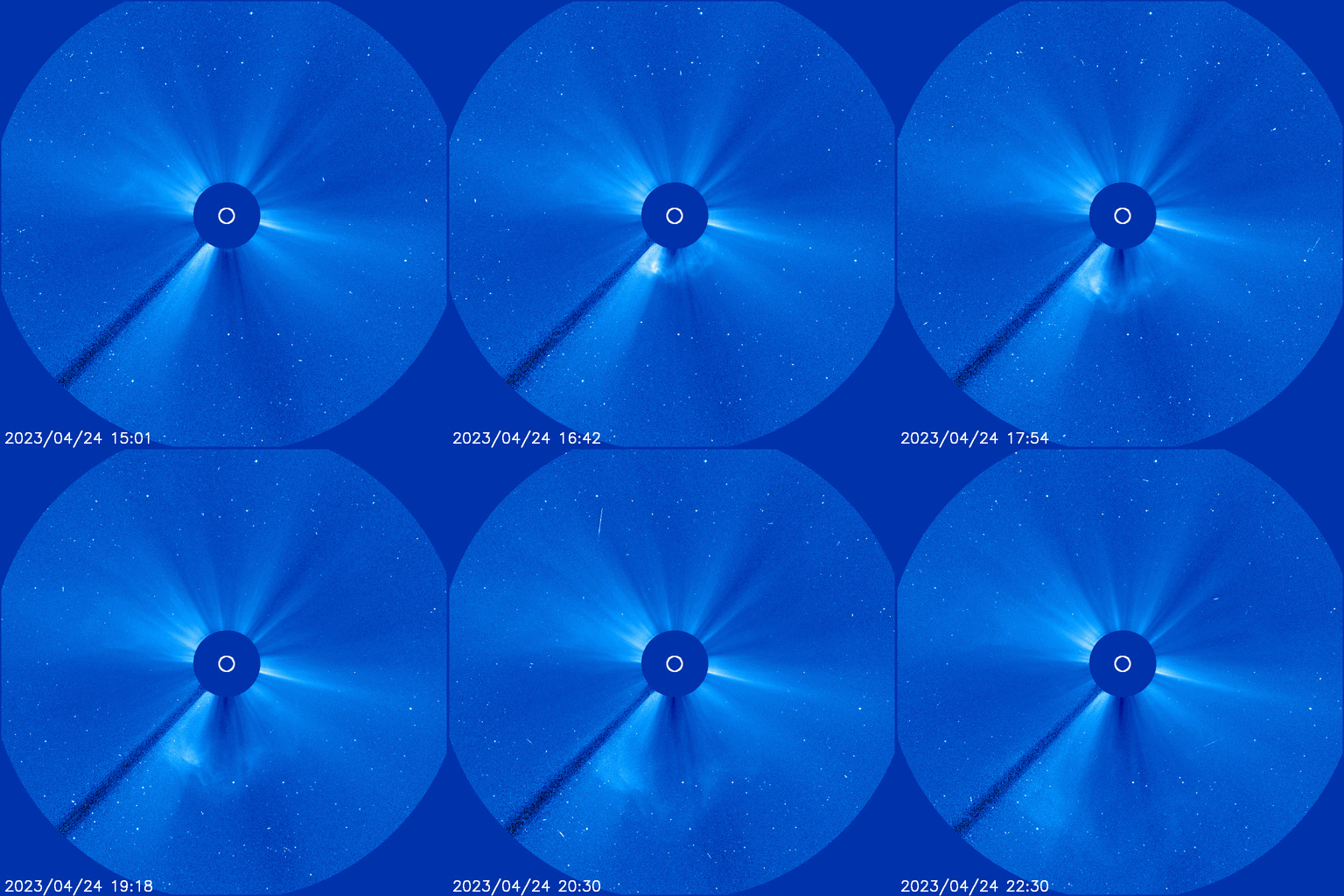
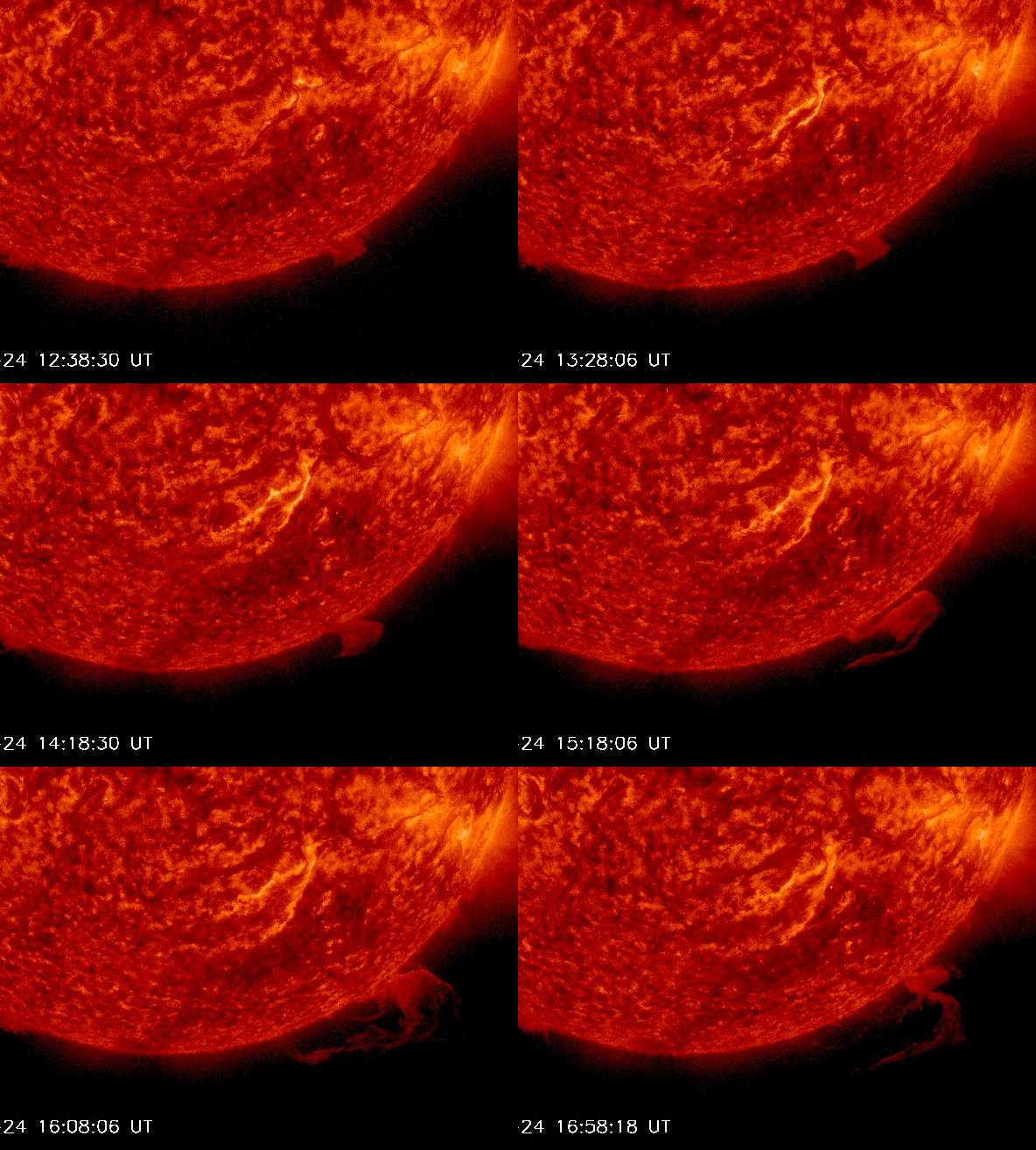
ANOTHER CME IS COMING: But this one will not cause a severe geomagnetic storm. Unlike the CME that struck Earth directly on March 23rd, the next CME will deliver only a glancing blow. It was hurled into space on April 24th by an explosion in the sun's southern hemisphere; most of the CME will sail harmlessly south of our planet. Minor G1-class geomagnetic storms are possible on April 27th and 28th when the CME arrives. Aurora alerts: SMS Text.

AUSTRAL STEVE: In Earth's southern hemisphere, the severe geomagnetic storm of April 23-24 sparked bright auroras--and something more. STEVE also appeared. Ian Griffin photographed the luminous purple ribbon from Hooper's Inlet on the Otago Peninsula of New Zealand:
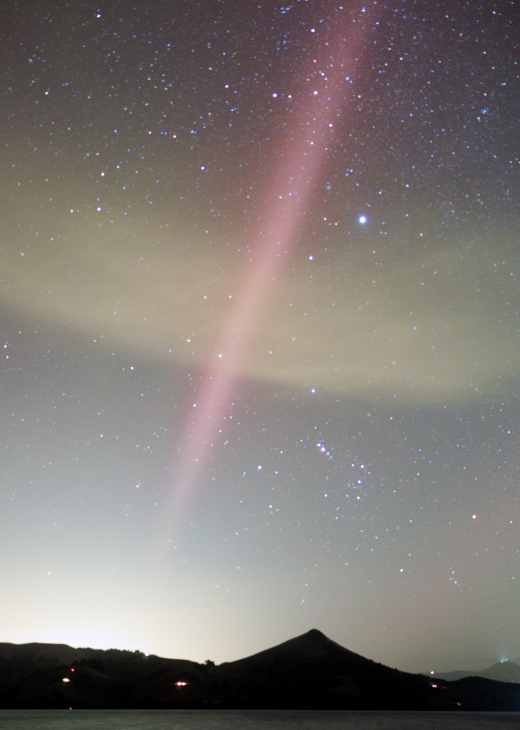
"The night was amazing, with a wonderful display of aurora australis dominating the southern sky," says Griffin. "At around 9:30pm local time, an unexpected guest arrived--STEVE!"
STEVE (Strong Thermal Emission Velocity Enhancement) looks like an aurora, but it is not. The phenomenon is caused by hot (3000°C) ribbons of gas flowing through Earth’s magnetosphere at speeds exceeding 6 km/s (13,000 mph). These ribbons appear during strong geomagnetic storms, revealing themselves by their soft purple glow.
STEVE is a recent discovery. Sky watchers in Canada identified it less than 10 years ago. Since then it has been seen many times in the northern hemisphere, but not as often in the south. The sightings on April 23-34 are among the best so far of "Austral STEVE."
more images: from Dave Curtis of Brighton, Dunedin, New Zealand
HOW LOW DID THE NORTHERN LIGHTS GO? A CME hit Earth's magnetic field on April 23rd, a direct hit that sparked a severe G4-class geomagnetic storm. Northern lights spilled out of the Arctic Circle all the way down to the US-Mexico border (+29.5N):

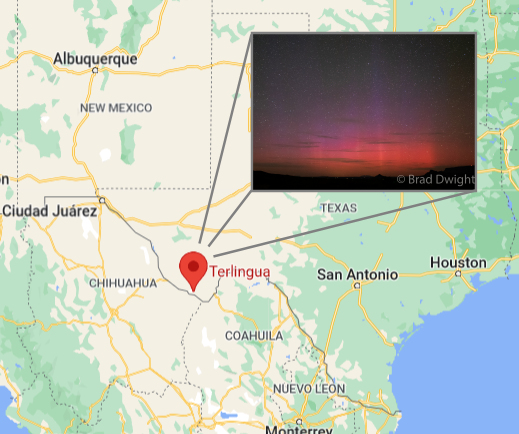
"I was out shooting the night sky in the Big Bend region of Texas when I saw the alerts of the severe geomagnetic storm," says photographer Brad Dwight. "I decided to point my camera north just to see if I could see anything. These pillars exploded into view."
Other notable low-latitude sightings in the USA include southern California (+32.5N), Arizona (+34.8N), Arkansas (+35.1 N), Colorado (+38N), Utah (+40.8N), Oklahoma (+36.3N), North Carolina (+36.2N), Tennessee (+35.4N), New Mexico (+35.9N) and Nebraska (+40.6N).
There were advantages to being a bit farther north. Consider this photo taken by Katie Korbuszewski of Helena, Montana (+46.5N):
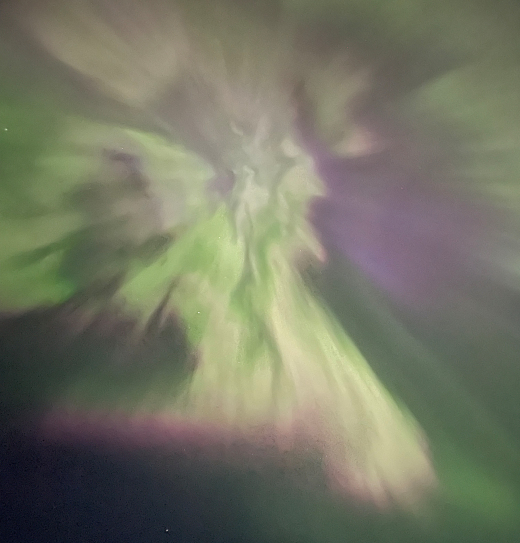
"This was the first time I have seen Northern Lights," she says. "They became a bright dome right above my head and all around. You could visibly see cars and people in the gravel lot that had previously been obscured by darkness. I used my iPhone 12 mini on the night mode setting with an exposure of 3 seconds."
"I thank my dad Paul Korbuszewski, an avid astronomer who checks Spaceweather.com like one checks the NASDAQ," says Katie. "He gave me a call from Western Washington to tell me where to look!"
Did you miss the storm? Subscribers to our Space Weather Alert service received instant text messages when the CME arrived and when the subsequent storm erupted. Solar Cycle 25 is just getting started, so this will happen again. Make sure you don't miss the next storm!
Realtime Aurora Photo Gallery
Free: Spaceweather.com Newsletter
SILVER SNOOPY SPACE PENDANT: Snoopy has touched space. This sterling silver pendant flew to the stratosphere on April 15, 2023, floating on a cosmic ray balloon 117,400 feet above the Sierra Nevada mountains of central California:
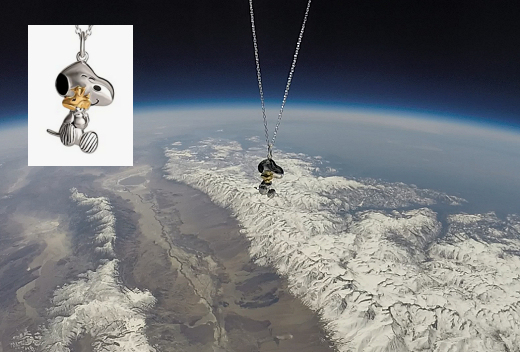
You can have it for $159.95. Space Snoopy makes a great birthday, anniversary or Mother's day gift. The students of Earth to Sky Calculus are selling space pendants to support their cosmic ray ballooning program. Each one comes with a greeting card showing the pendant in flight and telling the story of its journey to the stratosphere and back again
Far Out Gifts: Earth to Sky Store
All sales support hands-on STEM education
Realtime Space Weather Photo Gallery
Free: Spaceweather.com Newsletter