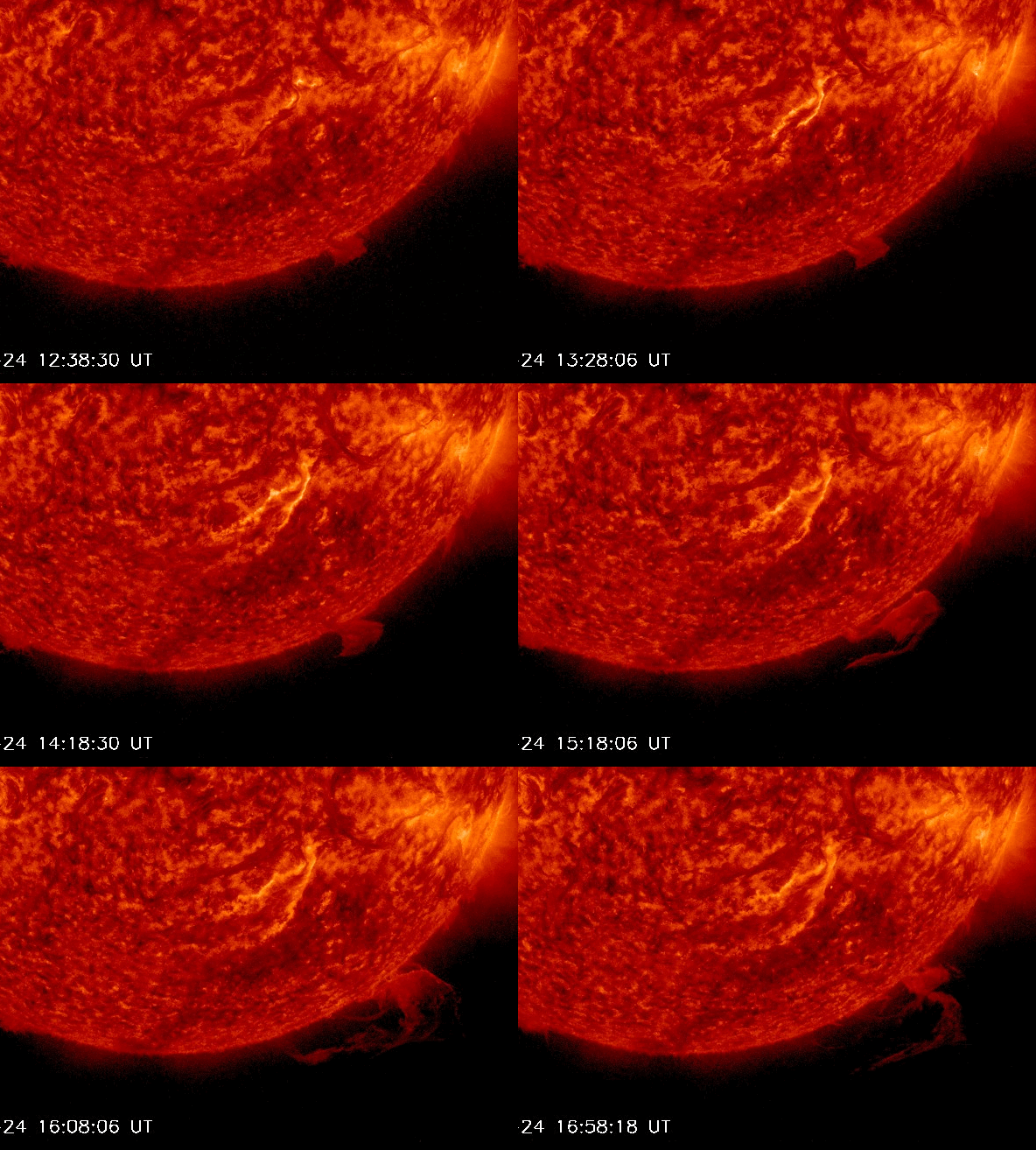
GEOMAGNETIC STORM WATCH: NOAA forecasters say that minor G1-class geomagnetic storms are possible on April 27th when a CME is expected to hit Earth's magnetic field. It was hurled into space on April 24th by an explosion in the sun's southern hemisphere. Most of the CME will sail south of Earth, but its northern flank will probably touch our planet. Aurora alerts: SMS Text.

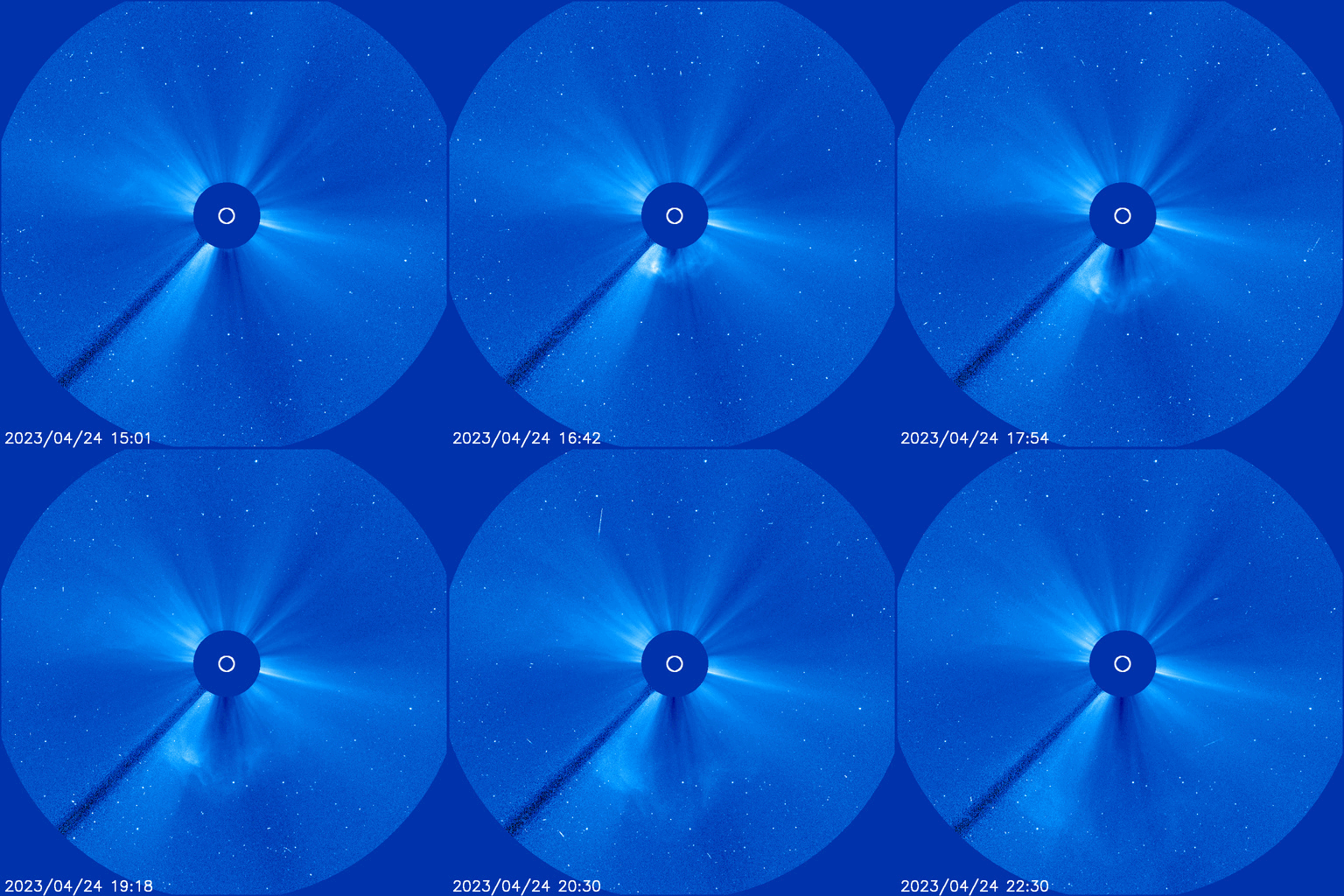
CANNIBAL CME: The Solar and Heliospheric Observatory (SOHO) just witnessed the formation of a 'cannibal CME.' In this coronagraph movie, note how a bright CME emerging from the sun's northeastern limb (11 o'clock position) sweeps up a slower, fainter CME almost directly ahead of it (10 o'clock position):
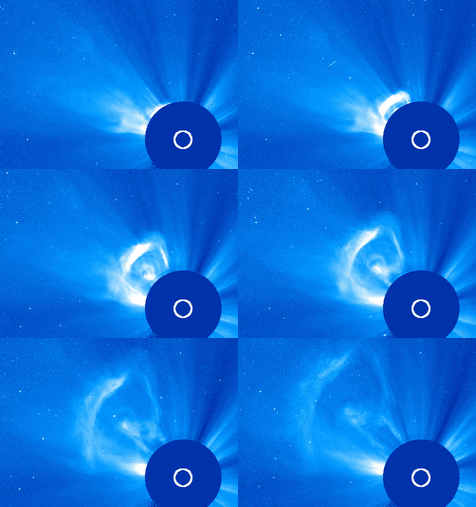

Cannibal CMEs are great at sparking geomagnetic storms and auroras. When two CMEs merge, the compression creates shock waves and enhanced magnetic fields that can poke holes in Earth's magnetosphere--opening the door to strong storms. Some of the biggest geomagnetic storms in recorded history were probably caused by cannibal CMEs.
Auroras watchers, don't get your hopes up. This particular cannibal CME will not affect our planet. It is heading away from us. Maybe next time. Aurora alerts: SMS Text.
Realtime Space Weather Photo Gallery
Free: Spaceweather.com Newsletter
AUSTRAL STEVE: In Earth's southern hemisphere, the severe geomagnetic storm of April 23-24 sparked bright auroras and something more. STEVE also appeared. Ian Griffin photographed the luminous purple ribbon from Hooper's Inlet on the Otago Peninsula of New Zealand:
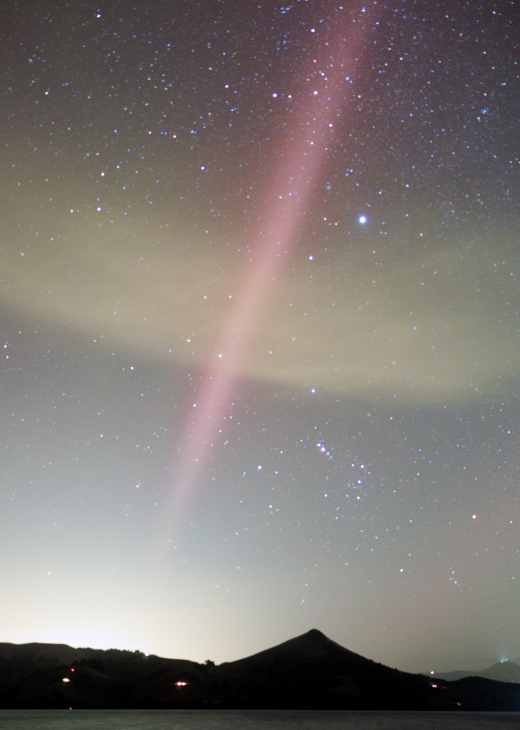
"The night was amazing, with a wonderful display of aurora australis dominating the southern sky," says Griffin. "At around 9:30pm local time, an unexpected guest arrived--STEVE!"
STEVE (Strong Thermal Emission Velocity Enhancement) looks like an aurora, but it is not. The phenomenon is caused by hot (3000°C) ribbons of gas flowing through Earth’s magnetosphere at speeds exceeding 6 km/s (13,000 mph). These ribbons appear during strong geomagnetic storms, revealing themselves by their soft purple glow.
STEVE is a recent discovery. Sky watchers in Canada identified it less than 10 years ago. Since then it has been seen many times in the northern hemisphere, but not as often in the south. The sightings on April 23-34 are among the best so far of "Austral STEVE."
more images: from Dave Curtis of Brighton, Dunedin, New Zealand
Did you miss the storm? Subscribers to our Space Weather Alert service received instant text messages when the CME arrived and when the subsequent storm erupted. Solar Cycle 25 is just getting started, so this will happen again. Make sure you don't miss the next storm!
Realtime Aurora Photo Gallery
Free: Spaceweather.com Newsletter
SILVER SNOOPY SPACE PENDANT: Snoopy has touched space. This sterling silver pendant flew to the stratosphere on April 15, 2023, floating on a cosmic ray balloon 117,400 feet above the Sierra Nevada mountains of central California:
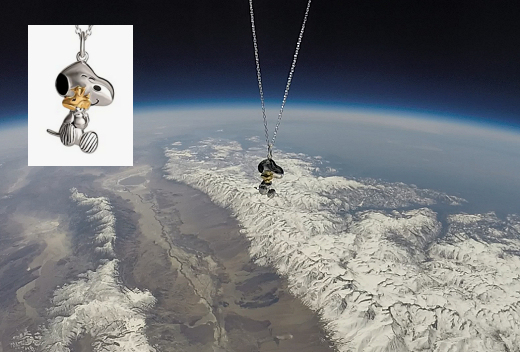
You can have it for $159.95. Space Snoopy makes a great birthday, anniversary or Mother's day gift. The students of Earth to Sky Calculus are selling space pendants to support their cosmic ray ballooning program. Each one comes with a greeting card showing the pendant in flight and telling the story of its journey to the stratosphere and back again
Far Out Gifts: Earth to Sky Store
All sales support hands-on STEM education