A DANGEROUS SUNSPOT: Big sunspot AR3288 has an unstable 'delta-class' magnetic field that harbors energy for powerful X-class solar flares. If such an explosion does occur this weekend, it will be geoeffective. The sunspot is almost directly facing Earth. Solar flare alerts: SMS Text.
AURORAS--AND SOMETHING ELSE--OVER CHINA: Chinese astrophotographer Jeff Dai has long dreamed of seeing auroras over his home country. "On April 24th, my dream came true," he says. A severe geomagnetic storm was underway when he drove to the countryside outside Karamay, Xinjiang, China, and photographed a sky full of Northern Lights:
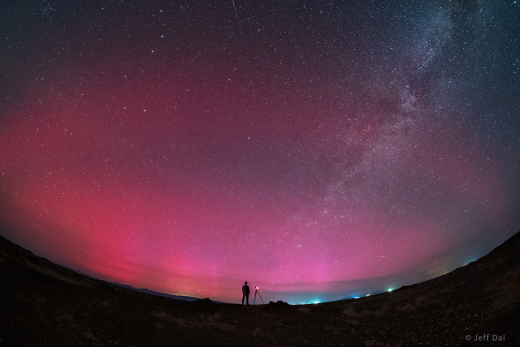
"I could see them with my naked eye," he says. "It was truly spectacular!"
But there's more to the story. Only a fraction of the lights he saw were actual auroras. Note the red arc at the top of his photo. That's something else--an "SAR."
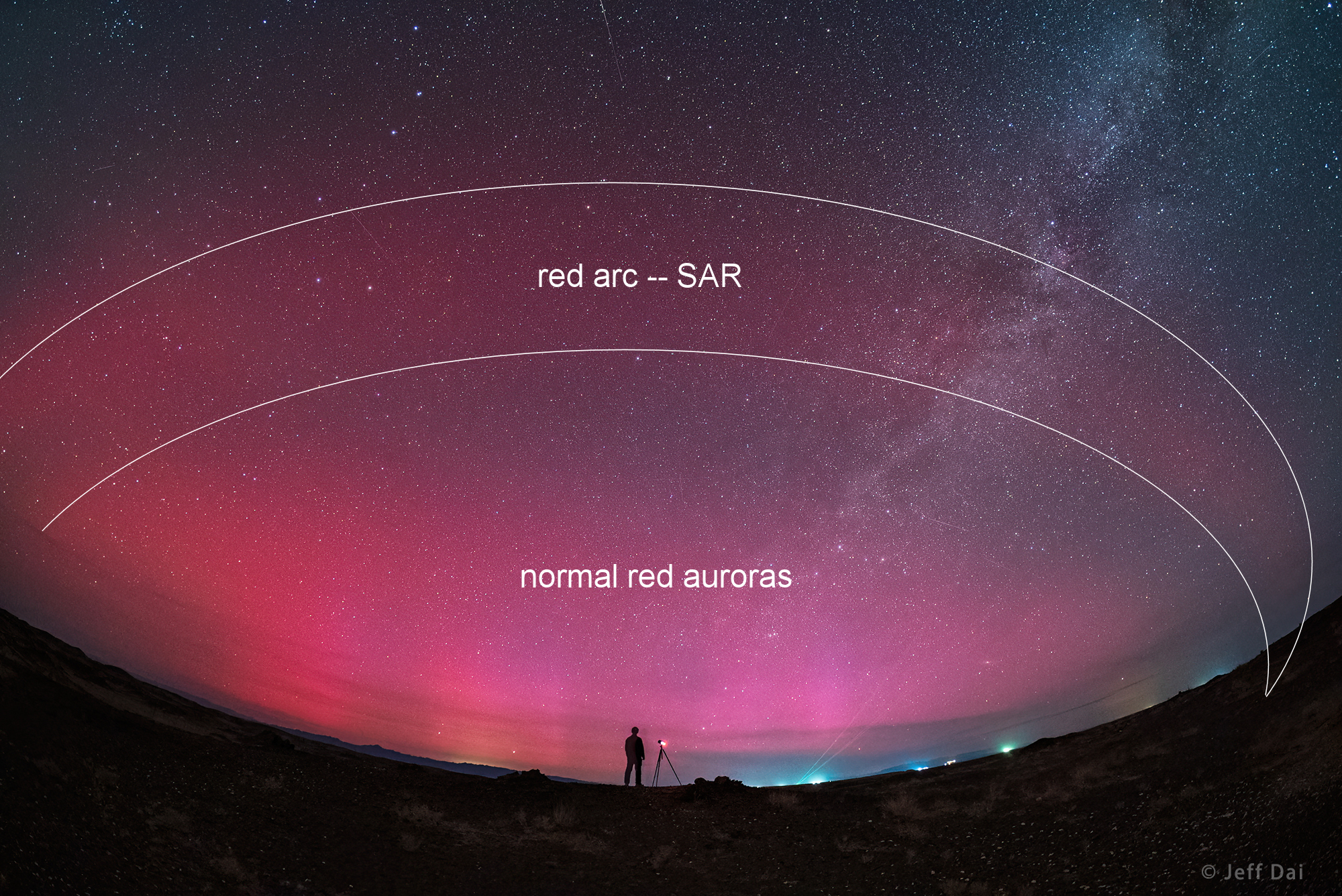
SARs are red arcs of light that ripple across the sky during some geomagnetic storms. They were discovered in 1956 at the beginning of the Space Age. Researchers didn’t know what they were and unwittingly gave them a misleading name: "Stable Auroral Red arcs" or SARs.
In fact, SARs are neither stable nor auroras. Auroras appear when charged particles rain down from space, hitting the atmosphere and causing it to glow like the picture tube of an old color TV. SARs form differently. They are a sign of heat energy leaking into the upper atmosphere from Earth’s ring current system--a donut-shaped circuit of plasma carrying millions of amps around our planet.

Above: SARs photographed by the Dynamics Explorer-1 satellite in 1982. More
SARs are among the reddest things in the sky, with a monochromatic glow at 6300 Å that comes from atomic oxygen in the upper atmosphere. The human eye is relatively insensitive to light at this wavelength, but cameras record the color easily. Pro tip for photographers: Use a 6300 Å filter.
"Seeing auroras from China is very difficult," says Dai. "It happens maybe 1-2 times every 11 years." Seeing an SAR is even more rare. It was a dreamy night, indeed.
more images: from Dan Bush of Albany, Missouri; from Otto Gruebl of Taurkura, Whangarei Heads, New Zealand
Realtime Aurora Photo Gallery
Free: Spaceweather.com Newsletter
SILVER SNOOPY SPACE PENDANT: Snoopy has touched space. This sterling silver pendant flew to the stratosphere on April 15, 2023, floating on a cosmic ray balloon 117,400 feet above the Sierra Nevada mountains of central California:
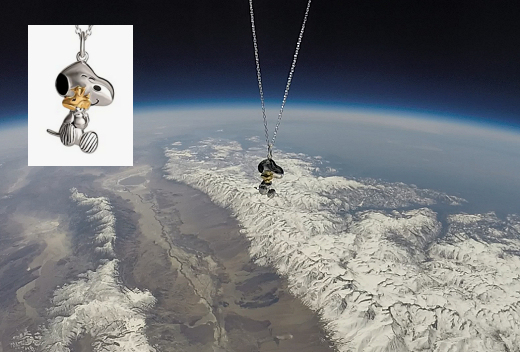
You can have it for $159.95. Space Snoopy makes a great birthday, anniversary or Mother's day gift. The students of Earth to Sky Calculus are selling space pendants to support their cosmic ray ballooning program. Each one comes with a greeting card showing the pendant in flight and telling the story of its journey to the stratosphere and back again
Far Out Gifts: Earth to Sky Store
All sales support hands-on STEM education
Realtime Space Weather Photo Gallery
Free: Spaceweather.com Newsletter