METEORS FROM HALLEY'S COMET: Earth is entering a stream of debris from Halley's Comet, source of the annual eta Aquariid meteor shower. Peak rates of 10 to 30 meteors per hour are expected on the night of May 6-7. Glare from a nearly full Moon will reduce visibility, but this could be offset by an extra dose of meteoroids nudged toward Earth by the gravity of Jupiter. Full Story.
SOLAR FLARE AND CME: Reversed-polarity sunspot AR3296 (described below) exploded on May 4th (0844 UT), producing an M3.9-class solar flare. The extreme ultraviolet flash lasted for nearly 3 hours:

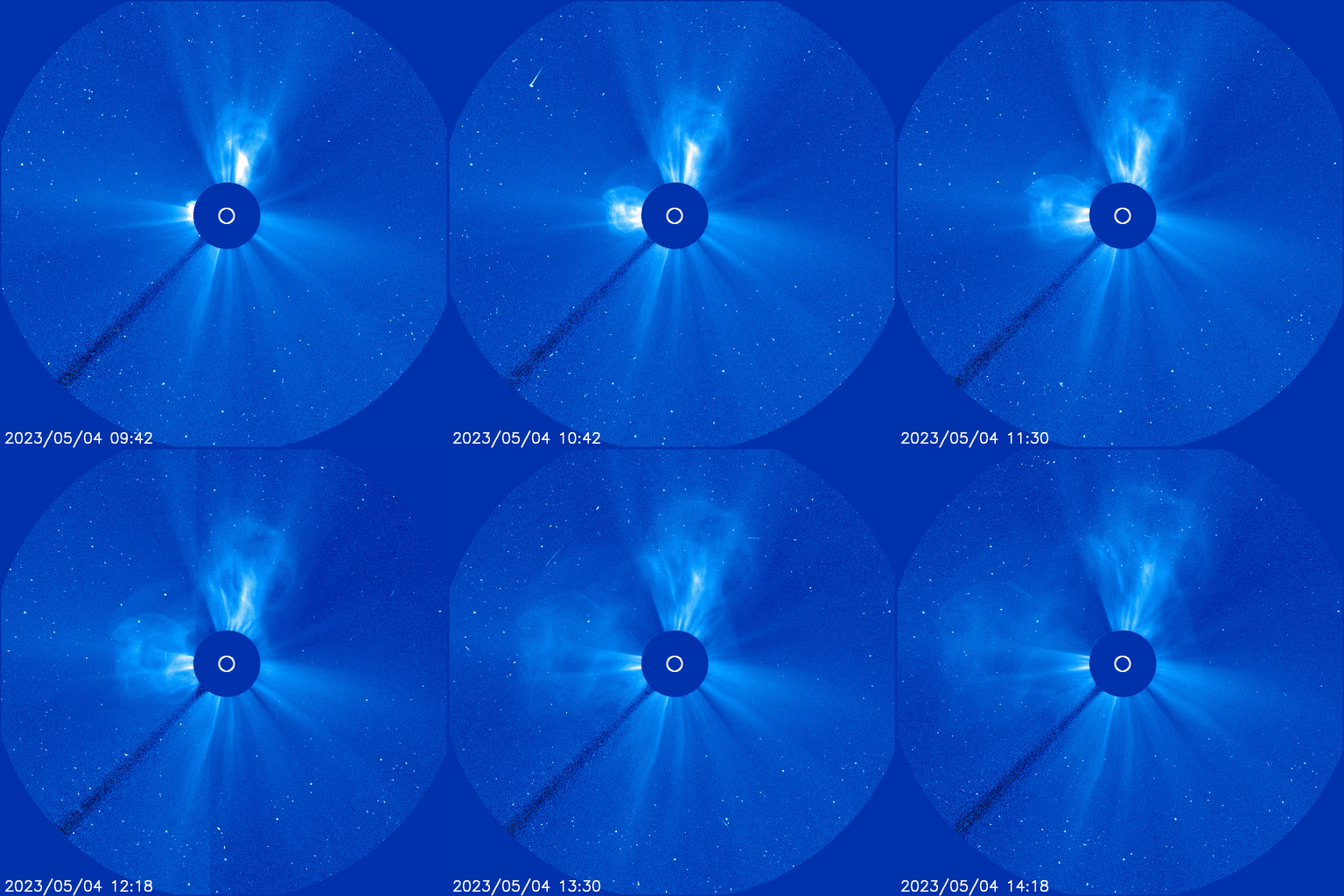
The explosion also hurled a CME into space. Coronagraph images from the Solar and Heliospheric Observatory show a halo CME emerging from the blast site. It appears to have an Earth-directed component. If so, we could experience a geomagnetic storm this weekend when the CME arrives. Confirmation awaits additional forecast modeling from NOAA and NASA. Stay tuned. Solar flare alerts: SMS Text.
REVERSED-POLARITY SUNSPOT: New sunspot AR3296 is breaking the law: Hale’s Law. The sunspot's magnetic field is reversed compared to other nearby sunspots in the sun's northern hemisphere. This magnetogram from NASA's Solar Dynamics Observatory (SDO) shows the situation:
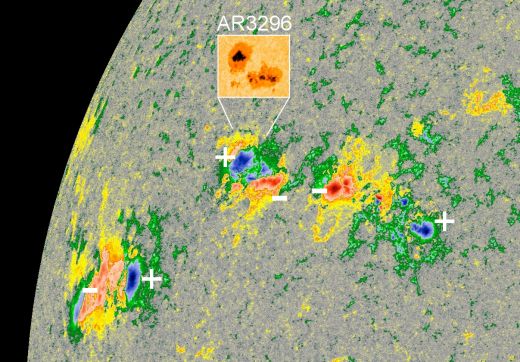
According to Hale's Law, Solar Cycle 25 sunspots in the sun’s northern hemisphere should have a -/+ polarity (negative on the left, positive on the right). AR3296 is reversed; its polarity is +/-.
Studies show that about 3% of all sunspots violate Hale’s Law. In most ways, reversed polarity sunspots are totally normal. They have about the same lifespan and size as ordinary sunspots. In one important way, however, they are different. According to a 1982 survey by Frances Tang of the Big Bear Solar Observatory, reversed polarity sunspots are more than twice as likely to develop complex magnetic fields, in which + and – are mixed together. Reversed polarity sunspots are therefore more likely to explode. Solar flare alerts: SMS Text.
Realtime Space Weather Photo Gallery
Free: Spaceweather.com Newsletter
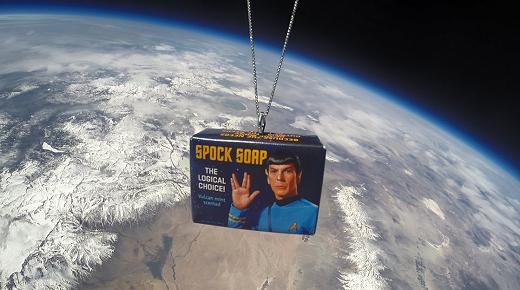
MR. SPOCK SOAP (VULCAN MINT SCENTED): It's the logical way to get clean: Vulcan-mint scented Spock Soap. This bar touched space on April 29, 2023, when it hitched a ride onboard an Earth to Sky Calculus cosmic ray balloon:
You can have it for $99.95. Not only does the bar smell like the mint gardens of Vulcan, but also each side of the wrapper features hilarious Spock lore. Take a look.
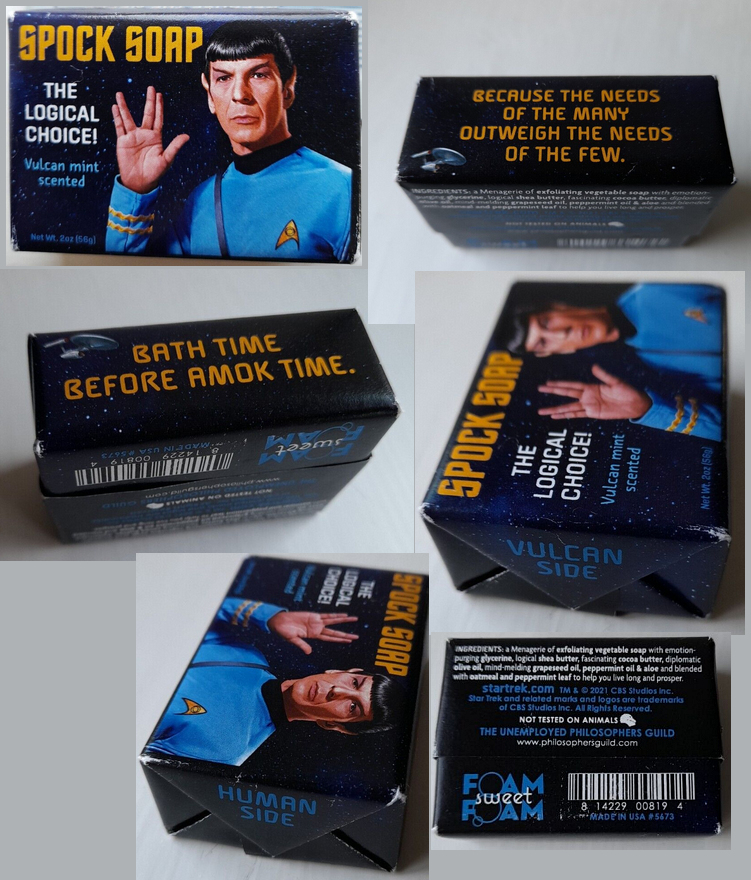
The students of Earth to Sky are selling space soap to support their cosmic ray ballooning program. Each bar comes with a greeting card showing the soap in flight and telling the story of its journey to the stratosphere and back again.
Far Out Gifts: Earth to Sky Store
All sales support hands-on STEM education
A SUDDEN DECREASE IN COSMIC RADIATION: Last month, on April 23rd, a CME hit Earth's magnetic field. The impact sparked a severe geomagnetic storm with auroras so bright they could be seen as far south as Texas. Invisible to the human eye, something else happened. There was a sudden decrease in cosmic radiation:

In a matter of hours, cosmic rays peppering Earth's atmosphere dropped to their lowest levels since 2015. Neutron monitors in Oulu, Finland, detected the drop, which lasted for days.
This is called a "Forbush decrease," named after American physicist Scott Forbush who studied cosmic rays in the early 20th century. It happens when a coronal mass ejection (CME) sweeps past Earth and pushes galactic cosmic rays away from our planet. It sounds counterintuitive, but big solar storms can cause sharp decreases in space radiation.
This Forbush decrease is over, but more are in the offing. Solar Max is coming and soon the sun will be hurling many more CMEs in our direction. Their cumulative effect could create a sustained decrease in cosmic radiation, lowering dose rates for astronauts and air travelers.
Realtime Space Weather Photo Gallery
Free: Spaceweather.com Newsletter
Realtime Aurora Photo Gallery
Free: Spaceweather.com Newsletter