A MINOR CME IS COMING: NOAA forecasters say that a CME could hit Earth's magnetic field on May 16th. Relatively faint and slow-moving, it was hurled into space on May 12th by an erupting filament of magnetism in the sun's southern hemisphere. No more than minor G1-class geomagnetic storms are expected. Aurora alerts: SMS Text.

MAGNETOMETERS ARE GETTING RESTLESS: Last week, solar activity was high. The sun hurled so many CMEs into space that scarcely a day went by without one hitting Earth. Stuart Green's magnetometer in Lancashire, England, recorded every impact:
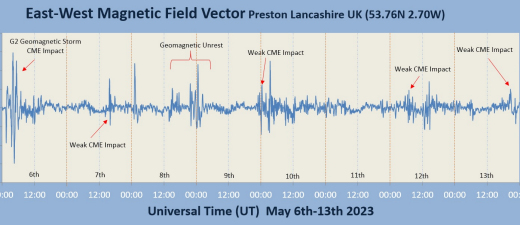
"Our crackling sun released multiple minor CMEs over the past week," says Green. "Their geomagnetic effect was generally weak, but nevertheless sufficient to be detected on my magnetometer here in the UK. The constant 'drumbeat' of CMEs shows that Solar Cycle 25 is continuing to develop nicely."
Green built his own magnetometer from scratch. "The sensor is buried in my garden about 0.5 meters below ground in an East/West orientation," he explains. "This allows very sensitive (sub nanotesla) measurements of magnetic declination during geomagnetic storms."
Would you like to build one, too? Here's how.
Realtime Aurora Photo Gallery
Free: Spaceweather.com Newsletter
56 MORE STARLINK SATELLITES: SpaceX launched a new batch of Starlink broadband satellites early Sunday morning, May 14th, and landed a rocket at sea in the company's latest successful mission. Twenty-one hours later Kevin Fetter watched all 56 satellites orbit over his home in Brockville, Ontario:
"It was a nice show," says Fetter.
This launch brings the total count of Starlinks in orbit to 4127, a number that would have seemed incredible less than 5 years ago. The entire constellation has been launched since 2019, more than doubling the number of active satellites in Earth orbit. This has made sightings of bright "Starlink trains" like Fetter recorded increasingly commonplace.
Adding together future launches proposed by SpaceX and other companies, some researchers estimate as many as 100,000 new satellites could be orbiting Earth by the end of the decade. Note to mission planners: Don't forget space weather.
Realtime Space Weather Photo Gallery
Free: Spaceweather.com Newsletter
SATURN'S CAT PENDANT: It's a far-out gift for the cat-lover in your life: Saturn's Cat. The sterling silver pendant touched space on April 29, 2023, when it hitched a ride onboard an Earth to Sky Calculus cosmic ray research balloon.
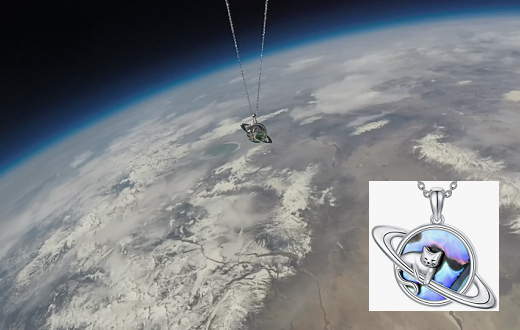
You can have it for $142.95. The students of Earth to Sky Calculus are selling space pendants to support their cosmic ray ballooning program. Each one comes with a greeting card showing the pendant in flight and telling the story of its journey to the stratosphere and back again.
Far Out Gifts: Earth to Sky Store
All sales support hands-on STEM education
Realtime Space Weather Photo Gallery
Free: Spaceweather.com Newsletter