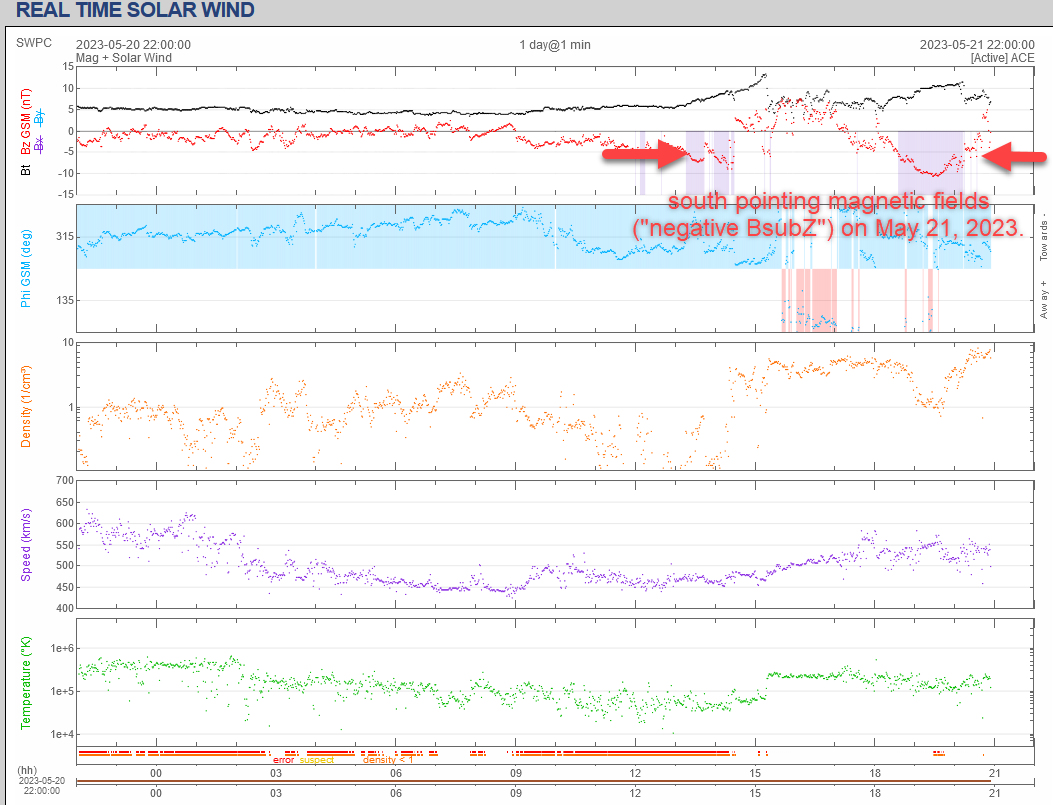
GEOMAGNETIC STORM UNDERWAY: A minor G1-class geomagnetic storm is underway on May 21st as Earth feels the effect of another probable near-miss CME. South-pointing magnetic fields in the CME's wake are opening a crack in Earth's magnetosphere, allowing solar wind to enter. Aurora alerts: SMS Text.

SUPERNOVA IN THE PINWHEEL GALAXY: Astronomers are scrambling to photograph a new supernova in the Pinwheel Galaxy (M101). "This is best supernova in a decade," says Eliot Herman of Tucson, Arizona. "I am pleased I caught it on the rise less than a day after its discovery." The red arrow marks the brightening explosion:
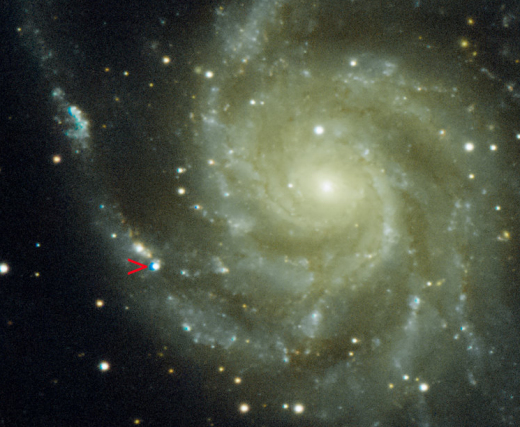
This is a Type II supernova, caused by the core collapse of a massive star. Amateur astronomer Koichi Itagaki discovered it on May 19th.
"While we be sure, the best estimate is it'll peak around magnitude +10 in the next two days or so," says Yvette Cendes, an astronomer at the Harvard Center for Astrophysics. If so, it would rival or outshine the galaxy's core.
The supernova's rapid brightening means that a shock wave has broken out of the dying star. How much "stuff" it hits will determine the supernova's light curve. At the moment, astronomers do not know much about the star's environment, so anything is possible.
Located in the constellation Ursa Major (finder chart), the Pinwheel Galaxy is an popular target for amateur astronomers. Many readers know how it looks and will immediately notice the "extra star" in one of its spiral arms.
"If amateurs have any data from the last few days, particularly right before discovery, it might actually prove useful for science and end up in some scientific papers!" says Cendes. "Adding the data to the AAVSO is probably the best way to do this."
Realtime Space Weather Photo Gallery
Free: Spaceweather.com Newsletter
SURPRISE GEOMAGNETIC STORM: Surprising forecasters, a crack opened in Earth's magnetic field on May 19th. Solar wind poured through the gap, sparking a G2-class geomagnetic storm. Naked-eye auroras were visible across many northern-tier US states while photographic auroras descended as far south as Missouri (latitude +40.2N):

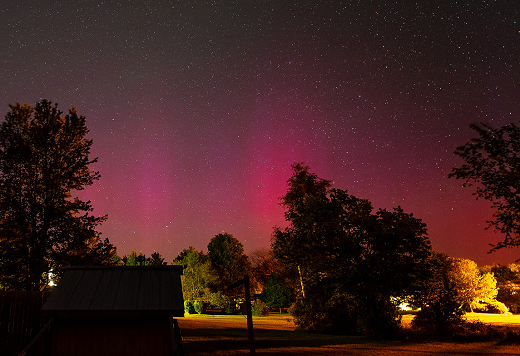
"The night started off with a surprise passage of Starlink satellites whose 21 or so members flared to incredibly bright for a few seconds," says photographer Dan Bush of Albany, Missouri. "Then the red auroras came and were visible to my camera for about an hour or so."
This event was probably caused by a near-miss CME--one of many that left the sun last week on trajectories slightly off the sun-Earth line. South-pointing magnetic fields in the CME's wake washed over Earth. Those south-pointing fields partially cancelled Earth's north-pointing magnetic field, lowering our defenses against the solar wind.
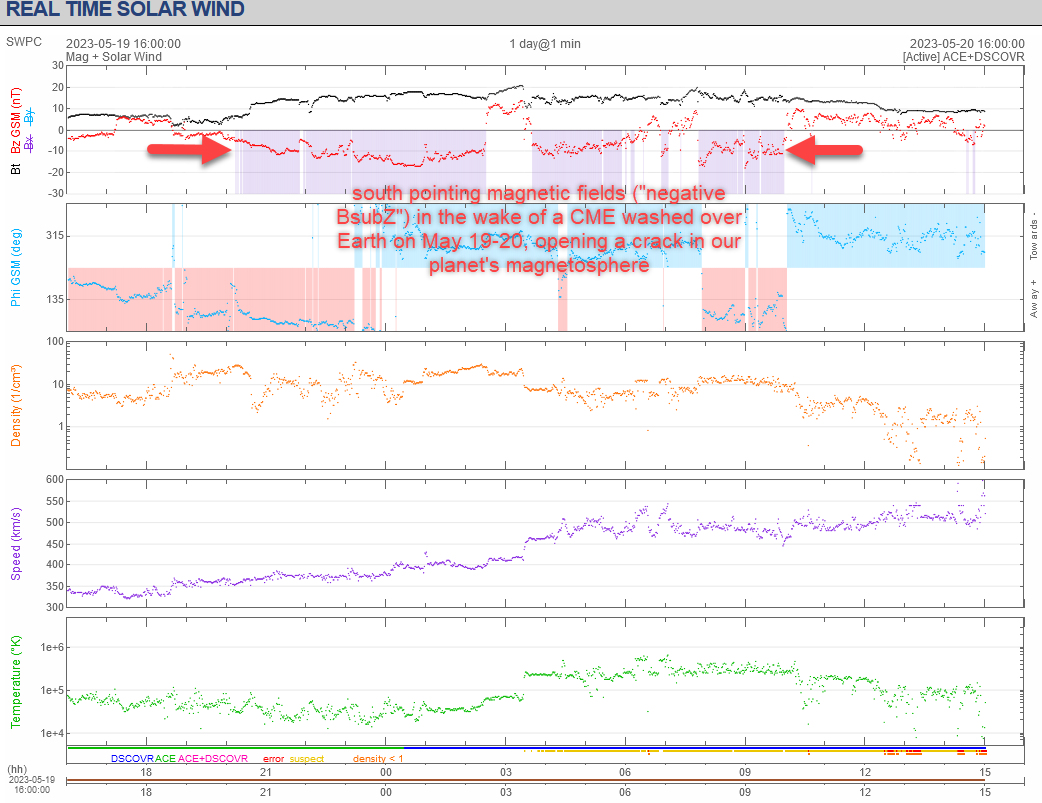
Did you miss the storm? Subscribers to our Space Weather Alert Service received instant text messages when the storm began, giving them time to dash out and catch the auroras. PRO subscribers also received early-warning "BsubZ alerts," which told them that a crack was opening in Earth's magnetic field.
Realtime Aurora Photo Gallery
Free: Spaceweather.com Newsletter
"ALWAYS AND FOREVER" SPACE PENDANT: Are you looking for a far-out gift? Consider the Always and Forever Space Pendent. The students of Earth to Sky Calculus launched it to the stratosphere onboard a cosmic ray research balloon:
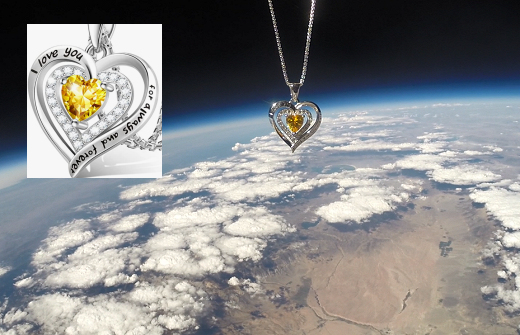
You can have it for $199.95. Engraved with the words "I love you always and forever", this 18K gold-plated pendant has a heart-shaped citrine crystal in the middle surrounded by a ring of glittering cubic zirconia nuggets.
The students are selling space pendants to pay the helium bill for their cosmic ray ballooning program. Each one comes with a greeting card showing the jewelry in flight and telling the story of its trip to the stratosphere and back again.
Far Out Gifts: Earth to Sky Store
All sales support hands-on STEM education
Realtime Space Weather Photo Gallery
Free: Spaceweather.com Newsletter