CHANCE OF FLARES TODAY: Unstable sunspot AR3311 has a 'beta-gamma-delta' magnetic field that harbors energy for strong solar flares. NOAA forecasters say there is a 75% chance of M-class flares and a 30% chance of X-flares on May 22nd. Solar flare alerts: SMS Text.
SUPERNOVA IN THE PINWHEEL GALAXY (UPDATED): Astronomers are scrambling to photograph a new supernova in the Pinwheel Galaxy (M101). "This is best supernova in a decade," says Eliot Herman of Tucson, Arizona. "It has tripled in brightness in only 24 hours."
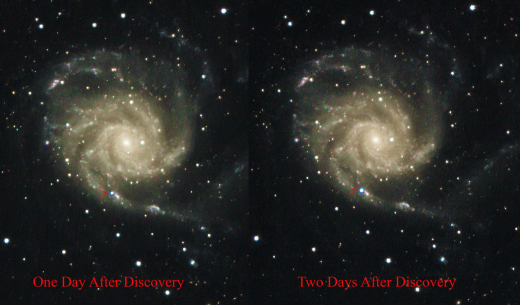
Image credit: Eliot Herman of Tucson, Arizona
At this rate, it will soon rival or outshine the spiral galaxy's core.
Astronomer Yvette Cendes of Harvard's Center for Astrophysics says the supernova should continue to brighten for another day or so. "We think it will peak around magnitude +10, although it is hard to be certain."
Discovered by amateur astronomer Koichi Itagaki on May 19th, this is a Type II supernova caused by the core collapse of a massive star. A shock wave has broken out of the dying star, creating a fireball as it plows into circumstellar material. That's what we are seeing now.
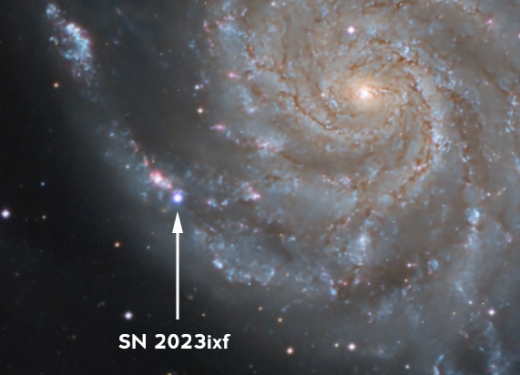
Image credit: Scott Tucker of Tucson, Arizona
The Pinwheel Galaxy is an popular target for amateur astronomers, easy to find in the constellation Ursa Major (finder chart). Many observers know how it looks and will immediately notice the "extra star" in one of its spiral arms.
"If amateur astronomers have any data from the last few days, particularly right before discovery, it might prove useful for science and end up in some scientific papers!" says Cendes. "Sending the data to the AAVSO is probably the best way to contribute."
Realtime Space Weather Photo Gallery
Free: Spaceweather.com Newsletter
A NEW AND BIGGER STARLINK SATELLITE: On May 20th, Dan Bush of Albany, Missouri, watched in amazement as 22 newly-launched Starlink satellites passed over his backyard. "They flared incredibly brightly," says Bush, who recorded this video of sunlight glinting off their metallic bodies:
The flares were incredibly bright because they came from a new type of satellite--the Starlink V2 Mini. Ironically, these "Mini" satellites are much larger then their predecessors. Each Starlink V2 Mini weighs about 1,760 pounds, nearly three times heavier than older Starlinks. They are also much wider, with two solar panels spanning 100 ft tip-to-tip. Previous generations had a single solar array only 36 ft wide.
Improved phased array antennas on these new Starlinks have four times the communications capacity of earlier generations, and they are the next step in SpaceX's plans to beam high-speed internet directly to cell phones.
Realtime Aurora Photo Gallery
Free: Spaceweather.com Newsletter
"ALWAYS AND FOREVER" SPACE PENDANT: Are you looking for a far-out gift? Consider the Always and Forever Space Pendent. The students of Earth to Sky Calculus launched it to the stratosphere onboard a cosmic ray research balloon:
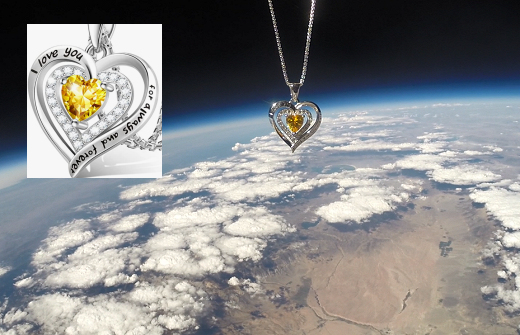
You can have it for $199.95. Engraved with the words "I love you always and forever", this 18K gold-plated pendant has a heart-shaped citrine crystal in the middle surrounded by a ring of glittering cubic zirconia nuggets.
The students are selling space pendants to pay the helium bill for their cosmic ray ballooning program. Each one comes with a greeting card showing the jewelry in flight and telling the story of its trip to the stratosphere and back again.
Far Out Gifts: Earth to Sky Store
All sales support hands-on STEM education
Realtime Space Weather Photo Gallery
Free: Spaceweather.com Newsletter