SUBSIDING CHANCE OF FLARES: NOAA forecasters have decreased the odds of an X-class flare from 30% (yesterday) to 20% (today). This is in response to decay in the magnetic field of sunspot AR3311, currently the biggest threat for flares on the solar disk. 20% is still plenty, though, for an X-class explosion. Solar flare alerts: SMS Text.
NAKED-EYE SUNSPOT: Got eclipse glasses? Put them on and look at the sun. Sunspot AR3310 is big enough to see without magnification. South Korean astronomer Bum-Suk Yeom created this infographic:
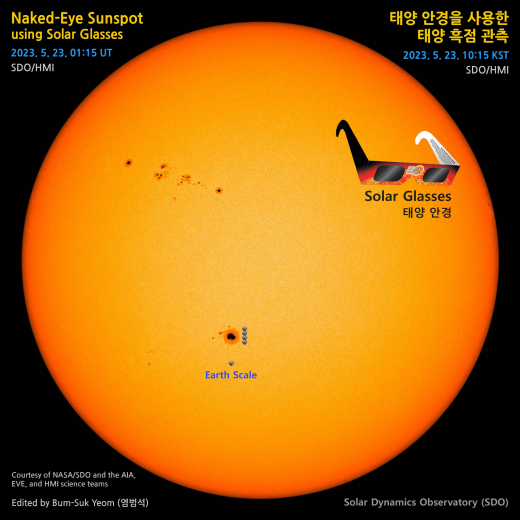
"A giant sunspot is crossing the sun's disk, and I could see it clearly with solar glasses," says Yeom. "Caution! You must use eclipse glasses or solar filters to protect your eyes."
In addition, Canadian wildfires are creating a type of natural solar filter for observers in parts of North America. Thick smoke dims the setting sun, revealing sunspots that would normally be lost in the glare. Here are some examples from New Jersey, New York, Pennsylvania and Nebraska.
Realtime Space Weather Photo Gallery
Free: Spaceweather.com Newsletter
A NEW AND BIGGER STARLINK SATELLITE: On May 20th, Dan Bush of Albany, Missouri, watched in amazement as 22 newly-launched Starlink satellites passed over his backyard. "They flared incredibly brightly," says Bush, who recorded this video of sunlight glinting off their metallic bodies:
The flares were incredibly bright because they came from a new type of satellite--the Starlink V2 Mini. Ironically, these "Mini" satellites are much larger then their predecessors. Each Starlink V2 Mini weighs about 1,760 pounds, nearly three times heavier than older Starlinks. They are also much wider, with two solar panels spanning 100 ft tip-to-tip. Previous generations had a single solar array only 36 ft wide.
Improved phased array antennas on these new Starlinks have four times the communications capacity of earlier generations, and they are the next step in SpaceX's plans to beam high-speed internet directly to cell phones.
With the May 19th launch of these satellites from Cape Canaveral, SpaceX has deployed 4,469 Starlinks in all, including units no longer in service. More than 4,100 Starlink satellites are currently in orbit.
Realtime Aurora Photo Gallery
Free: Spaceweather.com Newsletter
MR. SPOCK SOAP (VULCAN MINT SCENTED): It's the logical way to get clean: Vulcan-mint scented Spock Soap. This bar touched space on April 29, 2023, when it hitched a ride onboard an Earth to Sky Calculus cosmic ray balloon:
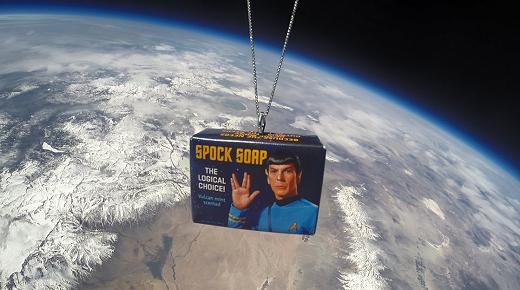
You can have it for $99.95. Not only does the bar smell like the mint gardens of Vulcan, but also each side of the wrapper features hilarious Spock lore. Take a look.
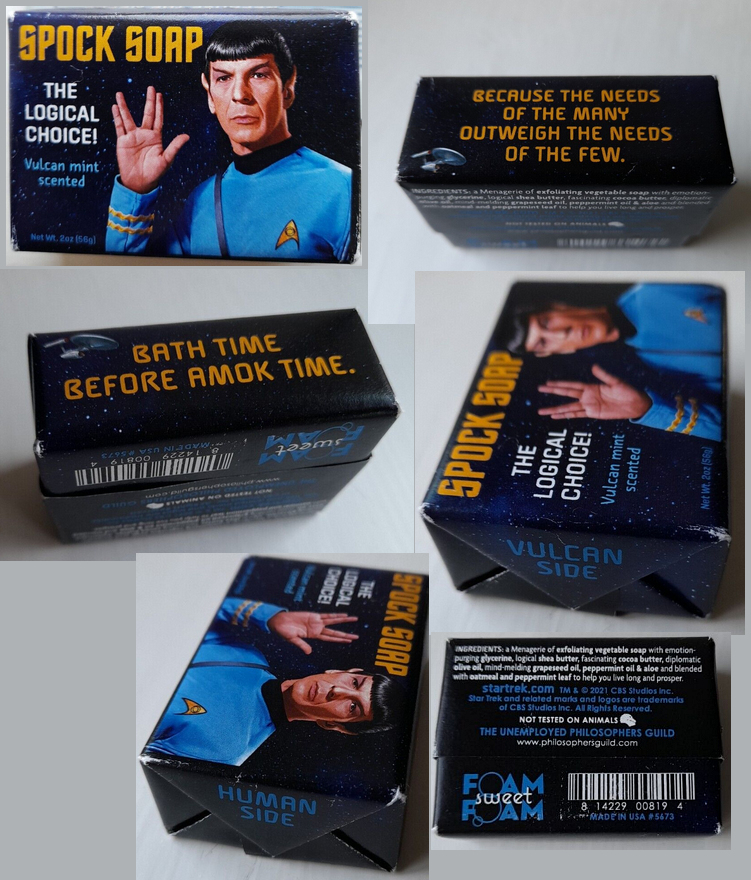
The students of Earth to Sky are selling space soap to support their cosmic ray ballooning program. Each bar comes with a greeting card showing the soap in flight and telling the story of its journey to the stratosphere and back again.
Far Out Gifts: Earth to Sky Store
All sales support hands-on STEM education
Realtime Space Weather Photo Gallery
Free: Spaceweather.com Newsletter