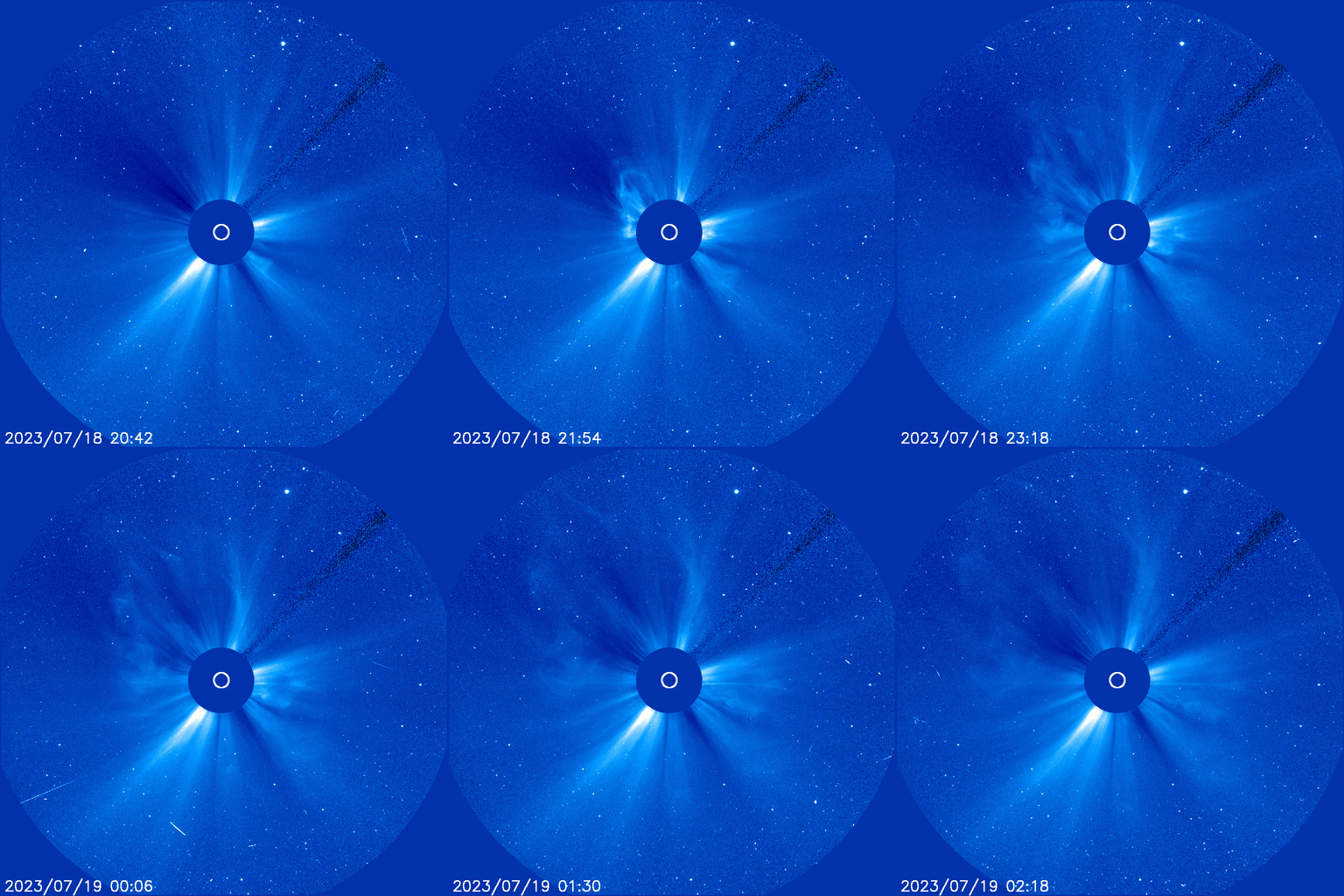
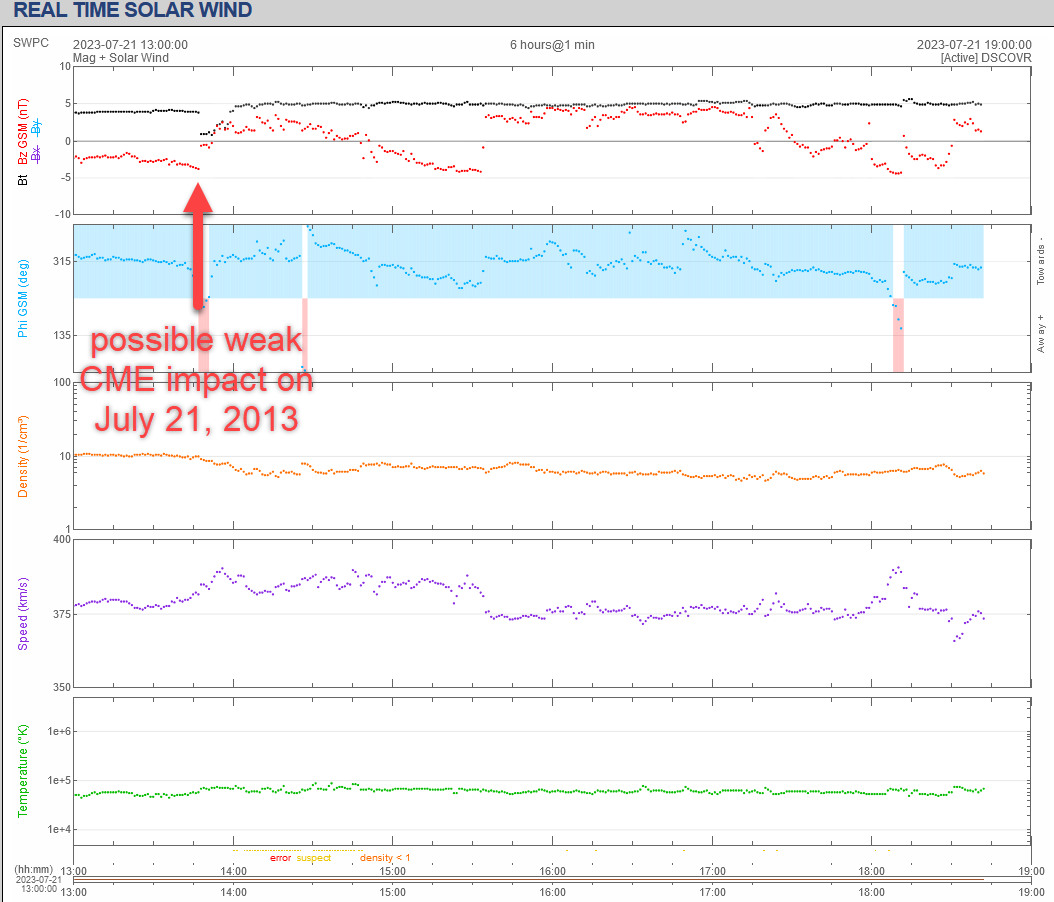
POSSIBLE WEAK IMPACT: A discontinuity in the solar wind near Earth may signal the arrival of today's expected CME. If so, it was a very weak impact. No geomagnetic storm will result from such a feeble blow. On the other hand, the discontinuity might be a random transient unrelated to the incoming storm cloud. Until July 21st is over, a minor (G1) geomagnetic storm watch is still in effect. . Aurora alerts: SMS Text

SPACEX JUST PUNCHED A HOLE IN THE IONOSPHERE: On the evening of July 19th, SpaceX launched a Falcon 9 rocket from Vandenberg Space Force Base in California. Sky watchers from southern California to Arizona witnessed a magnificent exhaust plume. At the San Francisco Volcanic Field north of Flagstaff, photographer Jeremy Perez saw something extra:
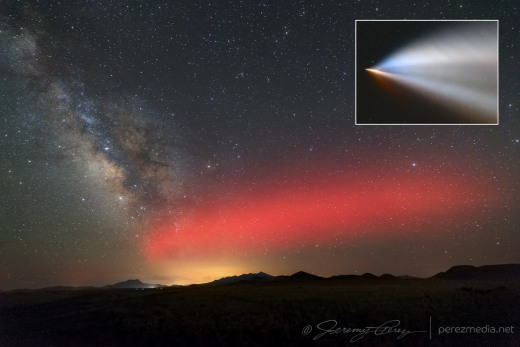
"After the rocket passed overhead, a red fluorescent glow expanded southward and crossed over the Milky Way," says Perez. "It was visible for almost 20 minutes."
The red glow is a sign that the rocket punched a hole in the ionosphere--something SpaceX and others have been doing for years. One famous example occured on August 25, 2017, when a Falcon 9 rocket carrying Taiwan’s FORMOSAT-5 satellite created a hole four times bigger than the state of California. On June 19, 2022, another Falcon 9 punched a hole over the east coast of the USA, sparking a display of red lights from New York to the Carolinas that many observers mistook for aurora borealis.
"This is a well studied phenomenon when rockets are burning their engines 200 to 300 km above Earth's surface," explains space physicist Jeff Baumgardner of Boston University. "The red glow appears when exhaust gasses from the rocket's 2nd stage cause the ionosphere to recombine quickly."
Rocket engines spray water (H2O) and carbon dioxide (CO2) into the ionosphere, quenching local ionization by as much as 70%. A complicated series of charge exchange reactions between oxygen ions (O+) and molecules from the rocket exhaust produce photons at a wavelength of 6300 Å--the same color as red auroras.
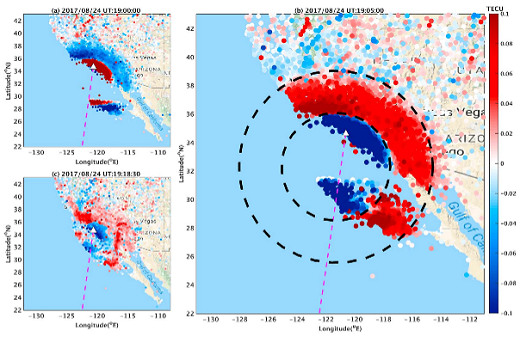
Above: Electron density maps show a hole in the ionosphere formed by a SpaceX rocket in 2017. [more]
"I reviewed footage from the July 19th launch," says Baumgardner. "It shows the second stage engine burning at 286 km near the ionosphere's F-region peak for that time of day. So, it is quite possible that an ionospheric 'hole' was made."
Once rare, ionospheric "punch holes" are increasingly common with record numbers of rocket launches led by SpaceX sending Starlink satellites to low-Earth orbit. Ham radio operators may notice them when shortwave signals fail to skip over the horizon, shooting through holes instead of bouncing back to Earth. Sudden GPS errors can also result from the anomalies. These effects may be troublesome, but they are shortlived; re-ionization occurs as soon as the sun comes up again.
Readers, did you see a red glow from this week's SpaceX launch? Submit your photos here.
more images: from David Blanchard of Flagstaff, AZ (he also saw the red glow); from Dennis Mammana of Borrego Springs, California; from Andrew Corkill of Riverside, California; from Chris Cook of Laguna Beach, California; from Art Brown of San Diego, California;
Realtime Space Weather Photo Gallery
Free: Spaceweather.com Newsletter
FANTASTIC DRAGON SPACE PENDANT: How high can a dragon fly? On July 14th, this one hitched a ride onboard an Earth to Sky Calculus cosmic ray research balloon, reaching an altitude of 117,524 ft:
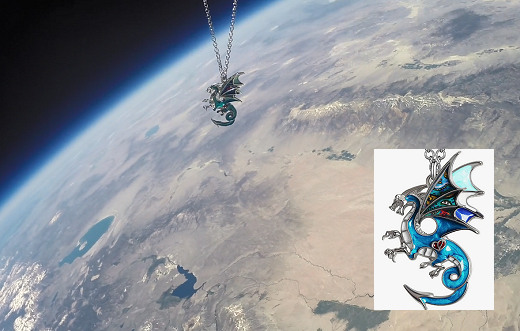
You can have it for $124.95. The pendant is hand-crafted with colorful enamel inlaid on a hypoallergenic alloy "dragon skeleton." It makes a great gift for anyone who loves fantasy and dragonlore.
The students are selling space pendants to support their cosmic ray ballooning program. Each one comes with a greeting card showing the pendant in flight and telling the story of its trip to the stratosphere and back again.
Far Out Gifts: Earth to Sky Store
All sales support hands-on STEM education
Realtime Noctilucent Cloud Photo Gallery
Free: Spaceweather.com Newsletter
Realtime Aurora Photo Gallery
Free: Spaceweather.com Newsletter