MYSTERY CME SPARKS GEOMAGNETIC STORM: Unexpectedly, a CME hit Earth's magnetic field on July 25th (2235 UT), sparking a G1-class geomagnetic storm. It is unclear if this is the early arrival of a CME originally expected on July 27th or a completely different CME which was previously overlooked. Because of the uncertainty, a minor geomagnetic storm watch is still in effect for July 27th. Aurora alerts: SMS Text


WELCOME BACK, STEVE: During last night's geomagnetic storm, Jody Majko of Bragg Creek, Alberta, went outside to look for auroras. Instead, there was STEVE:
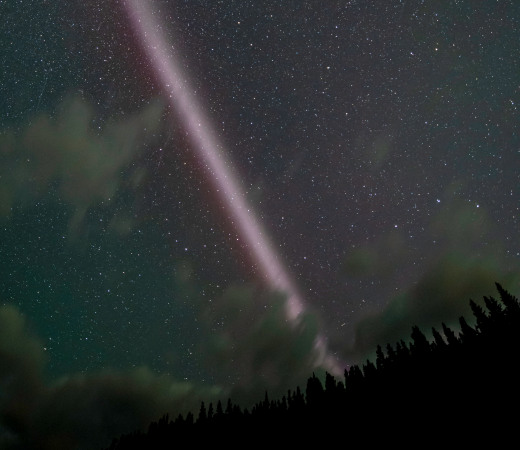
"STEVE decided to make an appearance for a couple of hours shortly after midnight," says Majko. "It beamed from the north horizon almost to the south horizon--the brightest I've ever seen it!"
STEVE (Strong Thermal Emission Velocity Enhancement) looks like an aurora, but it is not. The phenomenon is caused by hot (3000°C) ribbons of gas flowing through Earth’s magnetosphere at speeds exceeding 6 km/s (13,000 mph). These ribbons appear during some geomagnetic storms, revealing themselves by their soft purple glow.
Realtime STEVE Photo Gallery
Free: Spaceweather.com Newsletter
A COMET SHAPED LIKE THE MILLENNIUM FALCON: Until a few days ago, Comet 12P/Pons-Brooks looked like a perfectly ordinary comet. Then, something on its surface exploded. Now it resembles "the fastest hunk of junk in the galaxy"--the Millennium Falcon:
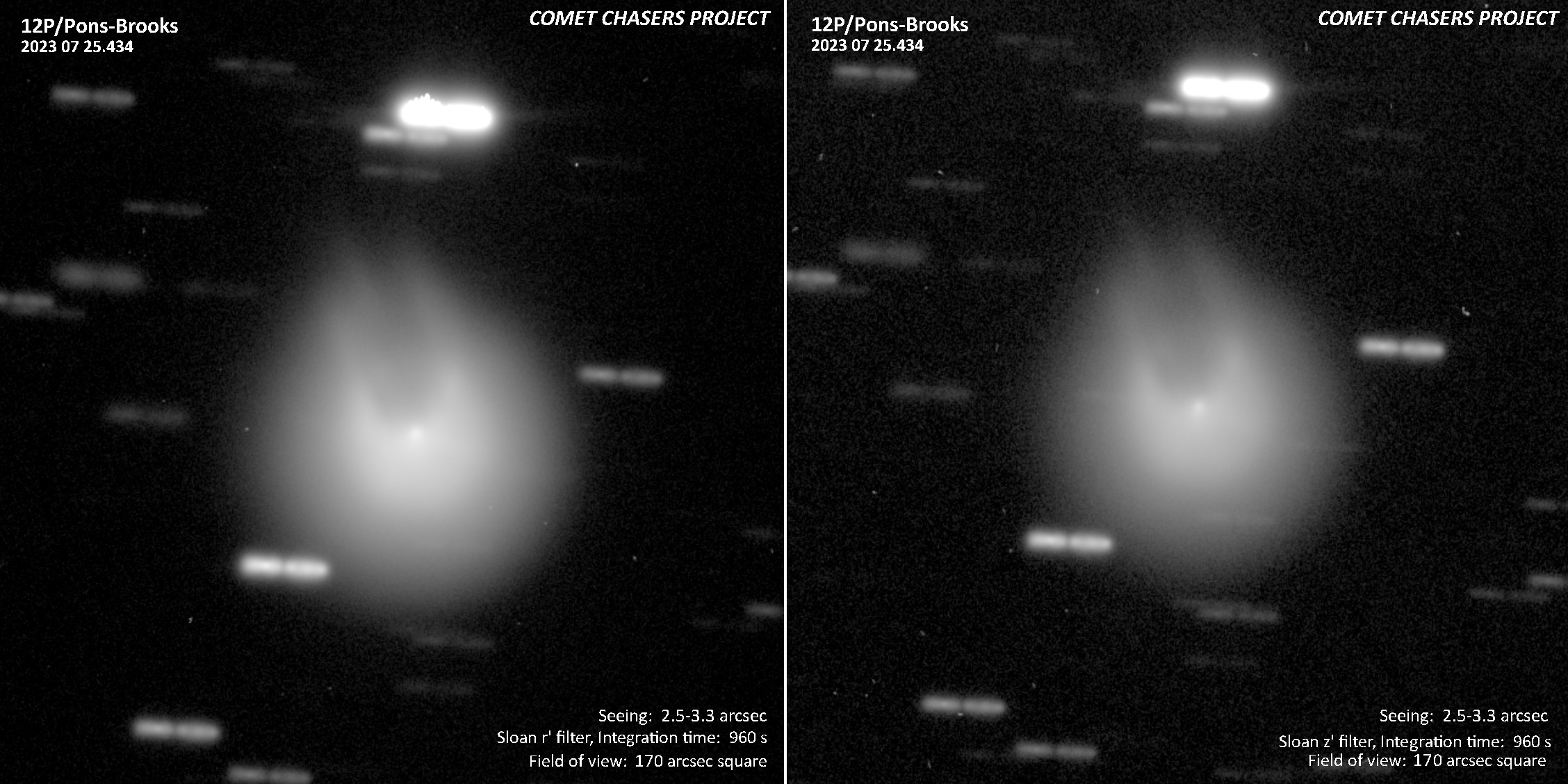
These images are hot off the press (July 25.434) from the Comet Chasers, a team of researchers led by Helen Usher of Cardiff/The Open Universities. They are using telescopes at the Las Cumbres Observatory network to monitor this comet's unusual eruption.
The action began on July 20th when the comet abruptly brightnened 100-fold. Astronomers watched as double plumes of debris streamed out of the comet's core, sweeping back to form the Falcon shape. It is now shining with about the same brightness as an 11th magnitude star, making it an easy target for mid-sized backyard telescopes.
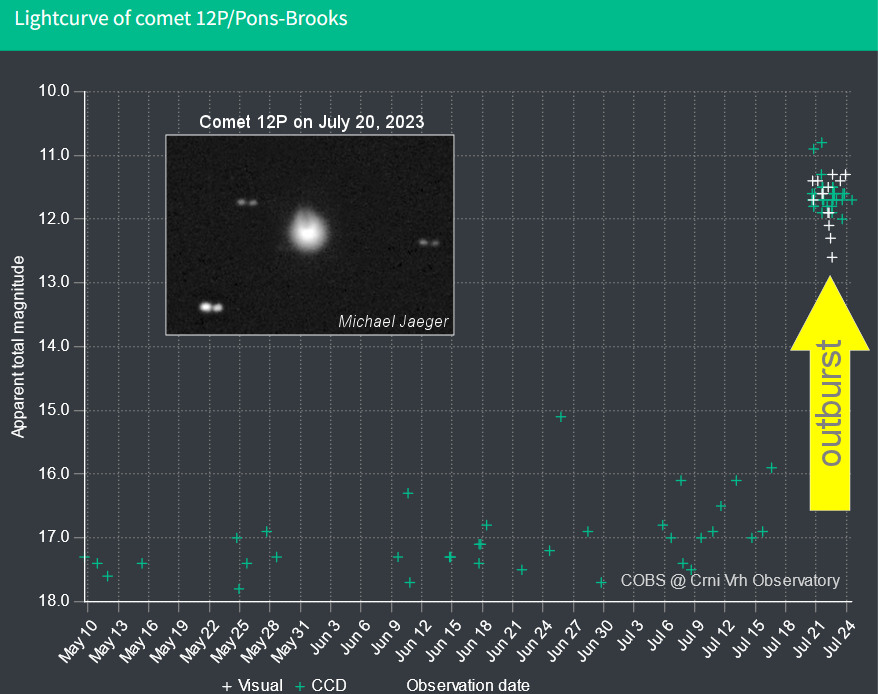
Comet 12P/Pons-Brooks is famous for exploding. Discovered in 1812 by Pons and discovered again in 1883 by Brooks, the bursty comet visits the inner solar system every 71 years. Since the 19th century at least seven significant outbursts have been observed.
At the Astronomical Station Vidojevica in Serbia, astronomers Igor Smolić and Marco Grazdanovic took a closer look using the station's big 1.4 meter telescope:
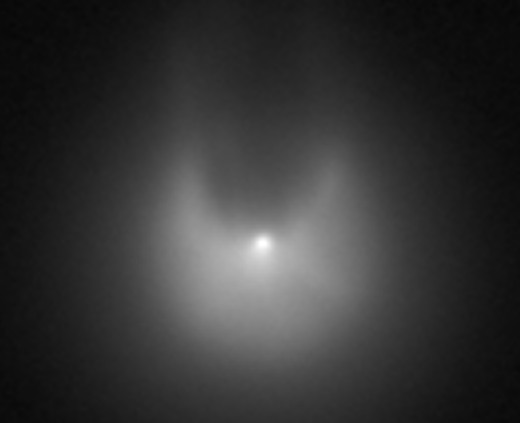
"This is a 60x30s exposure," says Smolić. "[It reveals the origin of the 'horns' curving out of the comet's compact core]."
Richard Miles of the British Astronomical Association thinks 12P may be one of 10 to 20 known comets with active ice volcanoes. The "magma" is a cold mixture of liquid hydrocarbons and dissolved gasses, all trapped beneath a surface which has the consistency of wax. These bottled-up volatiles love to explode when sunlight opens a fissure.
The best may be yet to come. The comet is currently beyond the orbit of Mars, but falling toward the sun for a close encounter in April 2024. At that time it is expected to become a naked-eye object at 4th or 5th magnitude.The timing is significant because 12P will reach maximum brightness only a few days before the total solar eclipse on April 8, 2024. Sky watchers in the path of totality could look up and see an outburst for themselves.
Amateur astronomers are encouraged to monitor developments. Comet 12P is currently crossing the head of Draco not far from the north celestial pole. Check out those horns! And submit your photos here.
more images: from Thomas Wildoner of Weatherly, PA; from David Strange of Salcombe Regis, East Devon, UK; from the Sormano Astronomical Observatory in Sormano CO Italy; from Tony Kiefer of Lexington, KY
Realtime Space Weather Photo Gallery
Free: Spaceweather.com Newsletter
STERLING SILVER STARCAT: Are you looking for a far-out gift? Introducing the Sterling SIlver StarCat Pendant. On July 14th, it hitched a ride to the stratosphere onboard an Earth to Sky Calculus cosmic ray research balloon:

You can have it for $159.95. The silver feline form is wrapped around a genuine moonstone with a matching 18 inch Italian sterling silver chain. It is 100% hypoallergenic.
The students of Earth to Sky are selling space pendants to support their cosmic ray ballooning program. Each one comes with a greeting card showing the pendant in flight and telling the story of its trip to the stratosphere and back again.
Far Out Gifts: Earth to Sky Store
All sales support hands-on STEM education
Realtime Noctilucent Cloud Photo Gallery
Free: Spaceweather.com Newsletter
Realtime Aurora Photo Gallery
Free: Spaceweather.com Newsletter