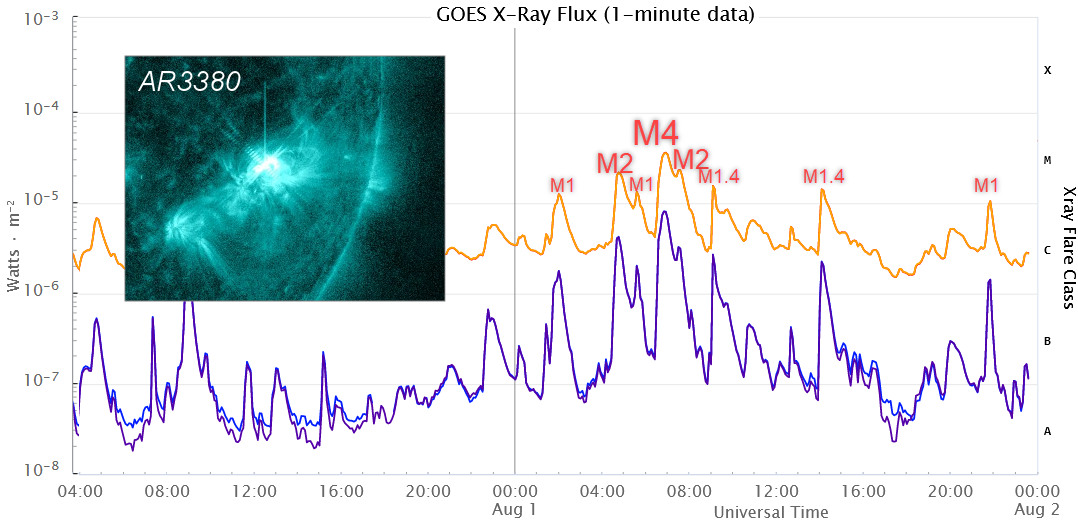
GEOMAGNETIC STORM WATCH (G1): Minor G1-class geomagnetic storms are possible on Aug. 4th-5th when one or more faint CMEs are expected to hit Earth's magnetic field. They were hurled in our direction by a series of M-class eruptions from active sunspot AR3380 on Aug. 1st and 2nd. High-latitude sky watchers should be alert for auroras later this week. Aurora alerts: SMS Text

BRIGHT FIREBALL RATTLES THE EASTERN USA (UPDATED): Yesterday morning, Aug. 2nd just after 2 a.m. EDT, sonic booms rolled across the eastern USA, shaking buildings hard enough to wake observers. Sky watchers looked up and saw a brilliant fireball tearing itself apart overhead. Amateur astronomer Bill Stewart of Ceredo, West Virginia, was outside on his rooftop observatory and accidentally videoed his own reaction to the booming flash:
"It was at 2:13 a.m.," says Stewart. "The fireball made two audible booms. After one bright flash it broke into 3 distinct fragments. One remained bright as it descended below the horizon. It could have possibly touched down although I didn’t hear it impact."
The American Meteor Society has collected more than 65 eyewitness reports from 9 US states. The fireball first appeared over Ohio, streaked south, then petered out over Georgia. Observers said "it flashed like lightning," "it shook my house," and "I've never seen anything like it."
At its peak, the fireball outshined the supermoon also visible in Stewart's video:
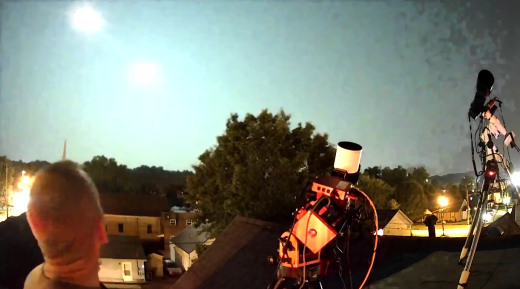
"I agree it was brighter," says Stewart. "The reflection of the fireball was cast on a metal roof below, quite vividly, whereas the Moon was not as reflective."
There are currently three active meteor showers capable of producing bright fireballs: The Perseids, Alpha Capricornids, and Southern Delta Aquariids. However, the fireball's path through the sky doesn't match any of those showers.
Update: NASA has figured out what it was-- a comet fragment weighing about 75 pounds with a diameter of just over a foot. According to Bill Cooke of NASA's Meteoroid Environment Office "it entered Earth's atmosphere about 50 miles above the Kentucky town of Krypton (yes, really), moving roughly southeast at 37,000 miles per hour. The object traveled 65 miles through the atmosphere before disintegrating 30 miles above Duffield, Virginia."
An infrasound station operated by the University of Western Ontario meteor physics group recorded the terminal explosion:

"The breakup of the fireball generated an energy of roughly 2 tons of TNT, which caused the booms and shakings experienced by some in the region," says Cooke. "At its brightest the fireball was about 5 times brighter than the full Moon."
FAQ: Which comet did the fragment come from? No one knows. It belongs to the general random "debris field" in the inner solar system composed of bits and pieces of many asteroids and comets. This was a "sporadic" fireball.
Realtime Space Weather Photo Gallery
Free: Spaceweather.com Newsletter
THE PANSPERMIA CUBE: Every week, the students of Earth to Sky Calculus take an astronomy class from Dr. Tony Phillips. This summer they've been learning about panspermia--the unverified yet tantalizing idea that seeds of life have spread through the cosmos. To celebrate the concept, they just flew the Panspermia Cube to the stratosphere:
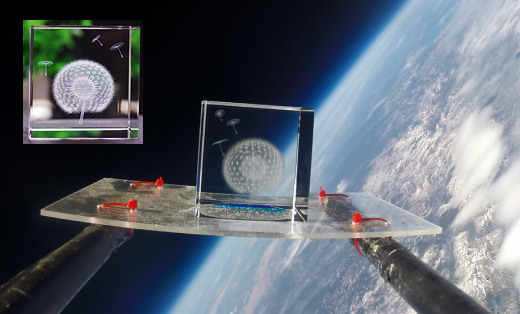
You can have it for $119.95. Inside the crystal cube, there is a laser-etched 3D model of a dandelion spreading its seeds on the winds of space. It comes with a greeting card showing the dandelion in flight (105,120 ft high on the students' cosmic ray research balloon) and telling the story of its trip to the stratosphere and back again.
Far Out Gifts: Earth to Sky Store
All sales support hands-on STEM education
Realtime Noctilucent Cloud Photo Gallery
Free: Spaceweather.com Newsletter
Realtime Aurora Photo Gallery
Free: Spaceweather.com Newsletter